
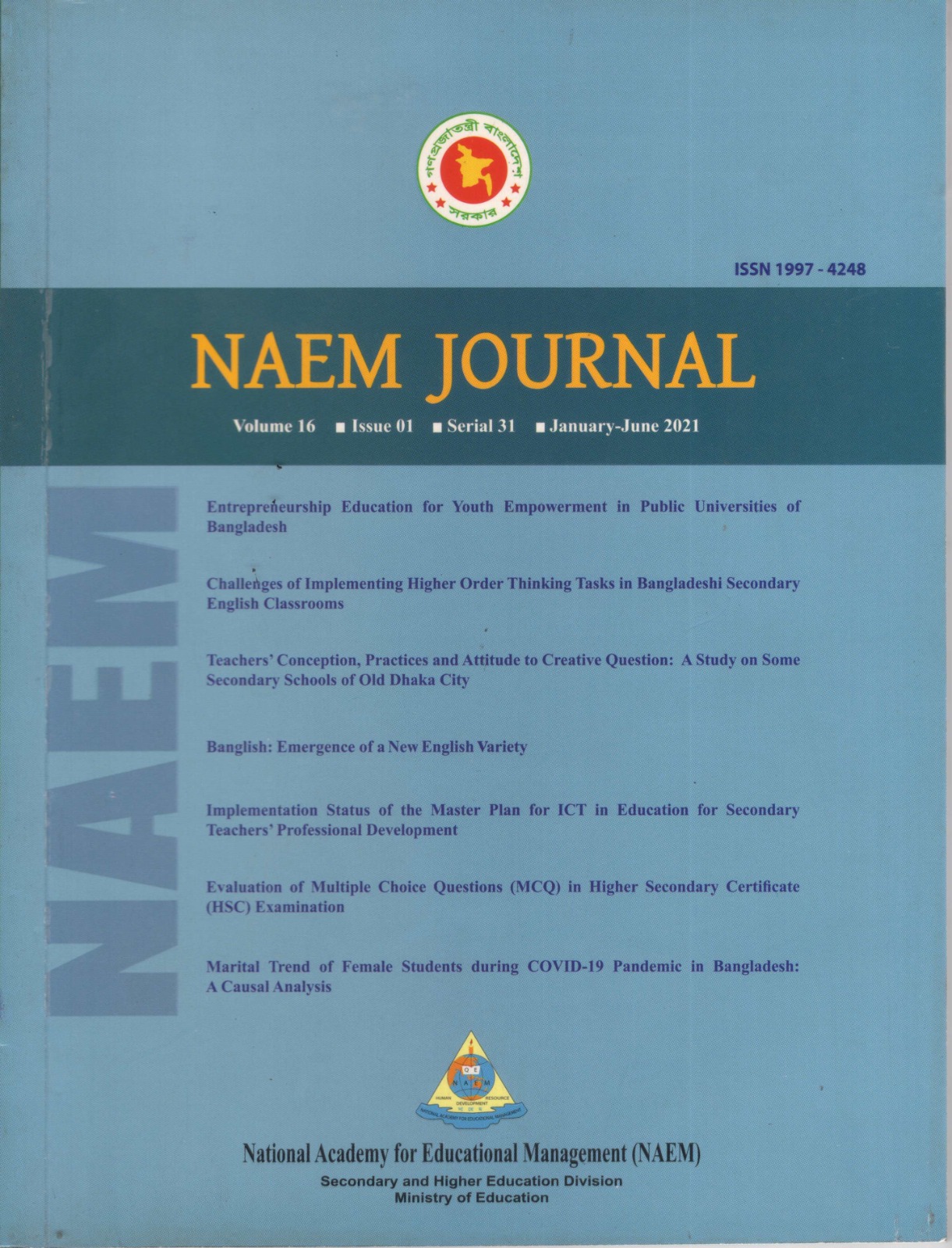
Teachers’ Conception, Practices and Attitude to Creative Question: A Study on Some Secondary Schools of Old Dhaka City
Keywords:
Creative Question, Bloom’s Taxonomy, Mixed Research Approach, Conception, Practice, And Attitude.Abstract
The key intention of this study is to investigate teachers’ knowledge, practices, and attitudes toward creative questions in selected secondary schools in Old Dhaka city. A cross-sectional survey design was used in this study. Positivist and constructivist perspectives were prominent, as both quantitative and qualitative data were generated to gain a better and more credible understanding of the phenomenon under investigation. The research was designed based on a questionnaire survey and focus group discussions (FGDs). A total of sixty (60) randomly selected teachers from four (4) purposively selected schools located in Old Dhaka constituted the sample of this study. The findings indicate that many teachers in Old Dhaka city schools do not have a clear conception of creative questions. Additionally, many teachers had not received any training on creative questions, although they were required to prepare them for their school examinations. The findings also revealed a gap in teachers’ knowledge and understanding of creative questions. It is expected that the findings will provide guidelines for researchers, education experts, and policymakers, which may be used in future policy formulation regarding creative questions.
References
Armstrong, P. (2015). Bloom’s Taxonomy. Center for Teaching. https://cft.vanderbilt.edu/guides-sub-pages/blooms-taxonomy/
Billah, M. (2012). Creative system has created a quagmire. Bdeduarticle.com. Retrieved May 30, 2017, from https://bdeduarticle.com/creative-system-has-created-a-quagmire/
Billah, M. (2016). Creative questions introduced but teachers still confused. The Independent. http://www.theindependentbd.com/printversion/details/69442
Carson, S. (2010). Your Creative Brain. San Francisco, CA: Jossey-Bass.
Cohen, L., Manion, L., & Morrison, K. (2011). Research Methods in Education (7th ed.). London: RoutledgeFalmer.
Ekvall, G. (1996). Organizational climate for creativity and innovation. European Journal of Work and Organizational Psychology, 5(1), 105–123.
Habib, W. (2016, March 1). Creative method still ineffective. The Daily Star. Retrieved May 30, 2017, from http://www.thedailystar.net/backpage/creative-method-still-ineffective-784417
Hasan, M., Naomee, I., & Bilkis, R. (2013). Reflection of Bloom’s Revised Taxonomy in the Social Science Question of Secondary School Certificate Examination. The International Journal of Social Science, 14(1), 47–56. https://www.tijoss.com/TIJOSS%2014th%20Volume/5mahbub.pdf
Khan, S. (2014). How creative are our teachers? The Daily Star. http://dspace.bracu.ac.bd/xmlui/bitstream/handle/10361/3764/How%20creative%20are%20our%20teachers(13.10.14).pdf?sequence=1
Ministry of Education. (2016). Revolution in Education Section. Dhaka: Ministry of Education.
Qatar Tribune. (2013). Bangladeshi school teachers learn creative teaching methods.
Sinek, S. (2009). Start with Why? How Great Leaders Inspire Everyone to Take Action. New York: Portfolio, Penguin Group. https://simonsinek.com/books/start-with-why/
Tuhin, J., Haque, M. I., Islam, M. S., Rab, A., & Uddin, M. S. (2016). Ambiguity in understanding of teachers and students on creative method effectiveness: A study on primary schools in Bangladesh. In Education in the Current World: Pedagogy, Research and Social Change, International Conference on Teaching and Learning (ICTL), April 22–23, 2016, Conference Proceedings.
Yasmin, S., Tanny, T. F., & Ullah, R. (2020). Creative education system at secondary level in Bangladesh: Teachers’ and students’ perspectives. Journal of Public Administration and Governance, 10(2), 350–369.
Downloads
Published
Issue
Section
License
Copyright (c) 2023 2026 NAEM Journal

This work is licensed under a Creative Commons Attribution-NonCommercial 4.0 International License.
Copyright (c) 2026 NAEM Journal