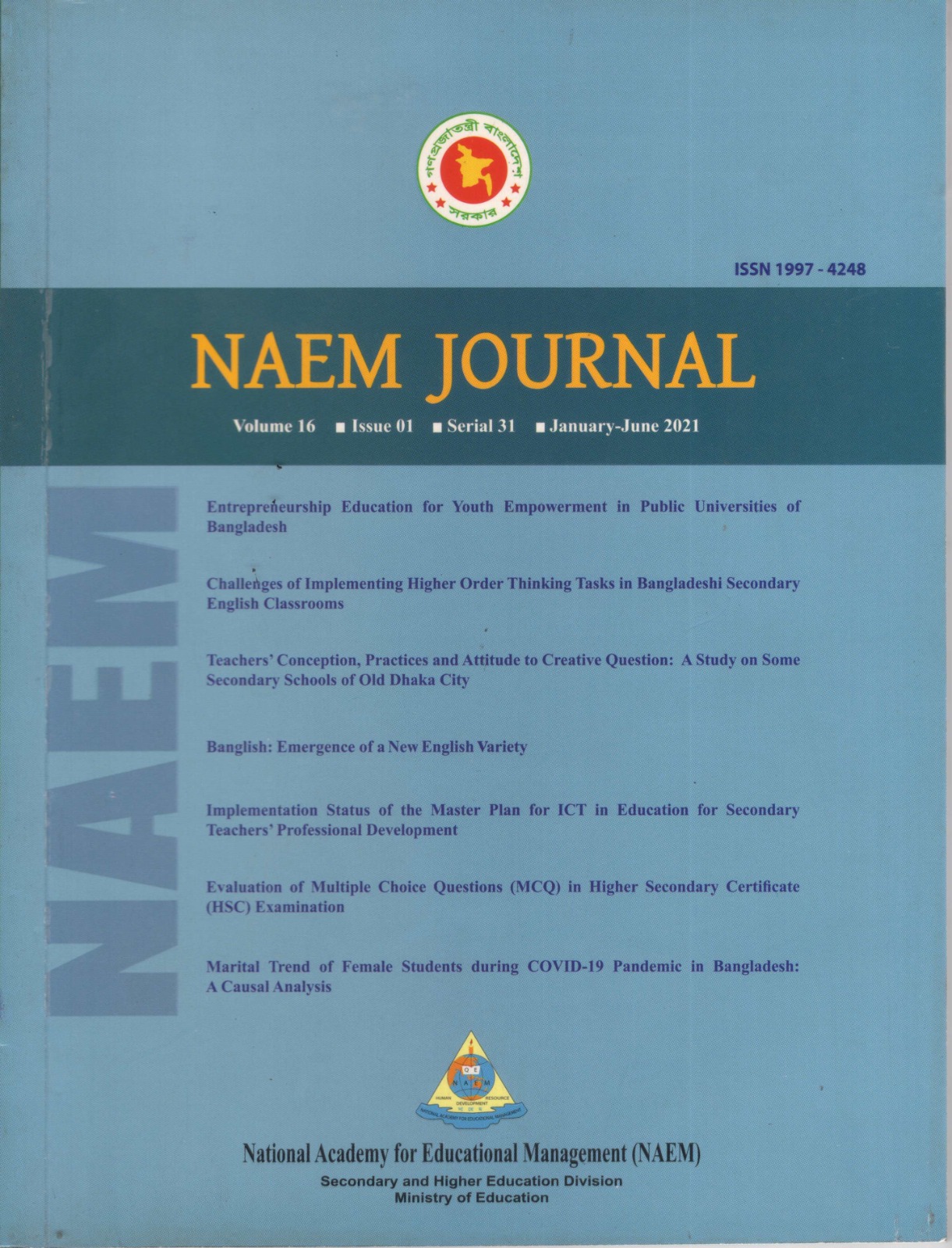
Challenges of Implementing Higher Order Thinking Tasks in Bangladeshi Secondary English Classrooms
Keywords:
Critical Thinking Skills, Secondary English Classrooms, Higher Order Thinking Tasks.Abstract
To make students think critically, the practice must begin during their schooling years across all subjects of study, and it can be nurtured by implementing Higher Order Thinking (HOT) tasks in classrooms. This exploratory study reports on the challenges faced by selected English teachers at the secondary level in mainstream schools in Bangladesh while implementing higher-order thinking tasks in their classrooms. In the first phase of the study, a total of 13 teachers were invited to participate in a teacher training programme that guided them on how to use techniques from the English for Today textbook in English classrooms. In the second phase, the teachers implemented these techniques in real-life classroom settings. In the final stage, the participants were interviewed by the researchers. The findings revealed that some students did not participate actively in group thinking tasks and tended to rely on rote learning of information from the text. The number of students and large class sizes were also identified as obstacles to the effective implementation of HOT tasks. The findings open up avenues for incorporating critical thinking tasks into Bangladeshi English classrooms, which are expected to contribute to preparing future citizens who can think critically.
References
Ahmed, S. & Mohd Asraf, R. (2018). The Workshop as a Qualitative Research Approach: Lessons learnt from a
critical thinking through writing workshop. The Turkish Online Journal of Design, Art, Communication
(TODJDAC), Special Edition, 1504-1510. http://www.tojdac.org/tojdac/VOLUME8-SPTMSPCL_files/
tojdac_v080SSE201.pdf
Alismail, H. A. & McGuire, P. (2015). 21st century standards and curriculum: current research and practice. Journal
of Education and Practice, 6 (6), 150-155. http://files.eric.ed.gov/fulltext/EJ1083656.pdf
Alrabah, S., Wu, S. & Alotaibi, A. (2018). The learning styles and multiple intelligences of EFL college students in
Kuwait. International Education Studies, 11 (3), 38-47. doi:10.5539/ies.v11n3p38
Baxter, P. & Jack, S. (2008). Qualitative case study methodology: Study design and implementation for novice
researchers. The Qualitative Report, 13 (4), 544-559. https://nsuworks.nova.edu/cgi/viewcontent.
cgi?article=1573&context=tqr
Bean, J. C. (2011). Engaging Ideas: Bean (2nd ed). San Fransisco, SF: Jossey-Bass Publishers.
Billah, M. (2015). Language and Education Inside and Beyond the Classroom. Dhaka: Murdhonno,
Brown, H. D. (2000). Principles of Language Teaching And Learning, (4th ed.). White Plains, NY: Longman.
Castillo-Montoya, M. (2016). Preparing for interview research: The interview protocolRefinement Framework. The
Qualitative Report, 21(5), 811-829. http://nsuworks.nova.edu/tqr/vol21/iss5/2
Common Core State Standards Initiative. (2010). Common core state standards initiative: Preparing America’s
students for college and career. Common Core State Standards. http://www.corestandards.org
Creswell, J. W., & Clark, P. VL. (2007). Designing And Conducting Mixed Method Research (2nded.) Thousand
Oaks, CA:Sage Publications Inc.
Das, S., Shaheen, R., Shrestha, P., Rahman, A. & Khan, R. (2014). Policy versus ground reality: Secondary English
language assessment system in Bangladesh, The Curriculum Journal, 25 (3), 326-343. https://doi.org/10
.1080/09585176.2014.909323
de Bono, E. (1994). De Bono’s Thinking Course revised edition. London, UK: Ariel Books.
Kumar, R., R. & James, R. (2015). Evaluation of critical thinking in higher education in oman. International
Journal of Higher Education, 4 (3), 33-43. http://dx.doi.org/10.5430/ijhe.v4n3p33
Mannan, M. (2016). Pedagogy in Bangladeshi private universities: context, culture, and confusion. Sociology
Study, 6 (9), 574-582. http://www.davidpublisher.org/index.php/Home/Article/index?id=29197.html
Mazumder, Q. H., Karim, R. & Bhuiyan, S. I. (2012). Higher education quality improvement in Bangladesh.
American Society for Engineering Education (ASEE) Conference. https://www.asee.org/public/
conferences/8/papers/5127/download
Moon, D. & Jenkins, R. (2011). How can I help students develop critical thinking skills? Magna 20 Minute Mentor,
1-10. https://www.kanopystreaming.com/sites/default/files/how_can_i_help_students_develop_critical_
thinking_skills-20mm-handouts.pdf
30
Oliver, H. & Utermohlen, R. (1995). An innovative teaching strategy: Using critical thinking to give students a
guide to the future. https://eric.ed.gov/?id=ED38970
Patton, M. Q., (2014). Qualitative Research & Evaluation Methods Integrating Theory and Practice (4th ed.),
Thousand Oaks, CA: Sage Publications.
Rahman, S. (2015). Implementing CLT at higher secondary level in Bangladesh: A review of change management.
Journal of Education and Practice 6 (2), 93-102.
Rahman, M. M. & Pandian, A. & Kaur, M. (2018). Factors affecting teachers’ implementation of communicative
language teaching curriculum in secondary schools in Bangladesh. The Qualitative Report, 23 (5), 1104
1126. https://nsuworks.nova.edu/tqr/vol23/iss5/6
Rasul, I. (2016). The situation of communicative language teaching approach in Bangladesh-An Assessment. UITS
Journal of Humanities and Social Sciences, 5 (1). 23-32.
Rupa, T. H. (2013). Lack of Critical Thinking Ability Among the Primary and High School Students of Bangladesh
and its Effects on their Tertiary Level Education (Master’s Disstertaion, North South University,
Bangladesh). https://www.grin.com/document/351056
Sazzadue, R. (2004). CLT another assumed ideal from the west. Dhaka University Studies, 60 (1), 15-28.
Thompson, C. (2011). Critical thinking across the curriculum: Process over output. International Journal of
Humanities and Social Science, 9 (1), 1-7. http://www.ijhssnet.com/journals/Vol._1_No._9_Special_
Issue_July_ 2011/1.pdf
Yin, R. K. (2003). Case Study Research: Design and Methods (3rd ed.). Thousand Oaks, CA: Sage Publications Ltd.
Zahra, F. T. (2012). A perspective on critical thinking, debate, higher education in Bangladesh. BRAC University
Journal, IX (1 & 2), 37-45. http://dspace.bracu.ac.bd/xmlui/bitstream/handle/10361/2601/Fatima_Tuz_
Zahra.pdf?sequence=1&isAllowed=y
Downloads
Published
Issue
Section
License
Copyright (c) 2023 Copyright (c) 2026 NAEM Journal

This work is licensed under a Creative Commons Attribution-NonCommercial 4.0 International License.
Copyright (c) 2026 NAEM Journal