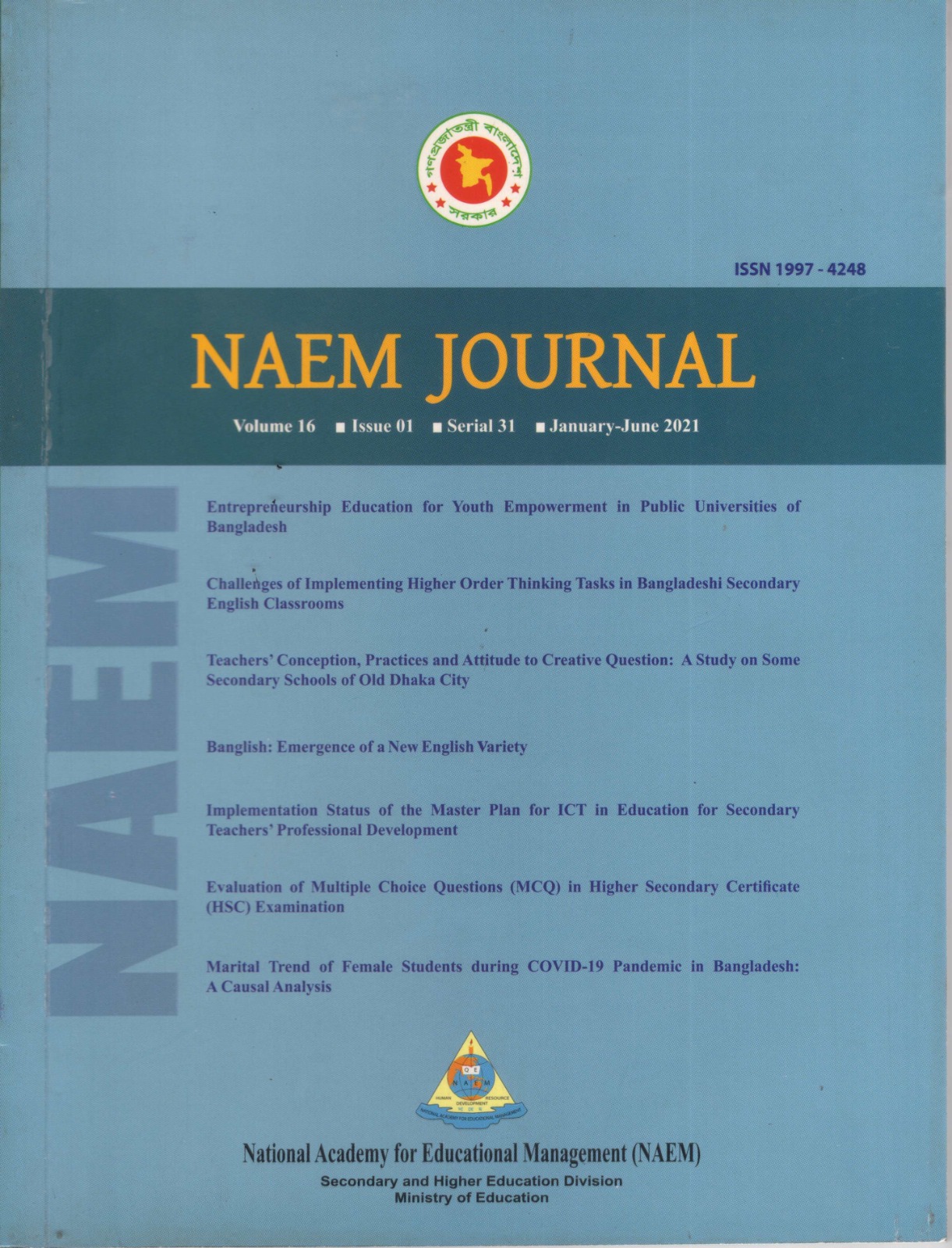
Entrepreneurship Education for Youth Empowerment in Public Universities of Bangladesh
Keywords:
Entrepreneurship, Education, Youth, Empowement, DemographicAbstract
Bangladesh is a country of 163 million people, where 4.2% of the labor force is unemployed and the unemployment rate among the university graduates is even higher than less educated people. If the trend continues, the demographic dividend of the country will be changed and the economic system will be affected badly. Therefore, this qualitative study has shed light on entrepreneurial skills development in public universities in the country. Data has been collected from post-graduate students, teachers and entrepreneurs of public universities and from educational experts using FGD guidelines and key informant interview questionnaires. Following the data driven thematic analysis, data has been analyzed and findings have been presented in different themes. Data shows that, there are no curricular activities in any social science faculty of the sample public universities for developing entrepreneurial skills for youth empowerment, although some co curricular activities help students develop those skills. Students and entrepreneurs found some courses and the university environment is helpful to some extent. All the respondents recommended to redesign the academic programs including some entrepreneurial courses in order to address the job markets and industry demands. Entrepreneurs and educational experts emphasized on redesigning the curriculum of the social science department for preparing graduates with contemporary knowledge and essential skills to survive in the ever changing global world.
References
Abdulkadir, A.A. (2011). The role of entrepreneurship education in empowering the Nigerian youths.Business Education Journal, 8 (1), 14-22.
Arogundade, B.B. (2011). Entrepreneurship Education: An Imperative for Sustainable Development in Nigeria, Journal of Emerging Trends in Educational Research and Policy Studies (JETERAPS). 2 (1), 26-29.
Bangladesh Bank, (2008). Recent Employment Situation and Labor Market Developments in Bangladesh. Policy Analysis Unit, Bangladesh Bank. Dhaka Bangladesh. http://www.bangladesh bank.org/pub/research/ policypaper/pp0807.pdf
BBS, (2011). Report on Labor Force Survey. Ministry of Planning, Dhaka-Bangladesh. http://203.112.218.66/ WebTestApplication/userfiles/Image/Latest%20Statistics%20Release/LFS% 20Report%202010.pdf
Braun, V. and Clarke, V. (2006). Using thematic analysis in psychology, Qualitative Research in Psychology, 3 (2). 77–101. doi: 10.1191/1478088706qp063oa.
Cohen, L., Manion, L. and Morrison, K. (2011). Research methods in education. 7th edn. London: Routledge.
Creswell, J. W. (2012). Educational Research: Planning, Conducting, and Evaluating Quantitative and Qualitative Research. 4th ed. Boston, MA: Pearson.
Denzin, N. and Lincoln, Y S. (eds), (2005). The Sage Handbook of Qualitative Research. 3rd ed. London: SAGE Publications.
Dhaka Tribune. (2018). Planting the seeds of education. Dhaka Tribune. (4 December) https://www.dhakatribune. com/magazine/weekend-tribune/2018/12/04/planting-the-seeds-of-education
Ifegbo, P. C. (2000). The use of activity oriented instruction for the acquiring of life coping skills in primary schools. Journal of Curriculum Organization of Nigeria, 9 (2), 34-41.
ILO, (2012).The Youth Employment Crisis: Time for Action. http://www.ilo.org/emppolicy/pubs/WCMS_176866/ lang--en/index.htm
Institutions for Graduates Empowerment. International Journal of Education and Research.1 (12). Johnson, B. and Christensen, L. (2017). Educational Research. 6th ed. Sage Publications, Inc.
Kehinde, M. O., Salau, K.K. & Bello, A. (2008). Rudiments Of Entrepreneurial Development. Ilorin Nathadex Printers.
Lucas .B. Ojo, Alaka Ambali Abayomi & Odozi, Anuli Faith (2014). Entrepreneurship Education: A Viable Tool for Youth Empowerment in Nigeria, Academic Journal of Interdisciplinary Studies, 3 (4), MCSER Publishing, Rome-Italy
McGraw-Hill. Odeyemi, T. K., Kehinde, M. O., Bankole, A.F. & Abifarin, Z.O. (2004). Developing entrepreneurial skills. Ilorin Nathadex Publishers.
Ministry of Youth and Sports (MoYS), (2023). National Youth Policy. Dhaka-Bangladesh. http://www.moysports. gov.bd/policy-youth.html
Odeyemi, T. K., Kehinde, M. O., Bankole, A. F., & Abifarin, Z. O. (2004). Developing Entrepreneurial Skills. Ilorin Nathadex Publishers.
Ogundele, Dr. O. J. K., Akingbade, W. A., & Akinlabi, H. B., (2012). Entrepreneurship training and education as strategic tools for poverty alleviation in Nigeria, American International Journal of Contemporary Research.2 (1).
Ojo. L. B., Abayooni, A, A., & Odozi, A. F. (2014). Enterpreneurship education; A viable tool for youth empowement in Nigeria. Academic Journal of Interdisciplinary Studies, 3 (4), 11. https://www.richtmann.org/journal/ index.php/ajis/article/view/3064
Okoye, D. I. (2004). The adequacy of secondary school agricultural science Curriculum For Entrepreneurship Education. Unpublished Master’s Thesis, NnamdiAzikiwe University, Awka.
Oloide, F. J. (2010). The economic history of poverty alleviation in Nigeria. Journal of the Nigerian Educational Research Association, 14 (2), 17-22.
Omolayo, B. (2006). Entrepreneurship in theory and practice. In F. Omotosho, T.K.O. Aluko, O.I. Wale Awe and G. Adaramola (eds). Introduction to Entrepreneurship Development in Nigeria. Ado-Ekiti: UNAD Press.
Onyesom & Uwaifo, (2013). Reforming entrepreneurship education curriculum of Nigerian tertiary institutions for graduates empowerment. International Journal of Education and Research, 1 (12) http://www.ijern.com/
Osuala, E. C. (2004). Principles and Method of Business and Computer Education. Enugu: Cheston Agency.
General Economics Division, Planning Commission, Government of The People’s Republic of Bangladesh (2010). Outline Perspective Plan of Bangladesh 2010-2021, http://planipolis.iiep.unesco.org/upload/Bangladesh/ Bangladesh_Final_Draft_OPP_June_2010.pdf
Robson, C. (2011). Real World Research: A Resource for Users of Social Research Methods in Applied Settings. 3rd ed. Chichester: Wiley.
UGC, (2012). Annual Report. Ministry of Education, Dhaka-Bangladesh.
UNESCO, (2012). Empowering youth for peace and sustainable development: What role for UNESCO in 2014- 2021? http://www.unesco.org/new/fileadmin/MULTIMEDIA/HQ/BPI/EPA/images/media_services/ Director-General/ConceptNoteEmpoweringYouth-for-Peace-and-SustainableDevelopmentEN.pdf
Williams, F. G. (1976). Business Policy-Strategic Formulation and Management Action. New York World Bank, (2009). Education and National Economic Development and Growth. New York: World Bank, (2014). Data: Bangladesh. http://data.worldbank.org/country/bangladesh.
World Bank, (2020). Population, total- Bangladesh. https://data.worldbank.org/indicator/SP.POP. TOTL?locations=BD
Submission: 31 December 2021
Downloads
Published
Issue
Section
License
Copyright (c) 2026 NAEM Journal