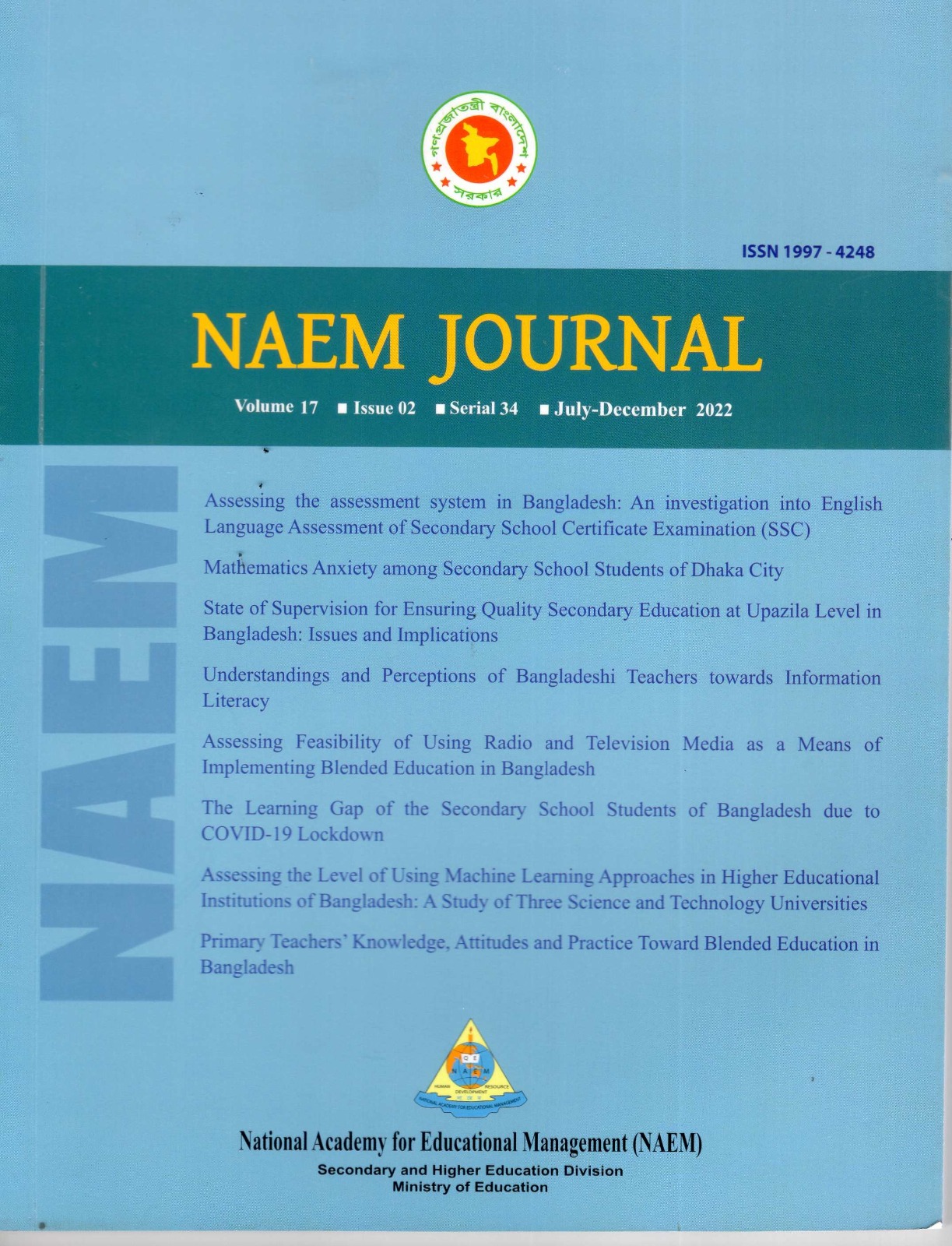
H, Primary Teachers’ Knowledge, Attitudes and Practice Toward Blended Education in Bangladesh
Keywords:
Blended Education; Online Teaching; Face-to-face Teaching; Primary Education.Abstract
This study explores the knowledge, attitudes, and practices of primary school teachers in Bangladesh regarding blended education. A total of 198 teachers from government primary schools participated in the study. A mixed-methods approach was employed to collect quantitative and qualitative data, and Exploratory Factor Analysis (EFA) was used to determine the factor structure of the blended education instruments.
The findings indicate that teachers generally need more knowledge about blended education. Their attitudes were largely neutral, with some expressing a preference for traditional face-to-face teaching over online methods. Differences were observed among teachers based on gender, school location (rural and urban), and teaching experience. Although many teachers had experience with synchronous and asynchronous online classes, more effective implementation of blended education is needed. The study highlights the importance of teacher training, professional development, adequate digital devices, reliable internet connectivity, and a clear policy framework to support successful implementation of blended education in Bangladesh.
References
1. Anthony, B., Kamaludin, A., Romli, A., Raffei, A. F. M., Phon, D. N. A., Abdullah, A., & Ming, G. L. (2020). Blended learning adoption and implementation in higher education: A theoretical and systematic review. Technology, Knowledge and Learning, 1–48.
2. Bangladesh Bureau of Educational Information and Statistics. (2021). Ministry of Education. Retrieved from https://banbeis.portal.gov.bd/
3. Birbal, R., Ramdass, M., & Harripaul, C. (2018). Student teachers’ attitudes towards blended learning. Journal of Education and Human Development, 7(2), 9–26.
4. Chakraborty, P., Mittal, P., Gupta, M. S., Yadav, S., & Arora, A. (2021). Opinion of students on online education during the COVID-19 pandemic. Human Behavior and Emerging Technologies, 3(3), 357–365.
5. Hasanah, H., & Malik, M. N. (2020). Blended learning in improving students’ critical thinking and communication skills at university. Cypriot Journal of Educational Sciences, 15(5), 1295–1306.
6. Lapitan, L. D., Jr., Tiangco, C. E., Sumalinog, D. A. G., Sabarillo, N. S., & Diaz, J. M. (2021). An effective blended online teaching and learning strategy during the COVID-19 pandemic. Education for Chemical Engineers, 35, 116–131.
7. Mali, D., & Lim, H. (2021). How do students perceive face-to-face/blended learning due to the COVID-19 pandemic? The International Journal of Management Education, 19(3), 100552.
8. Salman, S. A., Alkathiri, M., & Bawaneh, A. K. (2021). School off, learning on: Identification of preference and challenges among school students towards distance learning during COVID-19 outbreak. International Journal of Lifelong Education, 40(1), 53–71.
9. Shrestha, S., Haque, S., Dawadi, S., & Giri, R. A. (2022). Preparations for and practices of online education during the COVID-19 pandemic: A study of Bangladesh and Nepal. Education and Information Technologies, 27(1), 243–265.
10. Singh, J., Steele, K., & Singh, L. (2021). Combining the best online and face-to-face learning: Hybrid and blended learning approach for COVID-19, post-vaccine, and post-pandemic world. Journal of Educational Technology Systems, 50(2), 140–171.
11. Tang, C. M., & Chaw, L. Y. (2013). Readiness for blended learning: Understanding attitude of university students. International Journal of Cyber Society and Education, 6(2), 79–100.
Downloads
Published
Issue
Section
License
Copyright (c) 2024 2026 NAEM Journal

This work is licensed under a Creative Commons Attribution-NonCommercial 4.0 International License.
Copyright (c) 2026 NAEM Journal