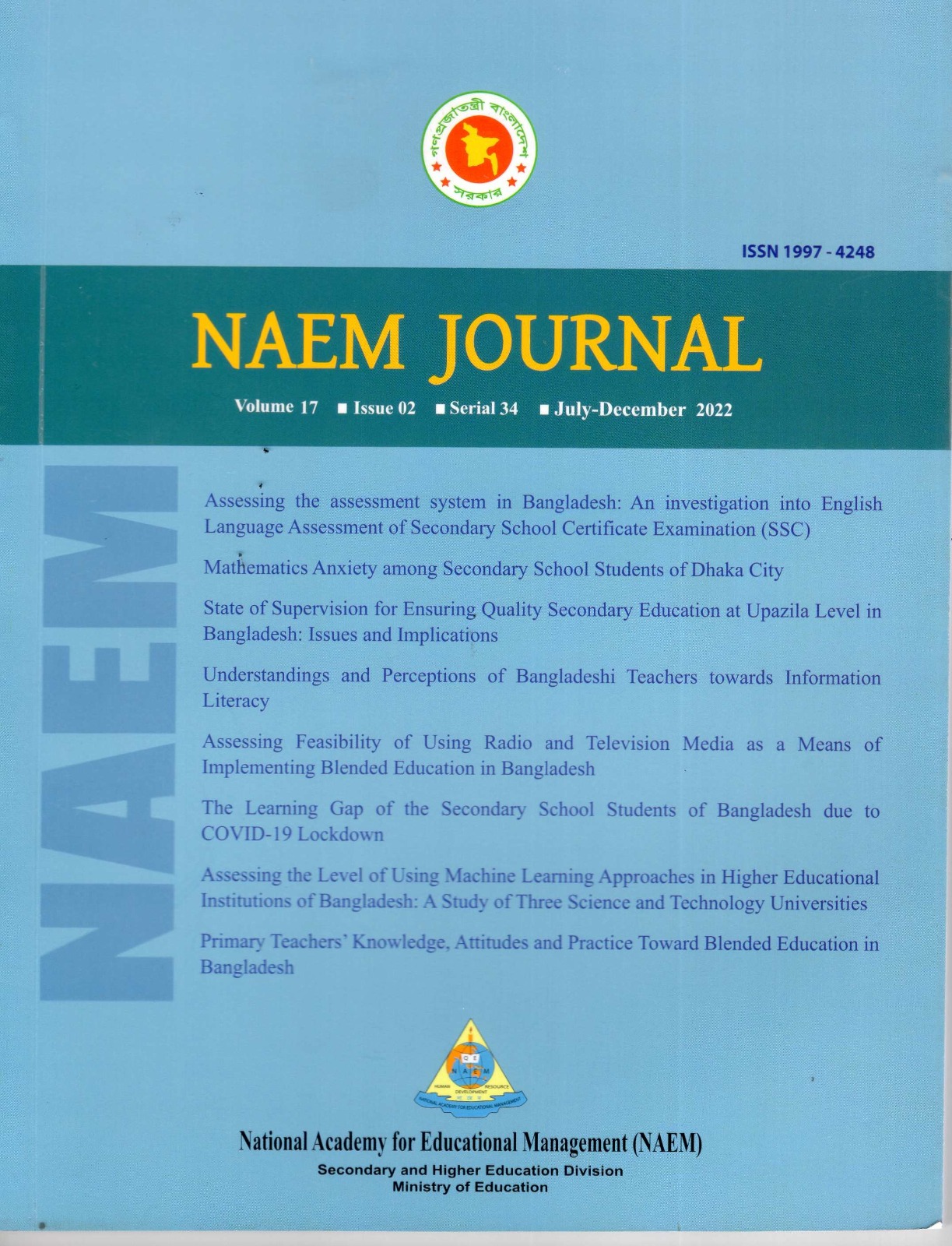
G, Assessing the Level of Using Machine Learning Approaches in Higher Educational Institutions of Bangladesh: A Study of Three Science and Technology Universities
Keywords:
Machine learning, Higher education, Bangladesh, Challenges.Abstract
This study aimed to assess the current state of machine learning (ML) adoption in Bangladesh’s higher education system. A survey involving 156 student respondents from three science and technology universities revealed that 55% of students found ML techniques unsatisfactory, with major challenges including a lack of skilled manpower, budget constraints, high artificial intelligence (AI) costs, and insufficient government support. However, 68.4% of students believed that ML presents an opportunity, while 26.5% did not. To address these challenges, the study proposed three recommendations: organizing seminars, securing funding, and procuring technology. By investing in skilled manpower, resources, and technology, Bangladesh can become better prepared for ML-driven digital learning and unlock the potential of AI and ML in higher education. Future research should focus on evaluating the effectiveness of the proposed solutions and exploring additional strategies to ensure the successful integration of ML techniques into higher education, ultimately improving teaching and learning outcomes.
References
1. Khatun, F. (2021, March 26). 50 years of Bangladesh: Accelerating export-led industrialization. The Daily Star.
2. Shibli, A. (2022, February 13). The economic impacts of the 4IR on Bangladesh. The Daily Star.
3. Hannan, E., & Liu, S. (2021). AI: A new source of competitiveness in higher education. Competitiveness Review: An International Business Journal. https://doi.org/10.1108/CR-03-2021-0045
4. Roberts, B. W., & DelVecchio, W. F. (2000). The rank-order consistency of personality traits from childhood to old age: A quantitative review of longitudinal studies. Psychological Bulletin, 126, 3–25.
5. Pocius, G. L. (1991). A Place to Belong: Community Order and Everyday Space in Calvert, Newfoundland. McGill-Queen’s University Press.
6. Bates, T., Cobo, C., Mariño, O., & Wheeler, S. (2020). Can artificial intelligence transform higher education? International Journal of Educational Technology in Higher Education, 17(1), 1–12.
7. Hossain, M. S. (2022). The ICT on the education system and its future prospects in Bangladesh. AGPE: The Royal Gondwana Research Journal of History, Science, Economic, Political and Social Science, 3(2), 48–60.
8. Rahman, M. (2022). Teacher education: Theory and practice in Bangladesh. In Handbook of Research on Teacher Education (pp. 111–140). Springer, Singapore.
9. Sultana, N., & Tamanna, M. (2022). Evaluating the potentials and challenges of IoT in education and other sectors during pandemic: A case of Bangladesh. Technology in Society, 68, 101857. https://doi.org/10.1016/j.techsoc.2021.101857
10. Lakshmi, Y. V., & Majid, I. (2022). Chatbots in education system. University News: A Weekly Journal of Higher Education, 60(8), 15–18.
11. Singh, N., Gunjan, V. K., Mishra, A. K., Mishra, R. K., & Nawaz, N. (2022). SeisTutor: A custom-tailored intelligent tutoring system and sustainable education. Sustainability, 14(7), 4167.
12. Gupta, S. L., & Mishra, N. (2022). Artificial intelligence and deep learning-based information retrieval framework for assessing student performance. International Journal of Information Retrieval Research, 12(1), 1–27.
13. Okeke, K., & Suardi, S. (2020). The Mobile Economy Sub-Saharan Africa 2020. GSMA Intelligence. https://www.gsmaintelligence.com
14. Staff Correspondent. (2021, June 18). UGC approves Tk 10,000 crore budget for public universities. The Daily Star.
15. Hmelo-Silver, C. E. (2004). Problem-based learning: What and how do students learn? Educational Psychology Review, 16(3), 235–266. http://www.jstor.org/stable/2336385
16. IGI Global. (2021). What is higher education institution? https://www.igi-global.com/dictionary/higher-education-institution/13096
17. Wahid-Uz-Zaman, M. G. M. (2019). Bracing artificial intelligence for socio-economic development: Opportunities, implications and challenges for Bangladesh. NDC E-Journal, 18(1), 1–22.
18. Latif, W. B., Pervin, K., & Karim, M. (2021). The impact of the Fourth Industrial Age (4IR 4.0) on higher education (HE 4.0) in the perspective of Bangladesh. International Journal of Education and Social Science Research, 4(5). https://doi.org/10.37500/IJESSR.2021.4501
19. Chowdhury, A. I. (2021). Empowering Bangladesh with the aid of artificial intelligence and Industry 4.0. Academia Letters, 2.
20. Chowdhury, A. (2021). Empowering Bangladesh with the aid of artificial intelligence and Industry 4.0. https://doi.org/10.20355/AL3137
21. Mollah, A. H., & Parvin, S. (2020). Online higher education during COVID-19 pandemic in Bangladesh: Benefits, problems and prospects. Journal of International Politics, 2(4), 23–28.
22. Chowdhury, M. K., & Behak, F. B. P. (2022). Online higher education in Bangladesh during COVID-19: Its challenges and prospects. Utamax: Journal of Ultimate Research and Trends in Education, 4(1), 15–28.
23. Ehsan, S. (2021). Artificial intelligence and the future of labor market in Bangladesh. https://doi.org/10.1007/978-3-319-31816-5_435-1
24. Hossin, M. S., Ulfy, M. A., & Karim, M. W. (2021). Challenges in adopting artificial intelligence (AI) in HRM practices: A study on Bangladesh perspective. International Fellowship Journal of Interdisciplinary Research, 1.
25. Khan, H., Soroni, F., Mahmood, S. J. S., Mannan, N., & Khan, M. M. (2021). Education system for Bangladesh using augmented reality, virtual reality and artificial intelligence. In 2021 IEEE World AI IoT Congress (AIIoT) (pp. 137–142). IEEE.
26. Dhawan, S., & Batra, G. (2021). Artificial Intelligence in Higher Education: Promises, Perils, and Perspective.
27. Ali, M., & Kayed, M. (2020). Bibliographical analysis of artificial intelligence learning in higher education: Is the role of the human educator and educated a thing of the past? https://doi.org/10.4018/978-1-7998-4846-2.ch003
28. Russell, S., & Norvig, P. (2003). Artificial Intelligence: A Modern Approach. Pearson, London, UK.
29. Bank of England. (2020). The impact of COVID on machine learning and data science in UK banking. Quarterly Bulletin, 2020 Q4. https://www.bankofengland.co.uk/quarterly-bulletin/2020/2020-q4/the-impact-of-covid-on-machine-learning-and-data-science-in-uk-banking
30. McKinsey. (2020). The State of AI in 2020 Survey. https://www.mckinsey.com/business-functions/mckinsey-analytics/our-insights/global-survey-the-state-of-ai-in-2020
31. Mosavi, A., Faghan, Y., Ghamisi, P., Duan, P., Ardabili, S. F., Salwana, E., & Band, S. S. (2020). Comprehensive review of deep reinforcement learning methods and applications in economics. Mathematics, 8(10), 1640. https://doi.org/10.3390/math8101640
32. Sutton, R. (1996). Generalization in reinforcement learning: Successful examples using sparse coarse coding.
33. Ilić, M., Popović Šević, N., & Ristić, B. (2020). Integrating human resources and customer relationship management for student satisfaction in higher education: Gaining a competitive advantage.
34. Popenici, S. A. D., & Kerr, S. (2017). Exploring the impact of artificial intelligence on teaching and learning in higher education. Research and Practice in Technology Enhanced Learning, 12, Article 22. https://doi.org/10.1186/s41039-017-0062-8
35. Murad, D., Heryadi, Y., Dw, B., Isa, S., & Budiharto, W. (2018). Recommendation system for smart LMS using machine learning: A literature review (pp. 113–118). https://doi.org/10.1109/ICCED.2018.00031
36. Sciarrone, F. (2018). Machine learning and learning analytics: Integrating data with learning (pp. 1–5). https://doi.org/10.1109/ITHET.2018.8424780
37. Romero, C., & Ventura, S. (2010). Educational data mining: A review of the state of the art. IEEE Transactions on Systems, Man, and Cybernetics, Part C: Applications and Reviews, 40, 601–618. https://doi.org/10.1109/TSMCC.2010.2053532
38. Romero, C., & Ventura, S. (2013). Data mining in education. Wiley Interdisciplinary Reviews: Data Mining and Knowledge Discovery, 3. https://doi.org/10.1002/widm.1075
39. Huang, J., Saleh, S., & Liu, Y. (2021). A review on artificial intelligence in education. Academic Journal of Interdisciplinary Studies, 10, 206. https://doi.org/10.36941/ajis-2021-0077
40. Chen, L., Chen, P., & Lin, Z. (2020). Artificial intelligence in education: A review. IEEE Access, 8, 75264–75278.
41. Guan, C., Mou, J., & Jiang, Z. (2020). Artificial intelligence innovation in education: A twenty-year data-driven historical analysis. International Journal of Innovation Studies, 4, 134–147. https://doi.org/10.1016/j.ijis.2020.09.001
Downloads
Published
Issue
Section
License
Copyright (c) 2024 2026 NAEM Journal

This work is licensed under a Creative Commons Attribution-NonCommercial 4.0 International License.
Copyright (c) 2026 NAEM Journal