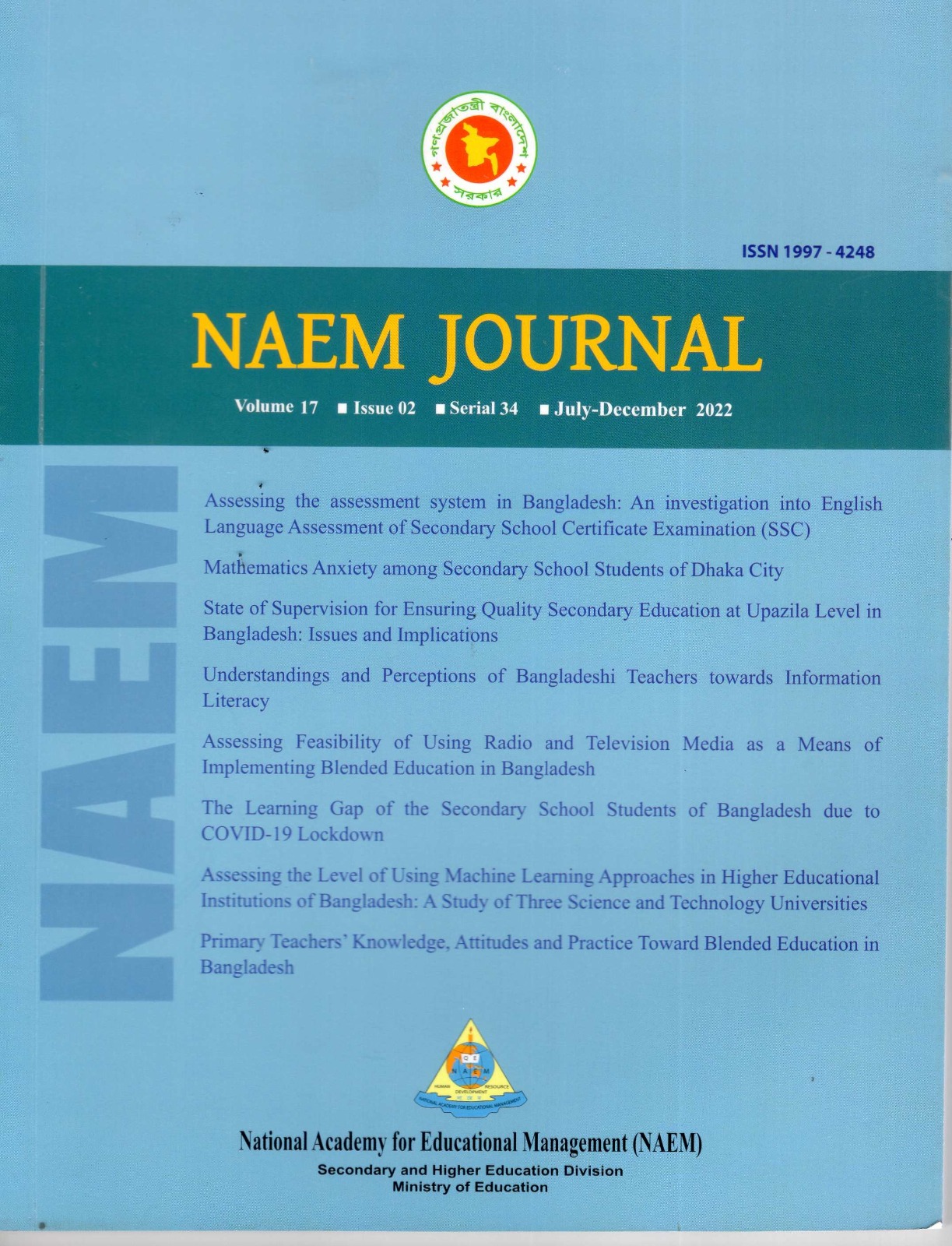
F, The Learning Gap of the Secondary School Students of Bangladesh due to COVID-19 Lockdown
Keywords:
Learning Gap; COVID-19 Education; Students’ Performance; BangladeshAbstract
This study aimed to investigate the learning gap of Grade 6 and Grade 8 students in Bangla and Mathematics during the COVID-19 pandemic in Rajshahi Division of Bangladesh. Despite continuous government support and various initiatives by teachers and schools to continue education remotely, the 59-week closure of educational institutions had a substantial negative impact on students’ learning. The major objectives of this study were to evaluate the extent of the learning gap, identify its causes, and suggest solutions to the problems encountered by students.
Purposive sampling was used to select 10 secondary schools, while simple random sampling was used to select 357 student respondents—180 from Grade 6 and 177 from Grade 8—for performance testing. Key informant interviews were conducted with 10 headteachers from the selected schools.
The findings revealed a substantial learning gap in Mathematics between students in the two grades, while students performed significantly better in Bangla. Most students’ performance was at Band 2 or below in Mathematics, and a large proportion performed at Band 3 or below in Bangla. Students also performed below the levels reported in the LASI 2015 assessment in both subjects. Gender disparities were observed, with girls outperforming boys in both subjects, particularly in Grade 6.
Factors affecting students’ achievement included limited access to technology and digital resources, lack of access to teachers, difficult economic conditions, poor mental and emotional well-being, and disruptions to daily routines and structures. The study highlights the urgent need for policymakers to address the learning gap through targeted learning support, teacher training, and improved access to digital learning resources.
References
The following references are transcribed from the reference section on pages 104–106 of the PDF. Some bibliographic details and URLs are unclear in the extracted text, so please verify them against the original PDF before publishing.
1. Azevedo, J. P., Goldemberg, D., Montoya, S., Nayar, R., & Rogers, H. (2021). Will every child be able to read by 2030? Policy Research Working Paper. World Bank.
2. Branson, N., Hofmeyr, C., & Lam, D. (2014). Progress through school and the determinants of school dropout in South Africa. Development Southern Africa, 31(1), 106–126. https://doi.org/10.1080/0376835X.2013.853610
3. Braun, V., & Clarke, V. (2006). Using thematic analysis in psychology. Qualitative Research in Psychology, 3(2), 77–101.
4. Conto, C. A., Akseer, S., Dreesen, T., Kamei, A., Mizunoya, S., & Rigole, A. (2020). COVID-19: Effects of school closures on foundational skills and promising practices for monitoring and mitigating learning loss. UNICEF Office of Research–Innocenti.
5. Directorate of Secondary and Higher Education (DSHE). (2016). Learning Assessment of Secondary Institutions (LASI) 2015. Dhaka.
6. Donnelly, R., & Patrinos, H. A. (2021). Learning loss during COVID-19: An early systematic review. Prospects. https://doi.org/10.1007/s11125-021-09582-6
7. Dorn, E., Hancock, B., Sarakatsannis, J., & Viruleg, E. (2020). COVID-19 and student learning in the United States: The hurt could last a lifetime. McKinsey & Company.
8. Engzell, P., Frey, A., & Verhagen, M. D. (2021). Learning loss due to school closures during the COVID-19 pandemic. Proceedings of the National Academy of Sciences, 118(17), e2022376118. https://doi.org/10.1073/pnas.2022376118
9. Fore, H. H., & Malpass, D. (2021, December 20). Reversing the pandemic’s education losses. World Bank Blogs.
10. Goudeau, S., Sanrey, C., Stanczak, A., Manstead, A., & Darnon, C. (2021). Why lockdown and distance learning during the COVID-19 pandemic are likely to increase the social class achievement gap. Nature Human Behaviour, 5(10), 1273–1281. https://doi.org/10.1038/s41562-021-01212-7
11. Hammerstein, S., König, C., Dreisörner, T., & Frey, A. (2021). Effects of COVID-19-related school closures on student achievement—a systematic review. Frontiers in Psychology, 12, 746289.
12. Hassan, H., Islam, A., Siddique, A., & Wang, L. C. (2021). “Low-tech” distance education: A remedy of the learning loss due to the COVID-19 pandemic. CDES Policy Brief Series, Monash University.
13. Hevia, F. J., Vergara-Lope, S., Velásquez-Durán, A., & Calderón, D. (2022). Estimation of the fundamental learning loss and learning poverty related to the COVID-19 pandemic in Mexico. International Journal of Educational Development, 88, 102515. https://doi.org/10.1016/j.ijedudev.2021.102515
14. Kuhfeld, M., Soland, J., Tarasawa, B., Johnson, A., Ruzek, E., & Liu, J. (2020). Projecting the potential impacts of COVID-19 school closures on academic achievement. https://doi.org/10.26300/CDRV-YW05
15. Li, Z., Sharma, U., & Matin, M. (2021). Impact of COVID-19 on primary school students in disadvantaged areas of Bangladesh. Asian Development Bank. https://doi.org/10.22617/BRF210471-2
16. Ngwacho, A. G. (2020). COVID-19 pandemic impact on Kenyan education sector: Learner challenges and mitigations. Journal of Research Innovation and Implications in Education, 4(2), 128–139.
17. Nusrat, M. (2021). Educational response toward COVID-19 pandemic: Perception, problems and prospects—A Bangladeshi context. European Journal of Education and Pedagogy, 2(5), 25–32. https://doi.org/10.24018/ejedu.2021.2.5.163
18. Oruche, C. A. (2021). COVID-19 pandemic: The impact of online schooling on students’ engagement with school work and physical activity. OIRT Journal of Humanities and Social Sciences, 1(1), 1–4.
19. Parker, A. (2021). Solutions to pandemic-induced global learning loss. Borgen Magazine.
20. Pasani, C. F., Amelia, R., & Hassan, Z. (2021). Learning loss and education inequality in Indonesia: Mapping the potential consequences and the COVID-19 crisis. Review of International Geographical Education Online, 11(10).
21. Rahman, T., & Sharma, U. (2021). A simulation of COVID-19 school closure impact on student learning in Bangladesh. World Bank. https://doi.org/10.1596/35043
22. Robson, C. (2011). Real-world research: A resource for users of social research methods in applied settings (3rd ed.). Wiley.
23. Roy, A. K., Mou, S. I., Kabir, H., & Hasan, M. K. (2021). The aftermath of prolonged academic institutions’ closure: Time to reopen safely. Bioresearch Communications, 7(2), 1038–1041. https://doi.org/10.3329/brc.v7i2.54379
24. UNESCO. (2021). Recovering lost learning: What can be done quickly and at scale? UNESCO COVID-19 Education Response.
25. UNESCO, UNICEF, & World Bank. (2021). COVID-19 learning losses: Rebuilding quality learning for all in the Middle East and North Africa.
26. UNICEF. (2020). How COVID-19 changed lives—Voices of children.
27. UNICEF. (2021). The future of 37 million children in Bangladesh is at risk with their education severely affected by the COVID-19 pandemic. Press release.
28. UNICEF. (2022). Learning loss must be recovered to avoid long-term damage to children’s well-being, new report says. Press release.
29. UNICEF & UNESCO. (2021). Bangladesh case study: Situational analysis on the effects of and responses to COVID-19 on the educator in Asia.
30. Van Cappelle, F., Chopra, V., Ackers, J., & Gochyyev, P. (2021). An analysis of the reach and effectiveness of distance learning in India during school closures due to COVID-19. International Journal of Educational Development, 85, 102439.
31. World Bank. (2021). Keeping Bangladesh’s students learning during the COVID-19 pandemic.
32. World Bank. (2022, January 26). Learning loss must be recovered to avoid long-term damage to children’s well-being and productivity, a new report says.
33. Yarrow, N., Masood, E., & Afkar, R. (2020). Estimates of COVID-19 impacts on learning and earning in Indonesia: How to turn the tide.
Downloads
Published
Issue
Section
License
Copyright (c) 2024 2026 NAEM Journal

This work is licensed under a Creative Commons Attribution-NonCommercial 4.0 International License.
Copyright (c) 2026 NAEM Journal