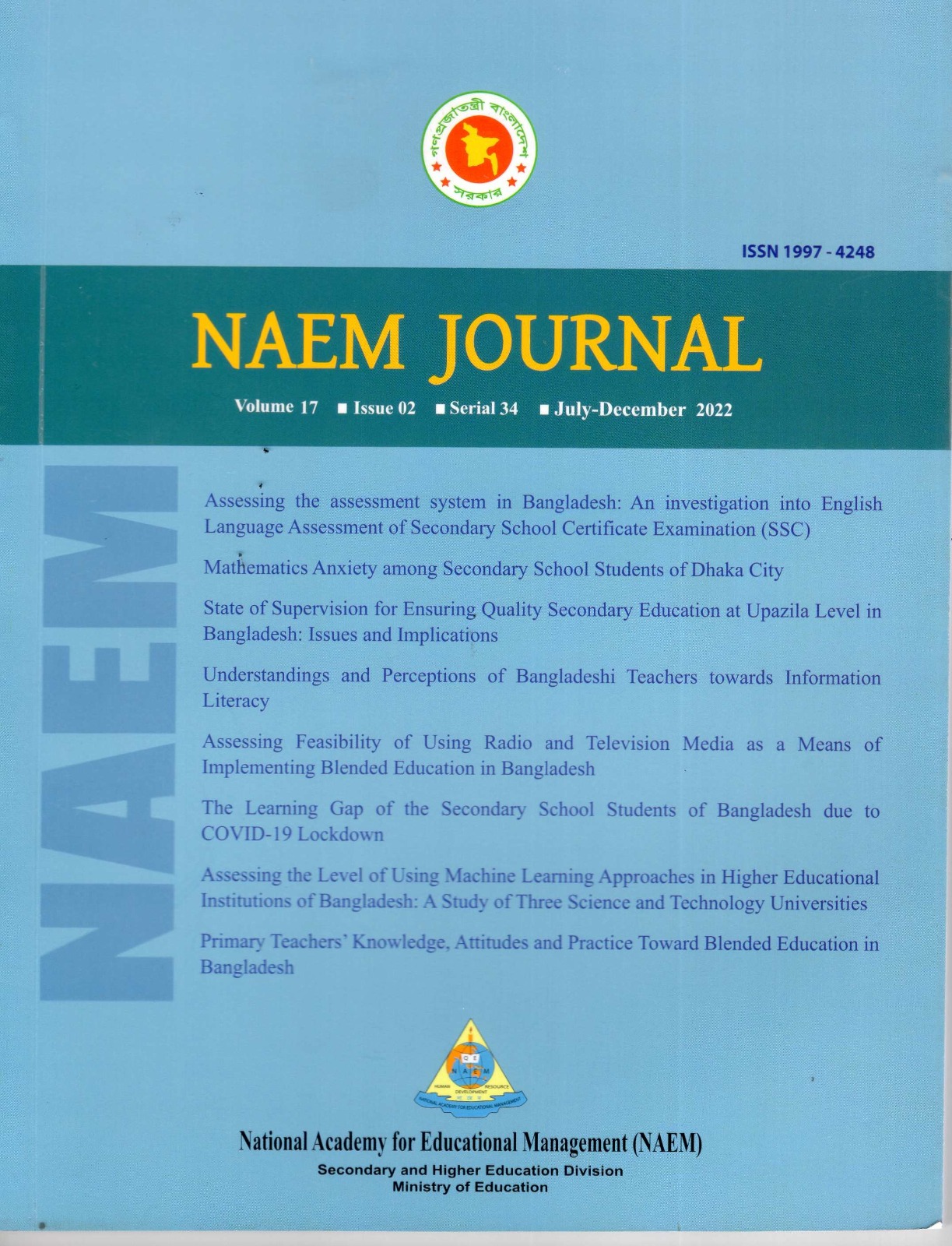
E, Assessing Feasibility of Using Radio and Television Media as a Means of Implementing Blended Education in Bangladesh
Keywords:
Blended Education; Education through Media; Effectiveness; Inclusiveness; Access and Participation; Assessment and Feedback.Abstract
The study investigated blended education in Bangladesh, which combines different learning methods and media to provide flexible learning experiences. Collaborative efforts by the government and development partners led to the development of remote learning content for television, radio, and the internet. The research aimed to assess the effectiveness, inclusiveness, and challenges of blended education using radio and television media. A mixed-method research design was employed, and data were collected through surveys, assessments, observations, interviews with parents, teachers, and experts, and content analysis. The findings revealed that student participation in radio lessons was low. Although most students had access to television, only 43% of students who watched televised lessons engaged with them regularly. Nevertheless, televised lessons were considered helpful by students and educators, supporting better understanding and self-study and contributing to slightly improved performance in language and mathematics among participating students. Despite these benefits, the study identified several shortcomings, including inadequate opportunities for home practice, limited support for students with disabilities, diverse learners, and ethnic minorities, insufficient feedback, and weak integration with classroom teaching. The study recommends reassessing radio-based educational programmes, improving access to televisions and appropriate broadcasting channels, addressing the needs of marginalized students, and strengthening planning, coordination, and stakeholder involvement to ensure the effective implementation of blended education in Bangladesh.
References
Gomboc-Turyan, J. L. (2013). Impact of learning theory methods on undergraduate retention and application of software in a studio setting. International Journal of Distance Education Technologies. https://doi.org/10.4018/IJDET.2020100105
Graham, C. R., Borup, J., Short, C. R., & Archambault, L. (2019). K–12 blended teaching: A guide to personalized learning and online integration (1st ed.). EdTech Books. https://dx.doi.org/10.59619
Grant, P., & Basye, D. (2014). Personalized learning: A guide for engaging students with technology. International Society for Technology in Education.
Gray, J. A., & DiLoreto, M. (2016). The effects of student engagement, student satisfaction, and perceived learning in online learning environments. NCP EA International Journal of Educational Leadership Preparation, 11(1).
Johnson, B., & Christensen, L. (2017). Educational research (6th ed.). Sage Publications, Inc.
Lesser, M. (2019). Why we badge: The potential for digital credentials. Education Digest, 84(8), 36–39.
Khan, M., Smith, T., Anand, K., Hossain, T., & Islam, M. (2022). Crisis-led approaches to teaching and learning in Bangladesh: Towards a blended learning framework: Final report. https://doi.org/10.13140/RG.2.2.17414.65602
Kintu, M. J., Zhu, C., & Kagambe, E. (2017). Blended learning effectiveness: The relationship between student characteristics, design features and outcomes. International Journal of Educational Technology in Higher Education, 14(1). https://doi.org/10.1186/s41239-017-0043-4
Multisilta, J., & Niemi, H. (2015). Digital storytelling promoting twenty-first-century skills and student engagement. Technology, Pedagogy and Education, 25(4). https://doi.org/10.1080/1475939X.2015.1074610
Murray, M. C., & Pérez, J. (2015). Informing and performing: A study comparing adaptive learning to traditional learning. Informing Science, 18, 111–125.
Musallam, R. (2010). The effects of screen casting as a multimedia pre-training tool to manage the intrinsic load of chemical equilibrium instruction for advanced high school chemistry students [Doctoral dissertation, University of San Francisco].
New Media Consortium. (2015). NMC Horizon Report: 2015 Higher Education Edition.
Nicolai, S., Jordan, K., Adam, T., Kaye, T., & Myers, C. (2023). Toward a holistic approach to EdTech effectiveness: Lessons from COVID-19 research in Bangladesh, Ghana, Kenya, Pakistan, and Sierra Leone. International Journal of Educational Development, 102, 102841. https://doi.org/10.1016/j.ijedudev.2023.102841
Noor, S., & Shaoun, S. P. (2021). Online education and community participation in Bangladesh: Challenges and opportunities to ensure inclusive learning during COVID-19 school closure. Indian Journal of Public Administration, 67(4), 620–638. https://doi.org/10.1177/00195561211044531
Paas, F., Renkl, A., & Sweller, J. (2003). Cognitive load theory. Instructional Science, 32(1–2), 1–8.
Patrick, S., Kennedy, K., & Powell, A. (2016). Mean what you say: Defining and integrating personalized, blended and competency education [Report]. International Association for K–12 Online Learning.
Prahmana, R. C. I., Hartanto, D., Kusumaningtyas, D. A., Ali, R., & Muchlas. (2021). Community radio-based blended learning model: A promising learning model in remote area during pandemic era. Heliyon, 7, e07511. https://doi.org/10.1016/j.heliyon.2021.e07511
Rasheed, R. A., Kamsin, A., & Abdullah, N. A. (2020). Challenges in the online component of blended learning: A systematic review. Computers & Education, 144, 103701.
Robson, C. (2011). Real world research: A resource for users of social research methods in applied settings (3rd ed.). Wiley.
Saleh, M. A., Khan, M. I., Banerjee, S., & Safi, F. (2023). A tale of online learning during COVID-19: A reflection from the South Asian Association for Regional Cooperation (SAARC) countries. Heliyon, 9, e19678. https://doi.org/10.1016/j.heliyon.2023.e19678
Sarkar, S. S., Das, P., Rahman, M. R., & Zobaer, M. S. (2021). Perceptions of public university students towards online classes during COVID-19 pandemic in Bangladesh. Frontiers in Education, 6. https://doi.org/10.3389/feduc.2021.703723
Singh, H. (2021). Building effective blended learning programs. In B. Khan, S. Affouneh, S. H. Salha, & Z. N. Khlaif (Eds.), Challenges and opportunities for the global implementation of e-learning frameworks (pp. 15–26). IGI Global.
Sturgis, C., Patrick, S., & Pittenger, L. (2011). It’s not a matter of time: Highlights from the 2011 competency-based summit. International Association for K–12 Online Learning.
Su, et al. (2023). Student engagement and teaching presence in blended learning and emergency remote teaching. Journal of Computer Education. https://doi.org/10.1007/s40692-023-00263-1
Tadesse, S., & Muluye, W. (2020). The impact of COVID-19 pandemic on education system in developing countries: A review. Open Journal of Social Sciences, 8, 159–170. https://doi.org/10.4236/jss.2020.810011
Tayebinik, M., & Puteh, M. (2013). Blended learning or e-learning? arXiv preprint arXiv:1306.4085.
The Daily Star. (2021, July 30). Towards a blended learning framework for post-pandemic Bangladesh. The Daily Star. https://www.thedailystar.net/youth/education/news/towards-blended-learning-framework-post-pandemic-bangladesh-2140756
Tong, D. H., Syen, B. P., & Ngan, L. K. (2022). The effectiveness of blended learning on students’ academic achievement, self-study skills and learning attitudes: A quasi-experiment study in teaching the conventions for coordinates in the plane. Heliyon, 8(12), e12657. https://doi.org/10.1016/j.heliyon.2022.e12657
UNICEF. (2020). Guidance on distance learning modalities to reach all children during school closures: Focusing on low- and no-tech modalities to reach the most marginalized. UNICEF Regional Office for South Asia.
Wolf, M. (2010). Innovate to educate: System [re]design for personalized learning. Software & Information Industry Association.
Zhonggen, Y. (2021). A meta-analysis of effects of blended learning on performance, attitude, achievement, and engagement in different countries. Frontiers in Psychology, 12, 638066.
Downloads
Published
Issue
Section
License
Copyright (c) 2024 2026 NAEM Journal

This work is licensed under a Creative Commons Attribution-NonCommercial 4.0 International License.
Copyright (c) 2026 NAEM Journal