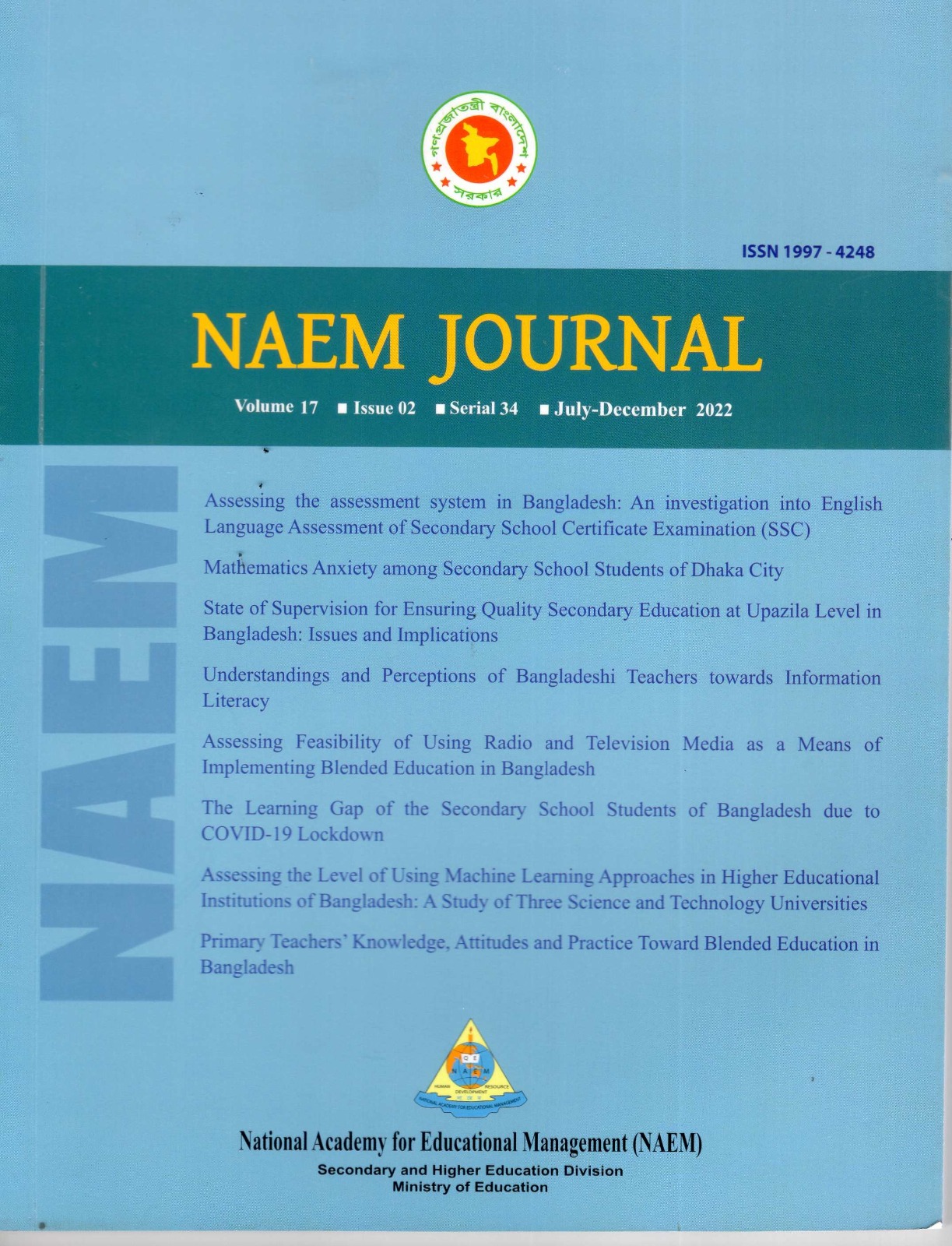
B, Mathematics Anxiety among Secondary School Students of Dhaka City
Keywords:
Mathematics Anxiety; Secondary Education; Secondary School Students; Dhaka City; Gender Differences; Parental Education; School Category.Abstract
Mathematics is an important compulsory subject at the secondary level and plays a significant role in developing scientific knowledge and technological advancement. This study aimed to measure and analyze the level of mathematics anxiety among secondary school students in Dhaka City, Bangladesh. The study employed a descriptive research design and a quantitative approach. A total of 479 Class Nine students, comprising 256 boys and 223 girls from 12 secondary schools, participated in the study. Data were collected using a questionnaire incorporating the Mathematics Anxiety Scale (MAS) developed by Khatoon and Mahmud. Descriptive statistics, analysis of variance (ANOVA), and t-tests were used to analyze the data.
The findings indicated that 17.1% of the students experienced low mathematics anxiety, 63.9% experienced moderate anxiety, and 19% experienced high anxiety. Although girls demonstrated higher mathematics anxiety scores than boys, the difference was not statistically significant. Similarly, mathematics anxiety did not differ significantly across school categories or according to mothers’ educational qualifications. However, a statistically significant relationship was observed between fathers’ educational qualifications and students’ mathematics anxiety. The study highlights the need to identify the underlying causes of mathematics anxiety and develop appropriate strategies to improve students’ learning experiences and confidence in mathematics.
References
The following references are taken from the article’s reference section (printed pages 33–36). Some bibliographic details and URLs are unclear in the source PDF.
1. Alexander, A. H. (2010). Effective Teaching Strategies for Alleviating Math Anxiety and Increasing Self-Efficacy in Secondary Students. Master in Teaching project, The Evergreen State College.
2. Ali, M. E. (1999). Juge Juge Shikkha Commission O Shikshar Uttaron. Jagoroni Prokashoni, Dhaka.
3. Ashcraft, M. H., & Faust, M. W. (1994). Mathematics anxiety and mental arithmetic performance: An exploratory investigation. Cognition and Emotion, 8(2), 97–125.
4. Altermatt, E. R., & Kim, M. E. (2004). Can anxiety explain sex differences in college entrance exam scores? Journal of College Admission, 183, 6–11.
5. Betz, N. E. (1978). Prevalence, distribution, and correlates of math anxiety in college students. Journal of Counseling Psychology, 25(5), 441–448.
6. Devine, A., Fawcett, K., Szűcs, D., & Dowker, A. (2012). Gender differences in mathematics anxiety and the relation to mathematics performance while controlling for test anxiety. Behavioral and Brain Functions, 8, Article 33.
7. Dreger, R. M., & Aiken, L. R. (1957). The identification of number anxiety in a college population. Journal of Educational Psychology, 48(6), 344–351.
8. Directorate of Secondary and Higher Education (DSHE). (2014). Evaluation Report. Dhaka, Bangladesh.
9. Education Commission of Bangladesh. (1974). Bangladesh Education Commission Report. Bangladesh.
10. Fennema, E., & Sherman, J. (1976). Fennema-Sherman Mathematics Attitude Scales. JSAS Catalog of Selected Documents in Psychology, 6, 31.
11. Furner, J. M., & Duffy, M. L. (2002). Equity for all students in the new millennium: Disabling math anxiety. Intervention in School and Clinic, 38(2), 67–74.
12. Ganley, C. M., & McGraw, A. L. (2016). The development and validation of a revised version of the Math Anxiety Scale for young children. Frontiers in Psychology, 7, Article 1181.
13. Haciomeroglu, G. (2014). Elementary pre-service teachers’ mathematics anxiety and mathematics teaching anxiety. International Journal for Mathematics Teaching and Learning.
14. Halat, E. (2007). Sex-related differences in the acquisition of the van Hiele levels and motivation in learning geometry. Asia Pacific Education Review, 8(1), 119–132.
15. Hembree, R. (1990). The nature, effects, and relief of mathematics anxiety. Journal for Research in Mathematics Education, 21(1), 33–46.
16. Jackson, C. D., & Leffingwell, R. J. (1999). The role of instructors in creating math anxiety in students from kindergarten through college. Mathematics Teacher, 92(7), 583–586.
17. Karp, K. S. (1991). Elementary school teachers’ attitudes towards mathematics: The impact on students’ autonomous learning skills. School Science and Mathematics, 91(6), 265–270.
18. Khatoon, T., & Mahmood, S. (2010). Mathematics anxiety among secondary school students in India and its relationship to achievement in mathematics. European Journal of Social Sciences, 16(1), 75–86.
19. Lee, J. (2009). Universals and specifics of math self-concept, math self-efficacy, and math anxiety across 41 PISA 2003 participating countries. Learning and Individual Differences, 19, 355–365.
20. Liu, F. (2009). Impact of online discussion on elementary teacher candidates’ anxiety toward teaching mathematics. Education, 129(3), 617–625.
21. McAnallen, R. (2010). Examining Mathematics Anxiety in Elementary Classroom Teachers. PhD thesis, University of Connecticut.
22. Mathison, M. A. (1988). Curricular interventions and programming innovations for the reduction of mathematics anxiety. Paper presented at the Annual Convention of the American Psychological Association, San Francisco, California.
23. Ma, X., & Cartwright, F. (2006). A longitudinal analysis of gender differences in affective outcomes in mathematics during middle and high school. School Effectiveness and School Improvement, 17(4), 413–436.
24. National Curriculum and Textbook Board (NCTB). (2013). National Curriculum and Textbook Board: Mathematics Textbook, Class IX. Dhaka, Bangladesh.
25. National Mathematics Advisory Panel (NMAP). (2008). The Final Report of the National Mathematics Advisory Panel. U.S. Department of Education, Washington, DC.
26. Richardson, F., & Suinn, R. (1972). The mathematics anxiety rating scale: Psychometric data. Journal of Counseling Psychology, 19(6), 551–554.
27. Reed, K. L. (2014). Do Teachers Who Participated in a Year-Long Math Course Have Less Teacher Math Anxiety Than Those Who Did Not Participate? Doctoral dissertation, University of Maryland, College Park.
28. Sloan, T., Daane, C. J., & Giesen, J. (2002). Mathematics anxiety and learning styles: What is the relationship in elementary preservice teachers? School Science and Mathematics, 102(2), 84–87.
29. Stuart, V. (2000). Math curse or math anxiety? Teaching Children Mathematics, 6(5).
30. Smith, M. R. (2004). Math Anxiety: Causes, Effects, and Preventative Measures. Senior thesis, Liberty University.
31. Sloan, T. R. (2010). A quantitative and qualitative study of math anxiety among pre-service teachers. The Educational Forum, 74(3), 242–256.
32. Tobias, S., & Weissbrod, C. (1980). Anxiety and mathematics: An update. Harvard Educational Review, 50(1), 63–70.
33. Trujillo, K. M., & Hadfield, O. D. (1999). Tracing the roots of mathematics anxiety through in-depth interviews with preservice elementary teachers. College Student Journal, 33(2), 219–232.
34. Usimaki, L., & Nason, R. (2004). Causes underlying pre-service teachers’ negative beliefs and anxieties about mathematics. In Proceedings of the 28th Conference of the International Group for the Psychology of Mathematics Education (Vol. 4, pp. 369–376).
35. Vinson, B. M. (2001). A comparison of preservice teachers’ mathematics anxiety before and after a methods class emphasizing manipulatives. Early Childhood Education Journal, 29, 89–94.
36. Wigfield, A., & Meece, J. L. (1988). Math anxiety in elementary and secondary school students. Journal of Educational Psychology, 80(2), 210–216.
37. World Economic Forum. (2016). The Global Information Technology Report 2016. Geneva, Switzerland.
38. Zettle, R. D., & Raines, S. J. (2002). The relationship of trait and test anxiety with mathematics anxiety. College Student Journal, 34, 246–258.
Downloads
Published
Issue
Section
License
Copyright (c) 2024 2026 NAEM Journal

This work is licensed under a Creative Commons Attribution-NonCommercial 4.0 International License.
Copyright (c) 2026 NAEM Journal