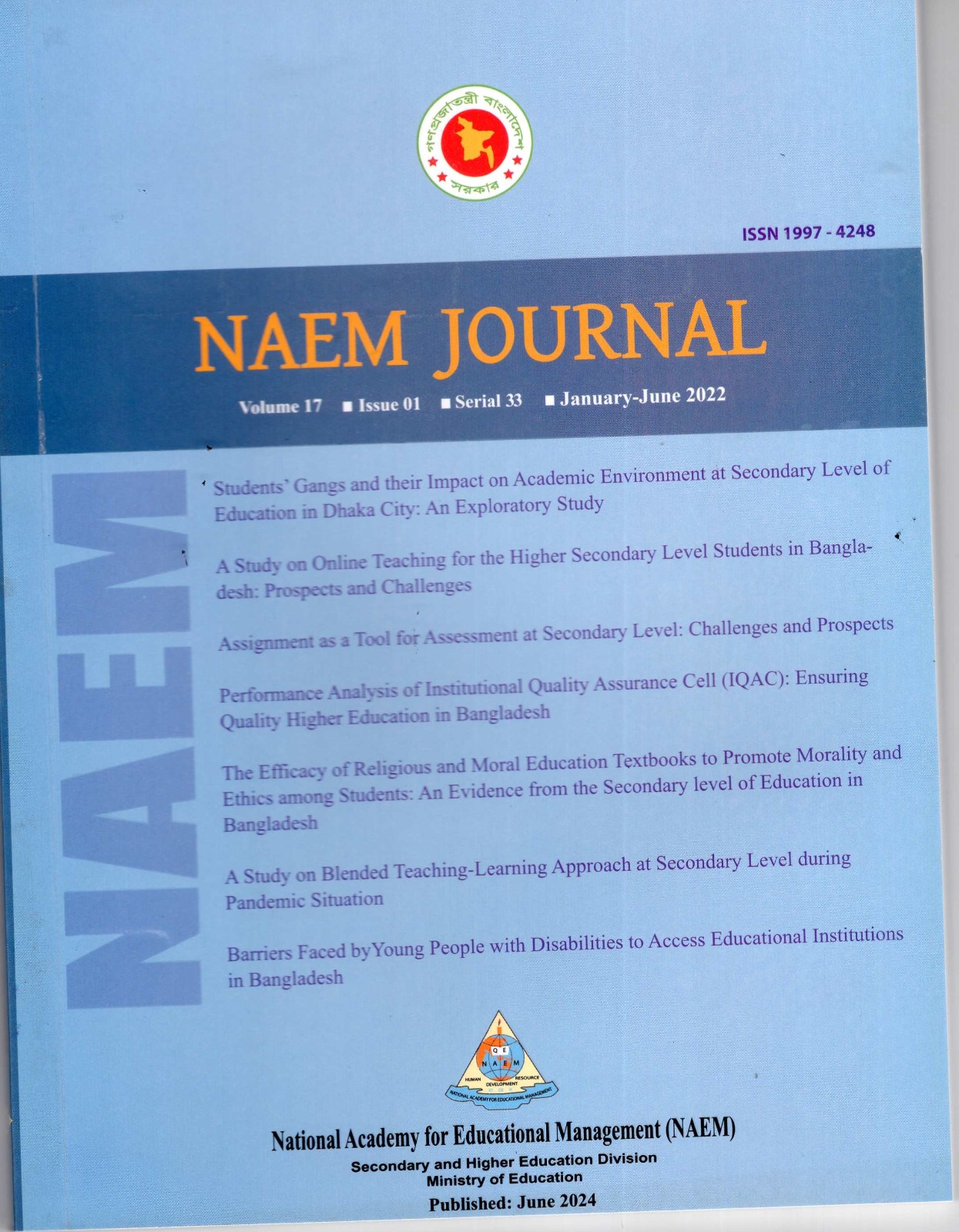
F, A Study on Blended Teaching-Learning Approach at Secondary Level during Pandemic Situation
Keywords:
Blending Learning, Online Education, TPACK, Devices, Connectivity, Platforms, Information Technology, Access, DistanceAbstract
Since 17 March 2020, schools in Bangladesh were closed due to the pandemic. There are around one million teachers in primary, secondary, madrasah, and vocational education institutions in Bangladesh. With the technical support of a2i, the Government of Bangladesh introduced alternative distance education through different channels, including offline and online platforms and television, so that students could continue learning while staying at home.
The teachers at the secondary level were the population of this study. The study explored access to digital technology, teachers’ current capacity to use educational technology (EdTech), and the challenges and possibilities of blended learning for future expansion. Both qualitative and quantitative approaches were integrated. Data collection tools included survey questionnaires for secondary-level teachers who were active and inactive in online teaching and learning, semi-structured interviews with head teachers, focus group discussions (FGDs) with teachers and students, key informant interviews (KIIs) with policymakers, and secondary document reviews. Participatory approaches were emphasized throughout the study.
The findings revealed that access to television was 82%, feature phones 75%, smartphones 100%, tablets 13%, laptops 57%, desktops 38%, mobile data 100%, and personal Wi-Fi 24%. Most respondents (88%) used ICT devices to conduct classes during the pandemic. Of the respondents, 81% were self-trained in conducting classes using ICT devices, while 19% did not use ICT devices. Half of the respondents considered their class quality good, while almost half considered it average. Twenty-five percent identified willingness and training as problems. More than half of the respondents (55%) reported using devices and connectivity for educational purposes, one-third for professional work, and 12% for entertainment during the pandemic. Nine respondents had average knowledge of the TPACK model, three reported a high level of understanding, and three had never heard of the model.
References
Allan, B. (2007). *Blended learning tools for teaching and training*. Facet Publishing.
Barbour, M. K. (2014). *A history of international K–12 and blended instruction*. Sacred Heart University. https://digitalcommons.sacredheart.edu/ced_fac/201
Braun, V., & Clarke, V. (2006). Using thematic analysis in psychology. *Qualitative Research in Psychology, 3*(2), 77–101. https://doi.org/10.1191/1478088706qp063oa
Graham, C. R. (2006). Blended learning systems: Definition, current trends, and future directions. In C. J. Bonk & C. R. Graham (Eds.), *The handbook of blended learning: Global perspectives, local designs* (pp. 3–21). Pfeiffer Publishing.
Graham, C. R. (2011). Theoretical considerations for understanding technological pedagogical content knowledge (TPACK). *Computers & Education, 57*(3), 1953–1960.
Graham, C. R. (2012). Emerging practice and research in blended learning. In M. G. Moore (Ed.), *Handbook of distance education* (pp. 333–350). Routledge. https://www.academia.edu/2068375/Emerging_practice_and_research_in_blended_learning
Graham, C. R., et al. (2019). K–12 blended teaching readiness: Model and instrument development. *Journal of Research on Technology in Education, 51*(3), 239–258. https://doi.org/10.1080/15391523.2019.1586601
Hockly, N. (2018). Blended learning. *ELT Journal, 72*(1), 97–101. https://academic.oup.com/eltj/article-abstract/72/1/97/4812363
Horn, M. B., & Staker, H. (2014). *Blended: Using disruptive innovation to improve schools*.
Johnson, B., & Christensen, L. (2017). *Educational research* (6th ed.). SAGE Publications.
Neumeier, P. (2005). A closer look at blended learning—Parameters for designing a blended learning environment for language teaching and learning. *ReCALL, 17*(2), 163–178. https://doi.org/10.1017/S0958344005000224
Orey, M., Bersin, G., & Associates, A. (2003). *Definition of blended learning*. http://www.arches.uga.edu/~mikeorey/blendedLearning
Robson, C. (2011). *Real world research: A resource for users of social research methods in applied settings* (3rd ed.). Wiley.
Sharma, P., & Barrett, B. (2007). *Blended learning: Using technology in and beyond the language classroom*. Macmillan Education.
Tayebinik, M., & Puteh, M. (2012). Blended learning or e-learning? *International Magazine on Advances in Computer Science and Telecommunications, 3*(1), 103–110. https://papers.ssrn.com/sol3/papers.cfm?abstract_id=2282881
Winkelmans, T., Anderson, B., & Barbour, M. (2010). Distributed learning in British Columbia: A journey from correspondence to online delivery. *Journal of Open, Flexible, and Distance Learning, 14*(1), 6–28. https://www.learntechlib.org/p/147924/
Wood, R. G. (2009). Classroom teaching in web-enhanced courses: A multi-institutional study. *EDUCAUSE Quarterly, 1*, 26–30.
Cohen, L., Manion, L., & Morrison, K. (2011). *Research methods in education* (7th ed.). Routledge.
Creswell, J. W. (2012). *Educational research: Planning, conducting, and evaluating quantitative and qualitative research* (4th ed.). Pearson.
Denzin, N., & Lincoln, Y. S. (Eds.). (2005). *The SAGE handbook of qualitative research* (3rd ed.). SAGE Publications.
Downloads
Published
Issue
Section
License
Copyright (c) 2024 2026 NAEM Journal

This work is licensed under a Creative Commons Attribution-NonCommercial 4.0 International License.
Copyright (c) 2026 NAEM Journal