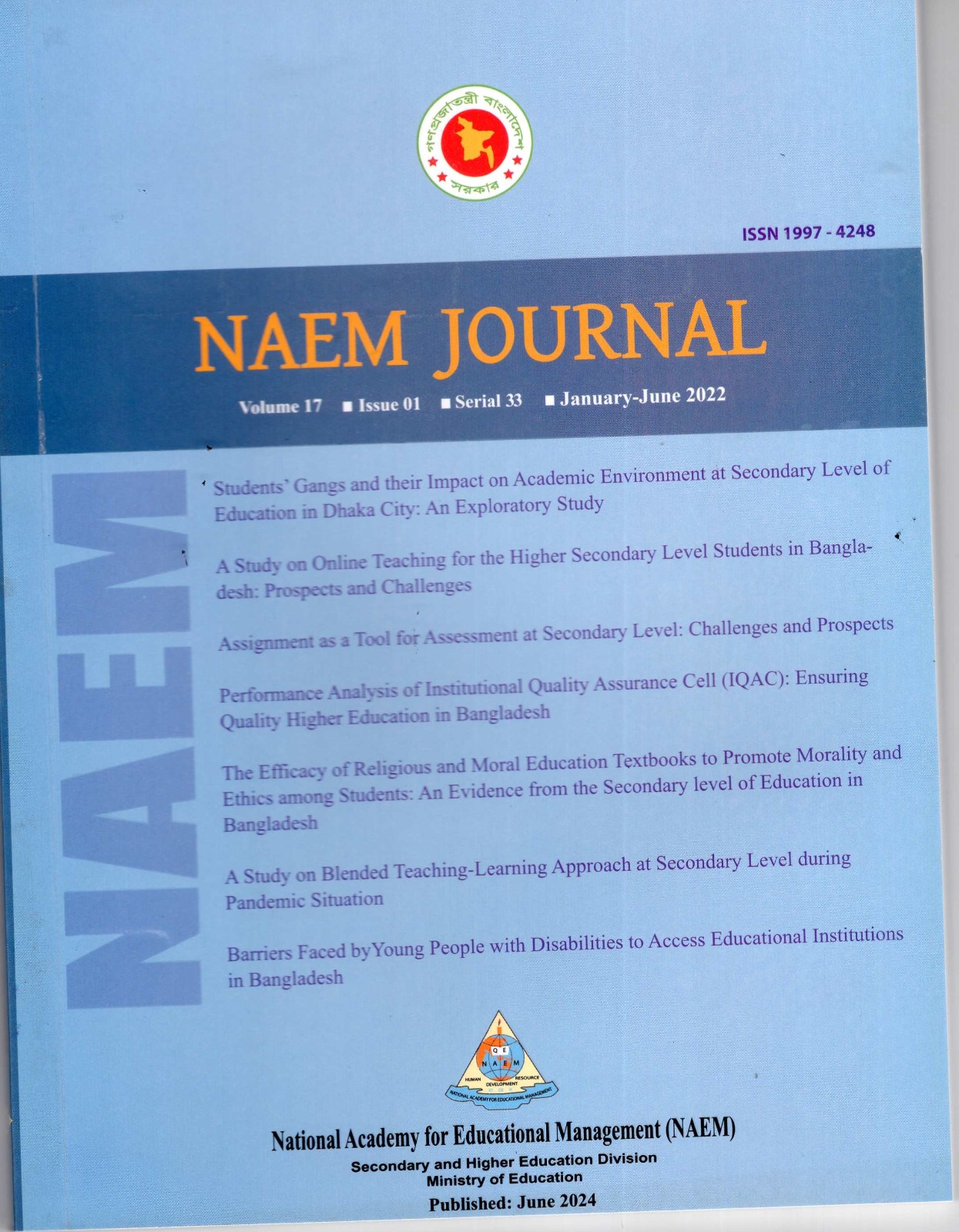
E, The Efficacy of Religious and Moral Education Textbooks to Promote Morality and Ethics among Students: An Evidence from the Secondary Level of Education in Bangladesh
Keywords:
Values, Religiosity, Spirituality, SchoolbooksAbstract
The study found that Religious and Moral Education (RME) textbooks are necessary for instilling ethics and morals among secondary-level students in Bangladesh. The RME textbooks of major religions, including Islam, Hinduism, Christianity, and Buddhism, advocate similar social and ethical principles, such as empathy, sympathy, thankfulness, honesty, compassion, communal harmony, and forbearance. Despite containing substantial religious and ethical materials, the books may not always achieve the expected learning outcomes because teaching and assessment practices prioritize memorization of exam-oriented content rather than practical application. Additionally, the textbooks may seem monotonous because of unappealing illustrations, inadequate content, outdated stereotypes in story presentation, insufficient practical examples, linguistic ambiguity, and publication issues. Therefore, the research advocates the comprehensive inclusion of moral values not only in textbooks but also in teaching practices and learning environments to develop a values-oriented generation with strong national and social commitments at the secondary school level.
References
Altalib, H., Abusulayman, A. H., & Altalib, O. (2013). *Parent-child relations: A guide to raising children*. International Institute of Islamic Thought.
Al-Qur’an. (2022). *Quran.com*. https://quran.com/
Chen, Y., & van de Weele, J. V. T. (2018). Associations of religious upbringing with subsequent health and well-being from adolescence to young adulthood: An outcome-wide analysis. *American Journal of Epidemiology, 187*(11), 2355–2364. https://doi.org/10.1093/aje/kwy142
Dewan, M., & Islam, F. (2021, November 13). Juvenile delinquency in Bangladesh. *The Daily Sun*. http://www.daily-sun.com/printversion/details/582289/Juvenile-delinquency-in-Bangladesh
Gui, A., Yasin, M. A., Madhubala, N. M., & Norzihani, S. (2020). Roles of teacher and challenges in developing students’ morality. *Universal Journal of Educational Research, 8*, 52–59. https://www.researchgate.net/publication/341908478_Roles_of_Teacher_and_Challenges_in_Developing_Students_Morality
Gupta, Y., & Mangal, A. (2021). Social media: A breeding ground for juvenile offenders. *The Criminal Law Blog*. https://criminallawstudiesnlus.wordpress.com/2021/06/05/social-media-a-breeding-ground-for-juvenile-offenders/
Khan, S. A. (2019, August 27). Role of family and religious values in preventing violent extremism. *The Daily Star*. https://www.thedailystar.net/round-tables/news/role-family-and-religious-values-preventing-violent-extremism-1791259
Mahajataq. (2021). *Shuddhachar (Etiquette and manners)*. Quantum Foundation. http://quantummethod.org.bd/books/publications/bangla-publications/shuddhachar
Mannan, M. (2021, October 2). Juvenile delinquency: Its impact and trial. *The Daily Independent*.
Ministry of Education. (2010). *National Education Policy*. Government of Bangladesh.
Ministry of Education. (2014). *Annual Report: Bangladesh Bureau of Educational Information and Statistics*. Government of Bangladesh.
Moslimany, A. E. (2018). *Teaching children: A moral, spiritual and holistic approach to educational development*. International Institute of Islamic Thought.
Nasser, I., Saroughi, M., & Shelby, L. (2020). *Advancing education in Muslim societies: Mapping the terrain study 2019–2020 report*. International Institute of Islamic Thought. https://iiit.org/wp-content/uploads/2020/02/Mapping-Report-2020-02-20-8-20.pdf
Nasser, I., Cheema, J., Saroughi, M., & Alwani, A. (2019). *Advancing education in Muslim societies: Mapping the terrain study 2018–2019 report*. International Institute of Islamic Thought. https://www.openicpsr.org/openicpsr/project/117371/version/V1/view
Nasche, D. (2011, December 7). *OECD reviews of evaluation and assessment in education: Sweden*. OECD Directorate for Education.
National Integrity Strategy of Bangladesh. (2012). *National Integrity Strategy for Building Golden Bengal*. Government of Bangladesh. http://www.cabinet.gov.bd/site/page/b998f70e-1722-4b17-aae2-6ef9ac7c5d5b
New International Version: The Holy Bible. (1984). International Bible Society.
Nichols, V. (2009, June 4). Schools should teach virtue, values and characters: Nichols. *The Telegraph*. https://www.telegraph.co.uk/education/educationnews/5444148/Schools-should-teach-virtue-values-and-character-Nichols.html
Oser, F. K. (2001). Moral education. In *International encyclopedia of the social & behavioral sciences* (pp. 10235–10240). Elsevier. https://www.sciencedirect.com/topics/social-sciences/moral-education
OECD. (2020). *OECD reviews of evaluation and assessment in education: Student assessment in Turkey*. https://doi.org/10.1787/5edc0abe-en
OECD. (2020). *OECD reviews of evaluation and assessment in education: Albania*. https://doi.org/10.1787/d267dc93-en
Qattawi, A., Venhovens, P., & Brooks, J. (2014). Rethinking automotive engineering education: Deep orange as a collaborative innovation framework for project-based learning incorporating real-world case studies. *Proceedings of the ASEE Annual Conference and Exposition*.
Rob, A. B. A., Roy, S., Huq, S., & Marshall, K. (2020). *Faith and education in Bangladesh: Approaches to religion and social cohesion in school textbook curricula*. World Faiths Development Dialogue, Berkley Center for Religion, Georgetown University. https://berkleycenter.georgetown.edu/publications/faith-and-education-in-bangladesh-approaches-to-religion-and-social-cohesion-in-school-textbook-curricula
Saha, N. C. (2020). *Islam and moral education*. National Curriculum and Textbook Board.
Sajjadi, S. M. (2008). Religious education and delegitimation of knowledge. *American Journal of Islamic Social Sciences, 25*(2). International Institute of Islamic Thought.
Smart, A., & Jagannathan, S. (2018). *Textbook policies in Asia: Development, publishing, printing, distribution, and future implications*. Asian Development Bank. https://www.adb.org/sites/default/files/publication/478946/textbook-policies-asia.pdf
Thera, N. M. (1973). *The Buddha and his teachings*. Singapore Buddhist Meditation Centre.
Tirmidhi. (2022). *Hadith 2647*. https://sunnah.com/tirmidhi/43/2647
*Strategic plan for higher education in Bangladesh: 2006–2026*. (2006). University Grants Commission of Bangladesh.
Vivekvani. (2020). *Education is the manifestation of the perfection already in man*. https://vivekvani.com/education-is-the-manifestation-of-the-perfection-already-in-man/
Yar, M. (2014). Imaginaries of crime, fantasies of justice: Popular criminology and the figure of the superhero. In M. Hviid Jacobsen (Ed.), *The poetics of crime* (pp. 43–58). Ashgate.
Ying, C. T., & van de Weele, J. V. (2018, November). Associations of religious upbringing with subsequent health and well-being from adolescence to young adulthood: An outcome-wide analysis. *American Journal of Epidemiology, 187*(11), 2355–2364. https://doi.org/10.1093/aje/kwy142
Parent.com. (n.d.). *The best age for kids to learn a second language*. https://www.parent.com/blogs/conversations/the-best-age-for-kids-to-learn-a-second-language
Downloads
Published
Issue
Section
License
Copyright (c) 2024 2026 NAEM Journal

This work is licensed under a Creative Commons Attribution-NonCommercial 4.0 International License.
Copyright (c) 2026 NAEM Journal