
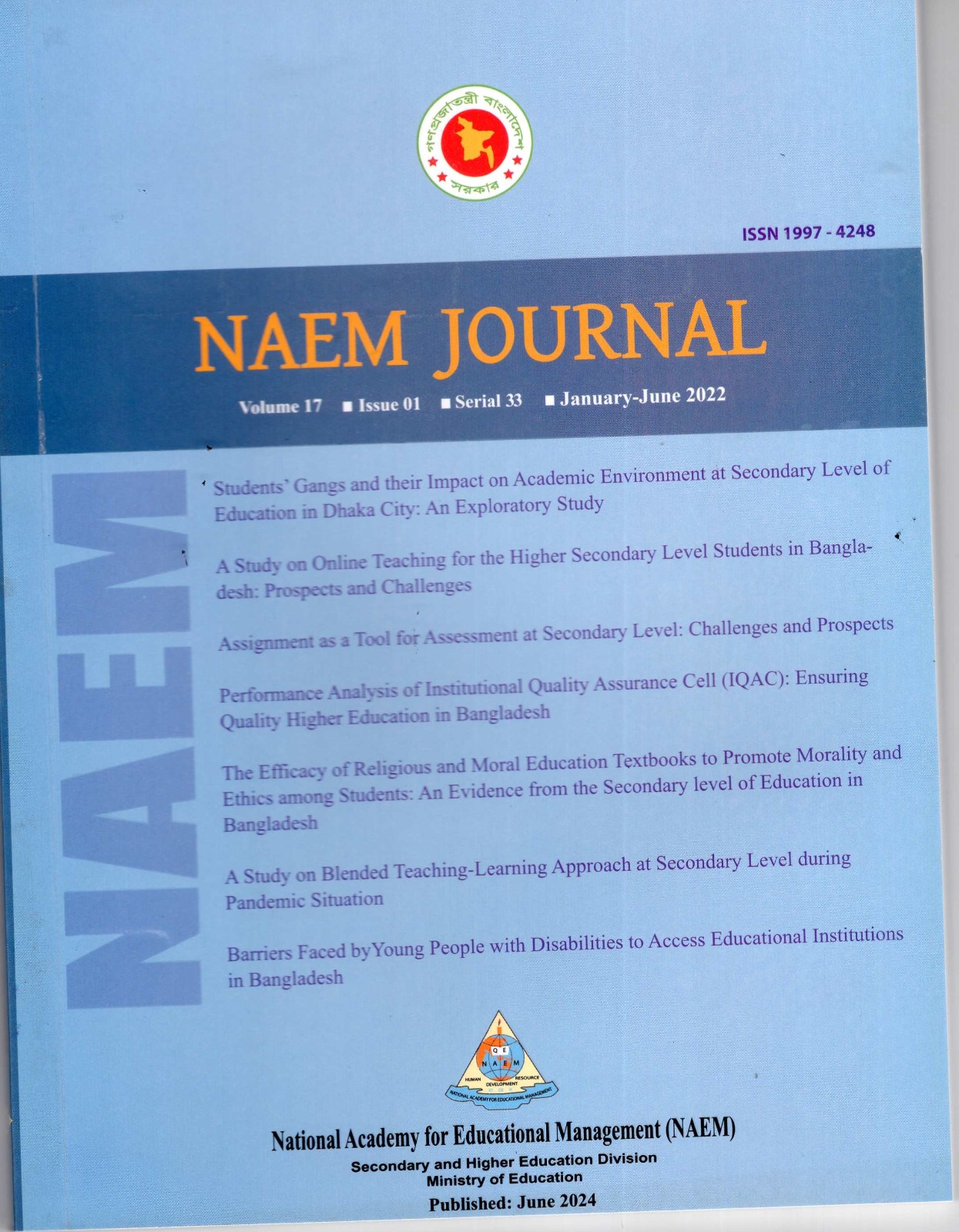
D, Performance Analysis of Institutional Quality Assurance Cell (IQAC): Ensuring Quality Higher Education in Bangladesh
Keywords:
Performance, Quality, IQAC, University, Education, SDGAbstract
In today’s knowledge-based and competitive world, a country like Bangladesh must have access to high-quality higher education if it is to succeed. A project with financial assistance from the World Bank was implemented by the University Grants Commission (UGC), which is responsible for ensuring that all public and private universities establish an Institutional Quality Assurance Cell (IQAC). The primary mission of IQAC is to promote a quality management mindset among university students. The main objective of this research is to examine the current state of higher education in Bangladesh. Using a qualitative research design, this study investigated the current functioning of IQACs in higher education institutions, identified the challenges they face in improving higher education, and explored ways to address these challenges. The findings reveal several significant obstacles to improving educational quality, including a lack of autonomy within programmes and departments because most decisions are centralized, inadequate infrastructure, limited student access to research facilities, and insufficient strategies and activities for continuous improvement. Although government initiatives encourage academics to pursue further studies, new teachers do not receive foundational training. Science graduates also face inadequate access to laboratory facilities, and information technology resources remain insufficient. The study recommends that universities prioritize research and create new opportunities, promote practical instruction over theoretical learning, reduce dependence on conventional note-based learning, and regularly update curricula to reflect changing needs.
References
Ahmed, S. U. (2021, October 22). Assessing dimensions and quality of higher education in Bangladesh. *The Daily Sun*. https://www.daily-sun.com/post/583570/Assessing-Dimensions-and-Quality-of-Higher-Education-in-Bangladesh
Aminuzzaman, S. M. (2011b). *Essentials of social research*. Osder Publications.
Ashraf, M. A., Joarder, M. H. R., Al-Masum, R., & Ibrahim, Y. (2007). Quality management and cost of education at private universities: Case for Bangladesh. In *5th ASEAN Symposium*, Kuala Lumpur, Malaysia.
Camp, W. G. (2001). Formulating and evaluating theoretical frameworks for career and technical education research. *Journal of Vocational Educational Research, 26*(1), 27–39.
Ehsan, M. (2008). *Higher education governance in Bangladesh: The public-private dilemma*. A H Development Publishing House.
Ferdous, J., & Foyjul-Islam, M. (2019). Higher education in Bangladesh: Quality issues and practices. *Public Affairs and Governance, 7*(2), 144–159.
Genilo, J. W. R. (2021). UGC’s responses to the pandemic: Roles of Institutional Quality Assurance Cells in Bangladesh. *Higher Education Evaluation and Development*. https://www.emerald.com/insight/content/doi/10.1108/HEED-05-2021-0038/full/pdf?title=ugcs-responses-to-the-pandemic-roles-of-institutional-quality-assurance-cells-in-bangladesh
Given, L. M. (2008). *The SAGE encyclopedia of qualitative research methods*. SAGE Publications.
Hammarberg, K., Kirkman, M., & Lacey, S. D. (2016). Qualitative research methods: When to use them and how to judge them. *Human Reproduction, 31*(3), 498–501.
Islam, M. R. (2008). Higher education in Bangladesh: Diversity, quality and accessibility. *Science, 29*, 14–50.
Karim, M. (2020, February 6). Improving quality of education: Main challenge. *The Financial Express*. https://thefinancialexpress.com.bd/views/views/improving-quality-of-education-main-challenge-1580309749
Momin, S. M. (2016, August 4). Ensuring quality in higher education. *The Independent*. https://www.theindependentbd.com/post/54276
Monem, M., & Baniamin, H. M. (2010). Higher education in Bangladesh: Status, issues and prospects. *Pakistan Journal of Social Sciences, 30*(2), 293–305.
Mujeri, M. K. (2010). The rights-based approach to education in Bangladesh. *The Bangladesh Development Studies, 33*(1–2), 139–203.
Munira, S. (2021, March 27). Bangladesh in 2071: World class universities, home of quality education. *The Financial Express*. https://thefinancialexpress.com.bd/views/bangladesh-in-2071-world-class-universities-home-of-quality-education-1616838115
Oxford University Press. (2003). *The Oxford compact English dictionary*. Oxford University Press.
Rabbani, G., & Chowdhury, S. (2014). Quality of higher education in Bangladesh: Governance framework and quality issues. *Beykent University Journal of Social Sciences, 7*(1), 78–91.
Sawant, D. G. (2016). Role of IQAC in maintaining quality standards in teaching, learning and evaluation. *Pacific Science Review B: Humanities and Social Sciences, 2*(2), 66–69.
Tasnima, T. (2008). *Determinants of quality in higher education? Bangladesh perspective through private universities* [Master’s dissertation].
University Grants Commission. (2020). *List of private universities*. http://www.ugc-universities.gov.bd/private-universities
Downloads
Published
Issue
Section
License
Copyright (c) 2024 2026 NAEM Journal

This work is licensed under a Creative Commons Attribution-NonCommercial 4.0 International License.
Copyright (c) 2026 NAEM Journal