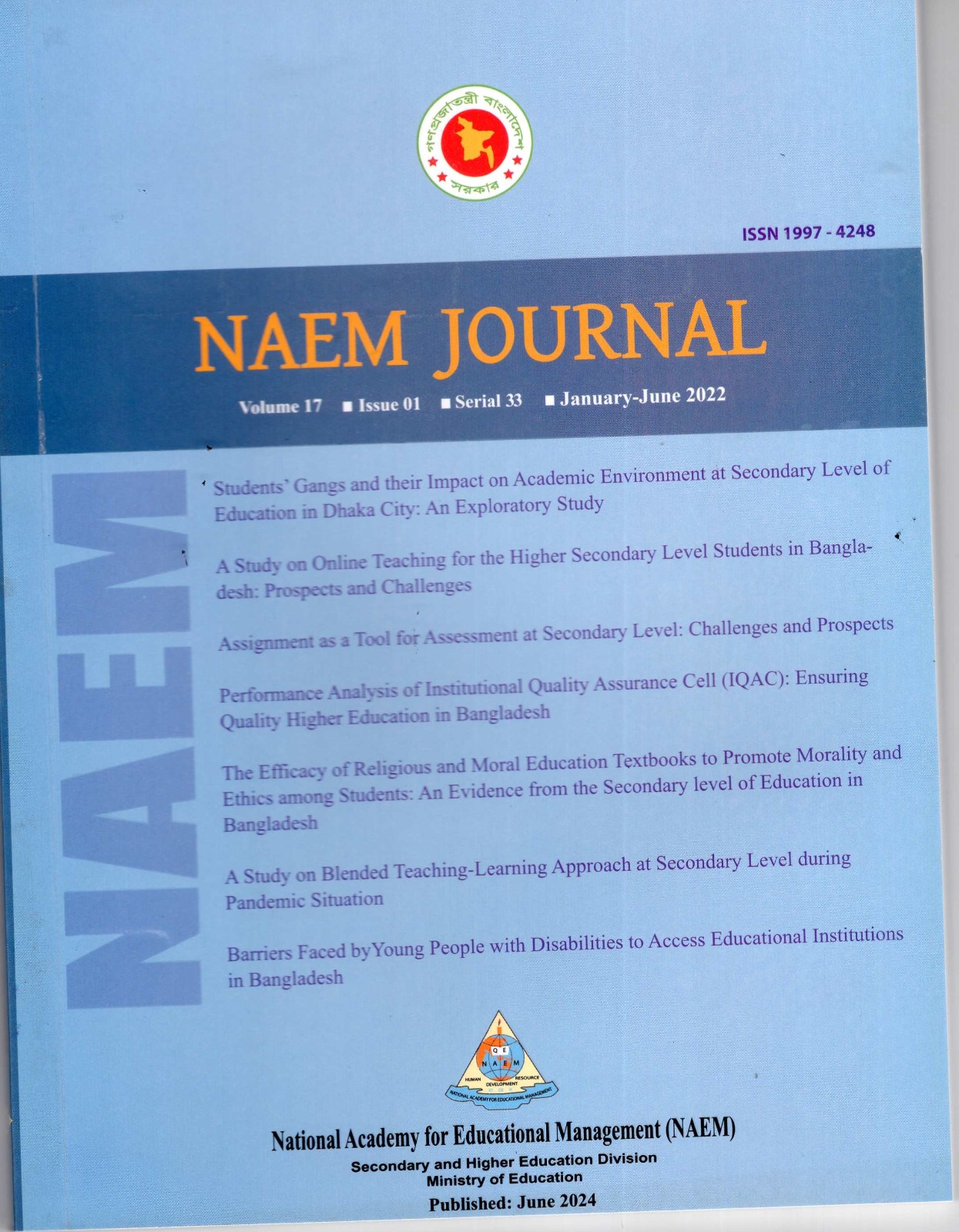
C, Assignment as a Tool for Assessment at Secondary Level: Challenges and Prospects
Keywords:
Assignment, Assessment, Covid-19, Pandemic, ChallengesAbstract
This qualitative study explored teachers’ and students’ understanding of assignments, the usefulness of assignments as a tool for assessment, the challenges faced during their implementation, and ways to continue using assignments for assessment after the COVID-19 pandemic. Purposive and convenience sampling techniques were employed to select five secondary schools in Dhaka Division, including three schools in Dhaka city, one in Keraniganj, Dhaka, and one in Narsingdi district. The selected schools represented government, non-government, co-educational, and private institutions. Data were collected through five focus group discussions (FGDs) involving 50 teachers, discussions with 50 Class Ten students, and semi-structured interviews with five head teachers, one curriculum expert, and one teacher educator, making a total of 107 respondents. The data were analysed thematically and presented descriptively. The findings revealed that teachers and students had a fairly good understanding of assignments and considered them useful during the educational disruption caused by COVID-19. However, major challenges included difficulties understanding assignments, copying from others, having assignments completed by others, and accessing ready-made assignments on the Internet. The study suggests that assignments can continue as an assessment tool under normal circumstances if their number is reduced and schools are given responsibility for selecting topics. It also recommends incorporating varied activities, including project work, presentations, recitation, dramatization, and report writing, to support students’ intellectual development, creativity, and learning.
References
Al Amin, M., & Greenwood, J. (2018). The examination system in Bangladesh and its impact on curriculum, students, teachers and society. https://languagetestingasia.springeropen.com/articles/10.1186/s40468-018-0060-9
Bogdan, R. C., & Biklen, S. K. (2007). *Qualitative research for education: An introduction to theory and methods.* Pearson.
Booth, D. (2012). *Exploring the washback of the TOEIC in South Korea: A sociocultural perspective on student test activity* (PhD thesis). University of Auckland.
Das, S., Shaheen, R., Shrestha, P., Rahman, A., & Khan, R. (2014). Policy versus ground reality: Secondary English language assessment system in Bangladesh. *The Curriculum Journal, 25*(3), 326–343.
Farhana, Z., Tanni, S. A., Shabnam, S., & Chowdhury, S. A. (2020). Secondary education during lockdown situation due to COVID-19 pandemic in Bangladesh: Teachers’ response on online classes. *Journal of Education and Practice, 11*(20), 97–102.
Longman. (2009). *Dictionary of contemporary English.* Pearson Education.
Maison, Kurniawan, D. A., & Anggraini, L. (2020). The influence of online learning on students’ awareness in doing assignments during COVID-19 pandemic. *Ta’dib, 23*(2), 171–178.
Maniruzzaman, M., & Hoque, M. E. (2010). How does washback work on the EFL syllabus and curriculum? A case study at the HSC level in Bangladesh. *Language in India, 10*(12), 49–88.
Ministry of Education, Bangladesh. (2010). *National education policy 2010.* Ministry of Education. https://moedu.gov.bd/site/page/318a22d2-b400-48a7-8222-303ab11cc205/National-Education-Policy-2010-
National Curriculum and Textbook Board (NCTB). (2012). *National curriculum of secondary education.* NCTB. http://www.nctb.gov.bd/
Qi, L. (2005). Stakeholders’ conflicting aims undermine the washback function of a high-stakes test. *Language Testing, 22*(2), 142–173.
Shohamy, E. (2014). *The power of tests: A critical perspective on the uses of language tests.* Routledge.
Spann, P., & Kaufman, D. (2015). *The negative effects of high-stakes testing.* https://www.luc.edu/media/lucedu/law/centers/childlaw/childed/pdfs/2015studentpapers/Spann.pdf
Wall, D., & Alderson, C. (1996). Examination washback: The Sri Lankan impact study. In A. Cumming & R. Berwick (Eds.), *Validation in language testing* (pp. 194–221). Multilingual Matters.
Downloads
Published
Issue
Section
License
Copyright (c) 2024 2026 NAEM Journal

This work is licensed under a Creative Commons Attribution-NonCommercial 4.0 International License.
Copyright (c) 2026 NAEM Journal