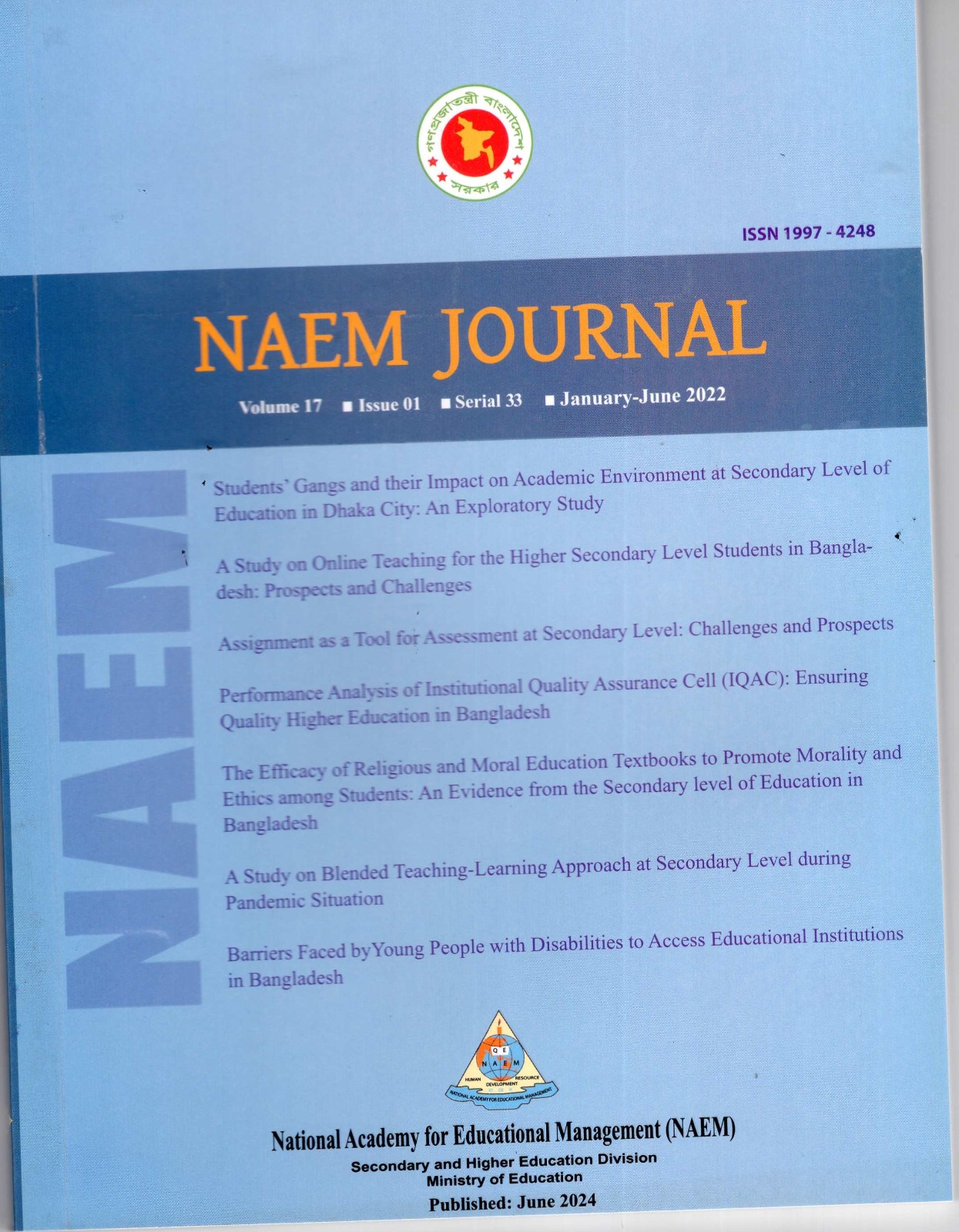
B, A Study on Online Teaching for the Higher Secondary Level Students in Bangladesh: Prospects and Challenges
Keywords:
Bangladesh, Higher Secondary Level, Online Teaching, Problems, Students’ Perception.Abstract
This study examines the possibilities and challenges of online teaching for higher secondary level students in Bangladesh. It investigates the availability of devices for online classes, the financial status of parents, the availability of Internet facilities, and students’ attitudes toward online classes. Data were collected through a survey of Class XI and XII students from six government colleges across three divisions of Bangladesh, involving 350 participants. Data were analysed using percentages. The findings reveal that approximately 80% of students’ parents face financial challenges, resulting in inadequate access to computers, laptops, smartphones, and tablets for online classes. Other challenges include interruptions in electricity supply, limited Internet coverage, high Internet package costs, short package validity, call drops, and slow Internet speeds. The study suggests that making online lectures more engaging, increasing monitoring, improving electricity supply, providing free or improved Internet services, and offering financial assistance to students could make online education more acceptable and a viable alternative to face-to-face learning at the higher secondary level in Bangladesh. The study also recommends introducing student-friendly Internet data packages.
References
Al-Amin, M., Zubayer, A. Al, Deb, B., & Hasan, M. (2021). Status of tertiary level online class in Bangladesh: Students’ response on preparedness, participation and classroom activities. Heliyon, 7(1), e05943. https://doi.org/10.1016/j.heliyon.2021.e05943
Angelino, L., Keels Williams, F., & Natvig, D. (2007). Strategies to engage online students and reduce attrition rates. The Journal of Educators Online, 4(2), 1–14. https://doi.org/10.9743/jeo.2007.2.1
BANBEIS. (2019). Multiple indicator cluster survey-Bangladesh. BANBEIS Press.
Bose, K. (2003). An e-learning experience: A written analysis based on my experience with primary school teachers in an e-learning pilot project. International Review of Research in Open and Distance Learning, 4(2), 1–11.
BRAC. (2020). A rapid assessment impact of COVID-19 on education in Bangladesh.
Coman, C., Tiru, L. G., Meseșan-Schmitz, L., Stanciu, C., & Bularca, M. C. (2020). Online teaching and learning in higher education during the coronavirus pandemic: Students’ perspective. Sustainability, 12(24), 1–22. https://doi.org/10.3390/su122410367
Crawford, J., Butler-Henderson, K., Rudolph, J., Malkawi, B., Glowatz, M., Magni, P. A., & Lam, S. (2020). COVID-19: 20 countries’ higher education intra-period digital pedagogy responses. Journal of Applied Learning & Teaching, 3(1). https://doi.org/10.37074/jalt.2020.3.1.7
Das, T. K. (2021). Online education during COVID-19: Prospects and challenges in Bangladesh. Space and Culture, India, 9(2), 65–70. https://doi.org/10.20896/saci.v9i2.1220
Deli, M., & Allo, G. (2020). Is the online learning good in the midst of COVID-19 pandemic? The case of EFL learners. Jurnal Sinestesia, 10 (May).
Ellis, R. (2009). Task-based language teaching: Sorting out the misunderstandings. International Journal of Applied Linguistics, 19(3), 221–246.
Fedynich, L. V. (2014a). Teaching beyond the classroom walls: The pros and cons of cyber learning. Journal of Instructional Pedagogies, 13, 1–7. http://aabri.comwww.aabri.com/manuscripts/131701.pdf
Fedynich, L. V. (2014b). Teaching beyond the classroom walls: The pros and cons of cyber learning. Journal of Instructional Pedagogies, 13, 1–7.
Islam, S., & Himel, S. H. (2018). Services quality and students’ satisfaction: A study on the public higher education institutions (HEIs) of Bangladesh. Journal of Business Studies, XXXIX(2).
Islam, T. (2006). Current status and prospects for e-learning in the promotion of distance education in Bangladesh. Turkish Online Journal of Distance Education, 2 (January).
Jordan, K., David, R., Phillips, T., & Pellini, A. (2021). Education during the COVID-19 crisis: Opportunities and constraints of using EdTech in low-income countries. Revista de Educación a Distancia, 21(65). https://doi.org/10.6018/RED.453621
Kumar, D. (2010a). Pros and cons of online research. Agri Marketing, 48(4), 55.
Kumar, D. (2010b). Pros and cons of online research. Agri Marketing, 48(4), 55.
Liaw, S., & Huang, H.-mei. (2011). A study of investigating learners’ attitudes toward e-learning. The Fifth International Conference on Distance Learning and Education, 12, 28–32.
Mathrani, A., Sarvesh, T., & Umer, R. (2021). Digital divide framework: Online learning in developing countries during the COVID-19 lockdown. Globalisation, Societies and Education, 0(0), 1–16. https://doi.org/10.1080/14767724.2021.1981253
Nassuora, A. (2013). Students acceptance of mobile learning for higher education in Saudi Arabia. International Journal of Learning Management Systems, 1(1), 1–9. https://doi.org/10.12785/ijlms/010101
Olugbenga, M. (2019). The role of principals in the effective utilization of instructional materials among selected secondary schools in Kaduna State, Nigeria. Scientific Research Journal, VII(IX). https://doi.org/10.31364/scirj/v7.i9.2019.p0919700
Olugbenga, M. (2020). Prospects and challenges of online education in secondary schools in Northern Nigeria. M.Ed. Educational Administration and Planning, Great Panaf Schools, Nigeria.
Oye, N., Salleh, M., & Iahad, N. (2011). Challenges of e-learning in Nigerian university education based on the experience of developed countries. International Journal of Managing Information Technology, 3(2), 39–48. https://doi.org/10.5121/ijmit.2011.3204
Pathan, A. K. (2005). E-learning: Can it help the education in Bangladesh? IIUM Repository. http://irep.iium.edu.my/591/1/EBPAT.pdf
Downloads
Published
Issue
Section
License
Copyright (c) 2024 2026 NAEM Journal

This work is licensed under a Creative Commons Attribution-NonCommercial 4.0 International License.
Copyright (c) 2026 NAEM Journal