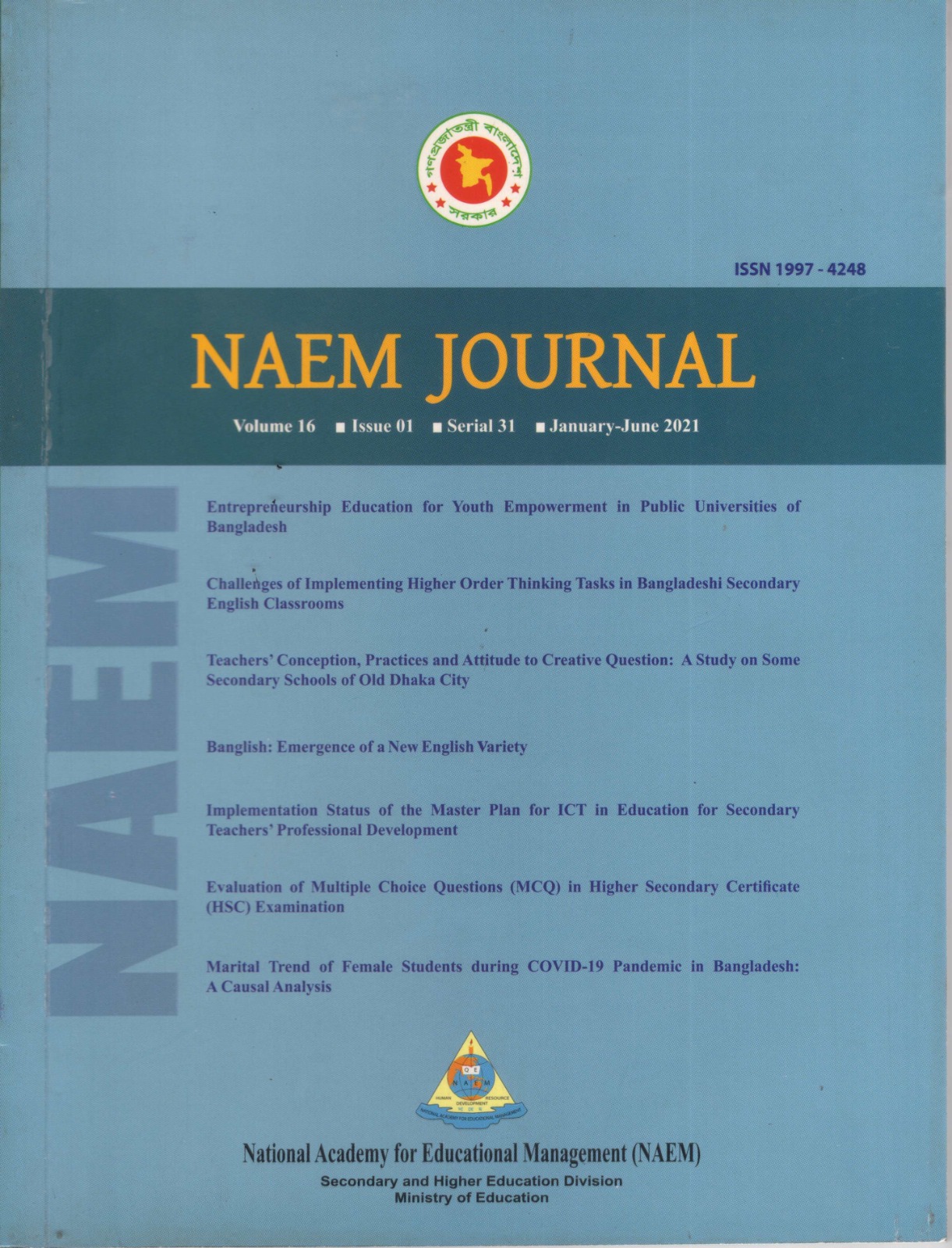
Evaluation of Multiple Choice Questions (MCQ) in Higher Secondary Certificate (HSC) Examination
Keywords:
Multiple Choice Questions, Difficulty Index, Discrimination Index, Functional Distractors, Non-functioning distractors, Focus Group Discussion, Internal Consistency Reliability.Abstract
This study examines the importance of evaluating multiple-choice questions (MCQs) in the Higher Secondary Certificate (HSC) examination. The objective of the study was to thoroughly evaluate MCQs in selected subjects of the HSC examinations. Both qualitative and quantitative approaches were employed, and purposive sampling techniques were used in the study areas. Qualitative data were collected through focus group discussions (FGDs). For the quantitative component, both primary and secondary data were collected. Primary data were gathered through structured questionnaires, while secondary data were obtained from the Dhaka Education Board.
The findings revealed that the questions in each selected subject in 2018 were more difficult than those in 2016, and the percentage of items with three functional distractors was higher in 2018 than in 2016. In contrast, the majority of items demonstrated good discrimination power in 2016, and the number of functional distractors was higher than in 2018. Regarding items with three functional distractors, the percentage was lowest in Civics (Humanities), while the overall percentage of functional distractors was highest in Physics (Science). Internal consistency reliability was good in 2016, whereas the correlation between creative questions (CQs) and MCQs was high in 2018. The cognitive-level analysis based on Bloom’s Taxonomy revealed that experts often disagreed about what the items actually measured. Furthermore, the FGDs revealed that formative assessment was absent in all colleges. Teachers who had received training still lacked sufficient knowledge to construct MCQs, while many teachers had not received any training.
References
Bacon, D. R. (2003). Assessing learning outcomes: A comparison of multiple-choice and short-answer questions in
a marketing context. Journal of Marketing Education, 25, 31-36.
Biggs, J. (1999). Teaching for Quality Learning at University. Buckingham, UK: Society for Research into Higher
Education and Open University Press.
Christian, D. S., Prajapati, A. C., Rana, B. M., & Dave, V. R. (2017). Evaluation of multiple choice questions
using item analysis tool: a study from a medical institute of Ahmedabad, Gujarat. International Journal
Of Community Medicine And Public Health, 4 (6), 1876–1881. https://doi.org/10.18203/2394-6040.
ijcmph20172004
Cizek, G., J., & O’ Day, D. M. (1994). Further investigations of non-functioning options in multiple-choice test
items. Educ Psychol Meas, 54 (4), 861-872.
DiBattista, D., & Kurzawa, L. (2011). Examination of the quality of multiple-choice items on classroom tests.The
Canadian Journal for the Scholarship of Teaching and Learning, 2 (2), 1-23.
Downing, S. M. (2002). Assessment of knowledge with written test forms. Ininternational Handbook of Research
in Medical Education, 2, 647-672. Kluwer Academic Publishers
Ebel, R. L, & Frisbie, D. A. (1991). Essentials of Educational Measurement (5th Ed). Englewood Cliffs, N. J.,
Prentice Hall.
Farley, J. K. (1989). The multiple-choice test: Writing the questions. Nursing Education, 14 (6), 10-12.
Gajjar, S., Sharma, R., Kumar, P., & Rana, M. (2014). Item and test analysis to identify quality multiple choice
question (MCQs) from an assessment of medical student Ahmedabad, Gujrat.Indian Journal of Community
Medicine, 39, 17-20.
Golam M., (2015). A study on educational assessment of secondary and higher secondary teachers of Bangladesh.
World Scientific News. http://www.worldscientificnews.com/
Haladyna, T. M., & Downing, S. M. (1989).Validity of taxonomy of multiple-choice item-writing rules. Applied
Measurement in Education, 2 (1), 51-78.
Haladyna, T. M., & Downing, S. M. (1993). How many options is enough for a multiple-choice test item?
EducPsycholMeas, 53 (4), 999-1010.
Haladyna, T. M., Downing, S. M., & Rodriguez, M. C. (2002). A review of multiple-choice item-writing guidelines
for classroom assessment. Applied Measurement in Education, 15, 309-344.
Hingorjo, M. R., & Jaleel, F. (2012). Analysis of one-best MCQs: The difficulty index, discrimination index and
distractor efficiency. J Pak Med Assoc 62, 142-7.
Holbrook, J. and BEDU. (2012). Report on the Impact of Revised SSC Examination Question Under 8 BISE,
December 2012 year
Holbrook, J. and BEDU. (2012). Report on the Impact Study of 2017 SSC Examination Questions Under 3
Examination Boards, March 2018.
Hafiz, L., R., Md. Mehedi, (2019). Investigating the effects of Bangladesh and Global Studies (BGS) assessment
of Secondary School Certificate (SSC) examination on students learning. British Journal of Education,
7 (2). https://eric.ed.gov/?
Masters, J. C., Hulsmeyer, B. S., Pike, M. E., Leichty, K., Miller, M. T., & Verst, A. L. (2001). Assessment of
multiple-choice questions in selected test banks accompanying text books used in nursing education.
Journal of Nursing Education, 40, 25-32.
McCoubrie, P. (2004). Improving the fairness of multiple-choice questions: a literature review. Med Teach, 26 (8),
709-712.
Mukherjee, P. & Lahiri, S. K. (2015). Analysis of multiple choice questions (MCQs): Item and test statistics from
an assessment in medical college of Kolkata, West Bengal. IOSR Journal of Dental and Medical Sciences,
14 (12), 47-52.
Schuwirth, L. W. T., & van der Vleuten, C. P. M. (2003). Different written assessment methods: what can be said
about their strengths and weaknesses? Med Educ, 38 (9), 974-979.
Tarrant, M., Knierim, A., Hayes, S. K., & Ware, J. (2006). The frequency of item writing flaws in multiple-choice
questions used in high stakes nursing assessments. Nurse Education Today, doi:10.1016/j.nedt.
2006.07.006.
Tarrant, M., & Ware, J. (2008). Impact of item-writing flaws in multiple-choice questions on student achievement
in high-stakes nursing assessments.Medical Education, 42, 198-206.
Tarrant, M., Ware, J., & Mohammed, A. M. (2009). An assessment of functioning and non-functioning distractors
in multiple-choice questions: A descriptive analysis. BMC British Medical Education, 9, 40.http://dx.doi.
org/10.1186/1472-6920-9-40
Walsh, C. M., & Seldomridge, L. A. (2006). Critical thinking: Back to square two. Nursing Education, 45, 212-219.
Ware, J., & Vik, T. (2009). Quality assurance of item writing: During the introduction of multiple choice
questions in medicine for high stakes examinations. Medical Teacher, 31, 238-243. http://dx.doi.
org/10.1080/01421590802155597
Downloads
Published
Issue
Section
License
Copyright (c) 2023 2026 NAEM Journal

This work is licensed under a Creative Commons Attribution-NonCommercial 4.0 International License.
Copyright (c) 2026 NAEM Journal