
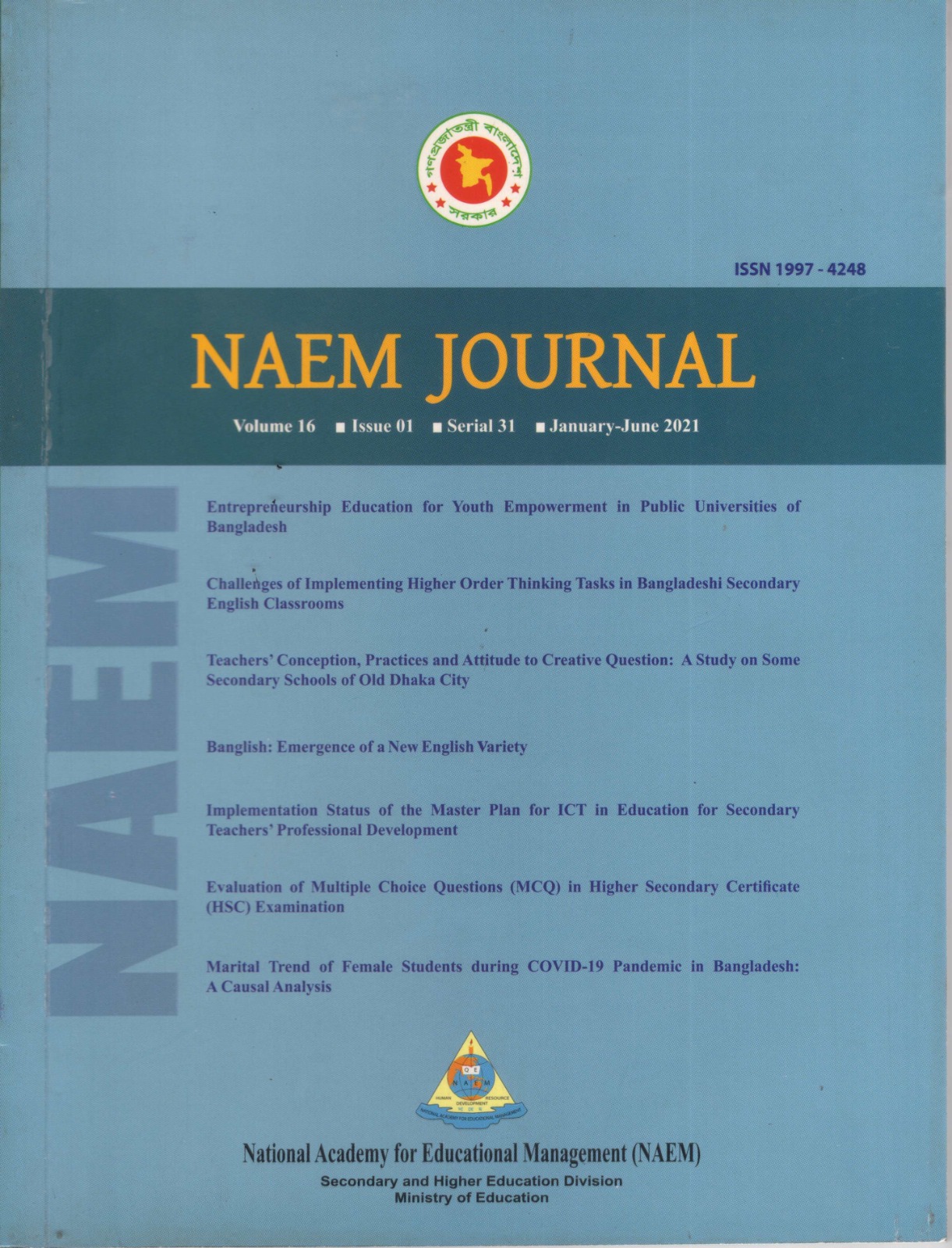
Implementation Status of the Master Plan for ICT in Education for Secondary Teachers’ Professional Development
Keywords:
Teacher Training, ICT in Education, Master Plan for ICT in Education, Online Course, E-Learning, Distance EducationAbstract
The Master Plan for ICT in Education is one of the key policy documents of the Government of Bangladesh (GoB) for integrating ICT into education in Bangladesh. The objective of this study was to analyse the status of teacher development in Bangladesh in comparison with the Master Plan for ICT in Education. A qualitative research approach was followed throughout the study. Forty respondents from three categories—planning and development, implementation, and beneficiaries—were consulted during data collection through interviews and focus group discussions (FGDs), following a purposive sampling technique. Both the interview and FGD guidelines focused on the planned activities regarding teacher development mentioned in the Master Plan for ICT in Education and were grouped into eight different themes.
It was found that ICT has been integrated into the teacher training curriculum mostly as a facilitation tool. However, the lack of Technological Pedagogical and Content Knowledge (TPACK) and the skills of both trainers and teachers is one of the key challenges to effective implementation. On the other hand, more than 1,000 master trainers have been developed, though this number seems insufficient to train all secondary teachers within the planned time. Moreover, several online courses have been introduced, although the lack of links between the courses, their benefits, and recognition were identified as key challenges. Since laptop purchase facilities on a monthly instalment basis have been introduced for teachers, most of them are unaware of these facilities.
Based on the findings, training on TPACK needs to be introduced for trainers and teachers. Online courses should be developed through proper needs analysis. Furthermore, online courses for teachers should be developed in partnership with academic institutions and training providers. The benefits of online courses should be communicated to teachers to motivate them to participate. Finally, campaigns, promotional activities, and official notices could be arranged to make teachers aware of online courses, their benefits, and available loan facilities.
References
Afshari, M., Bakar, K. A., Su Luan, W., Samah, B. A., & Fooi, F. S. (2009). Factors affecting teachers’ use of
information and communication technology. International Journal of Instruction. 2 (1), 77-104.
Bangladesh Sangbad Sangstha [BSS] (February 28, 2014). Teachers develop 6,000 digital contents for
multimedia classrooms. http://www1.bssnews.net/newsDetails.php?cat=0&id=303845$date=2013-01
03&dateCurrent=2013-01-13
Blurton, C (1999). New directions of ICT-use in Education. http://www.unesco.org/education/educprog/lwf/dl/
edict.pdf
Kozma, R. B. (2005). National policies that connect ICT-based education reform to economic and social
development. An interdisciplinary journal of humans in ICT environment. 1 (2), 117-156.
Kulik, J. A. (1994). Meta-analytic studies of findings on computer-based instruction. In Baker & O’Neil (Ed.).
Technology Assessment in Education and Training. Hillsdale, NJ: Lawrence Erlbaum.
Lowenthal, P., & Muth, R. (2008). Constructivism. In E. F. Provenzo, Jr. (Ed.), Encyclopaedia of The Social and
Cultural Foundations of Education. Thousand Oaks, CA: Sage.
Mamun, A. & Tapan, S. M. (2009). Using ICT in teaching-learning at the polytechnic institutes of Bangladesh:
Constraints and limitations. Teacher’s World-Journal of Education and Research. 33-34, 207-217.
Mikre, F. (2011). The roles of information communication technologies in education: Review article with emphasis
to the computer and internet. Ethiopian Journal of Education and Science. 6 (2). http://www.ajol.info/
index.php/ejesc/article/viewFile/73521/62437
Morgan, T. (1996). Using technology to enhance learning: changing the chunks. Learning and Leading with
Technology. 23 (5), 49–51.
OECD. (2002). ICT: Policy challenges for education. Planning Meeting, Agenda and Issue Paper. https://www.
oecd.org/
Olson, J. (2000). Trojan horse or teacher’s pet? Computer and the culture of the school. Journal of Curriculum
Studies. 32 (1), 1-8.
Patil, S. V. (2012). The Role of ICT in Educational Sector. Lokavishkar International E-Journal. 1 (4), 91. http://
www.liirj.org/liirj/oct-nov-dec2012/09.pdf
Pelgrum, W. J. (2001). Obstacles to the Integration of ICT in Education: Results from a Worldwide Educational
Assessment. Computers & Education. 37, 163-178.
Prime Minister’s Office (2013). Access to Information (a2i) Programme. Dhaka, Bangladesh. http://a2i.pmo.gov.
bd/content/multimedia-class-room
Prime Minister’s Office (2014). ICT in Education. http://www.a2i.gov.bd/sites/default/files/ICT%20in%20
Education_09_Janu_14.pdf
The Daily Ittefaq (2013). Jhinaigatite multimedia classroom kormoshuchi bayrtho words & thoughts:
Multimedia classrooms programme has been failed in Jhinaigati. http://www.ittefaq.com.bd/index.
php?ref=MjBfMTJfMzFfMTNfMV8yNV8xXzk3NTQ5
The Daily Sun. (2017). Use of multimedia in classroom: Successes and challenges. http://www.daily-sun.com/
printversion/details/209947/Use-of-multimedia-in-classroom:-Successes-and-challenges
The Daily Jugantor (September 16, 2013). 2016 Shaler modhye shob skule multimedia classroom words & thoughts:
Multimedia classrooms in all schools by 2016. http://www.jugantor.com/it-technology/2013/09/16/28610
Tinio, V. L. (2002). ICT in Education: UN Development Programme. http:www.eprmers.org
UNDP. (2004). Promoting ICT for human development. A Pioneering Regional Human Development Report
in Asia in 2004: Realizing the Millennium Development Goals. http://www.apdip.net/projects/rhdr/
resources/PDF
Volman, M. (2005). Variety of roles for a new type of teacher. Educational technology and the teacher profession.
Teacher and Teacher Education, 21, 15-31.
Voogt, J. (2003). Consequences of ICT for aims, contents, processes, and environments of learning. In Van den
Akker, W. Kuiper & U. Hameyer (Eds.), Curriculum landscapes and trends. 217 – 236. Dordrecht:
Kluwer Academic Publishers.
Watson, D. M. (2001). Pedagogy before technology: Re-thinking the relationship between ICT and Teaching.
Education and Information Technologies, 6 (4), 251-266. just arrange it
Downloads
Published
Issue
Section
License
Copyright (c) 2023 2026 NAEM Journal

This work is licensed under a Creative Commons Attribution-NonCommercial 4.0 International License.
Copyright (c) 2026 NAEM Journal