
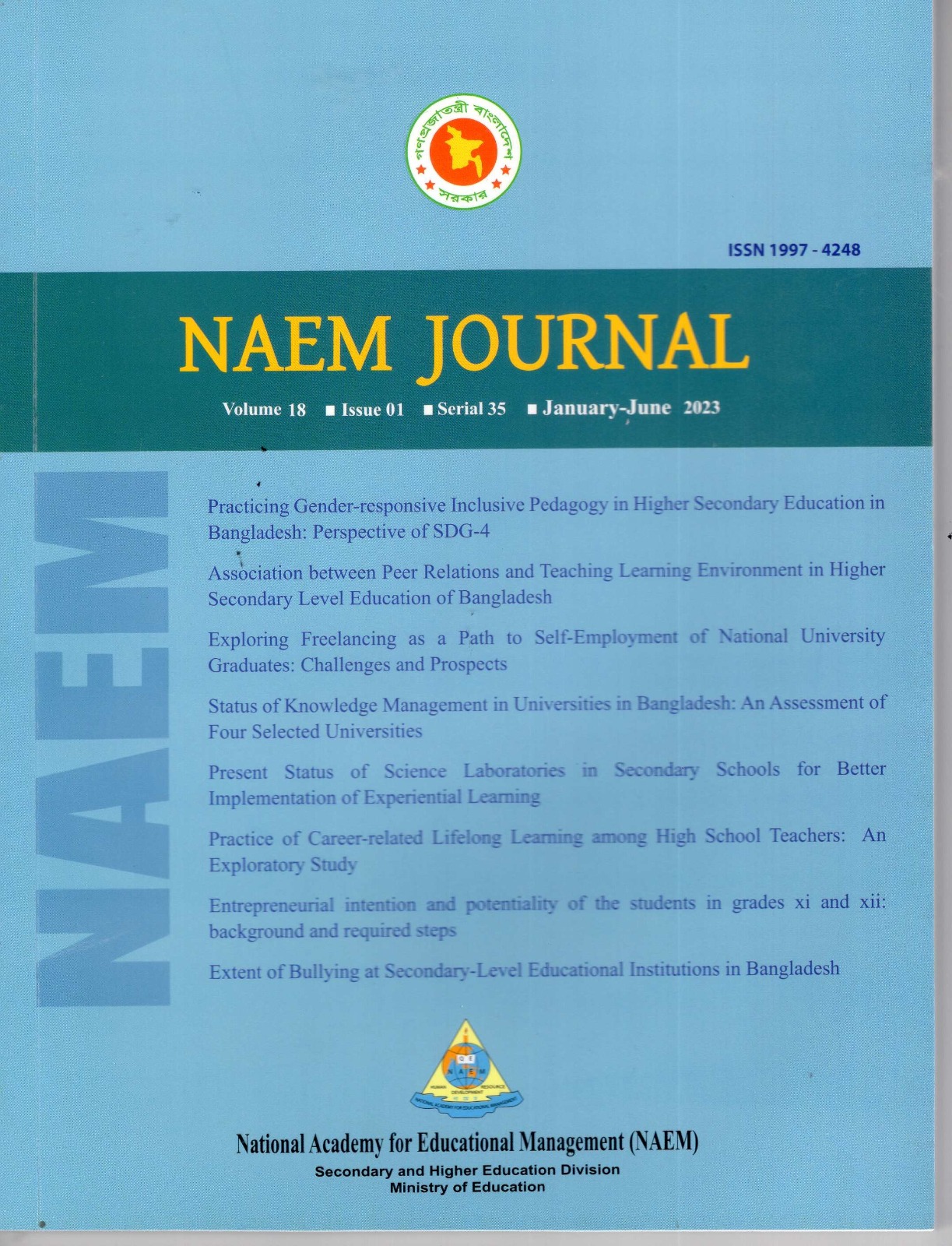
H, Extent of Bullying at Secondary-Level Educational Institutions in Bangladesh
Keywords:
Bullying Causes of Bullying Consequences of Bullying Health Hazards Academic PerformanceAbstract
Bullying at schools is considered the most contemptible anti-social behavior for students. In recent days, after COVID-19, the prevalence of this offense has been observed as very common among students at the secondary level. The present study aims to investigate the prevalence of bullying experienced by Bangladeshi school students and understand the relative consequences. The study follows a mixed research approach and collected both primary and secondary data. Some pseudo-case studies, semi-structured interviews, key informant interviews (KIIs), and surveys were conducted. Implementing the Social Cognitive Theory (1986), Social Order Theory (1912), and Iacovou et al. Model (1995) as the theoretical lens and bullying literature as a supportive theoretical background, a preliminary research model was formed.
Utilizing a semi-structured interview schedule, pseudo-case studies were conducted with eight purposively and conveniently selected bullying-victim students at secondary-level schools in Bangladesh. Based on the content analysis of case findings and KIIs, a structured questionnaire was formed for the survey. The survey was carried out among 320 students in classes nine and ten at secondary schools located in eight administrative divisions of Bangladesh. Using a stratified sampling technique, two schools were selected from each division, from which 20 students were chosen. Convenience and snowball sampling techniques were used to identify the sample respondents. Survey data were analyzed using SPSS 20.0 and SmartPLS 3.3.3 software.
The study reveals that about 67% of secondary school students were victims of bullying over the previous year. Verbal bullying dominates, including name-calling and teasing. Cyberbullying ranks second, while physical bullying, such as pushing or shoving, ranks third. Psychological bullying and sexual harassment were also observed to some extent. Boys, students in public schools, and students attending urban schools experienced significantly higher bullying victimization. Bullies’ jealousy, revenge-seeking, aggressive attitudes, power exercise, and victims’ deviance acted as contributing factors to bullying. The aftermath of bullying was observed in health hazards and weak academic performance among victims. The findings of this study would be helpful for policymakers and other stakeholders in reforming anti-bullying policies.
References
1. Abdulsalam, A. J., Al Daihani, A. E., & Francis, K. (2017). Prevalence and associated factors of peer victimization (bullying) among grades 7 and 8 middle school students in Kuwait. International Journal of Pediatrics.
2. Akter, S., & Khatun, F. (2020). Bullying behaviour and mental health of secondary school students. Bangladesh Psychological Studies, 30, 56–64.
3. Al-Raqqad, H. K., Al-Bourini, E. S., Talahin, F. M., & Aranki, R. M. E. (2017). The impact of school bullying on students’ academic achievement from teachers’ point of view. International Education Studies, 10(6), 44–50.
4. Athanasiades, C., & Kouimtzi, M. (2010). The experience of bullying among secondary school children. Psychology in the Schools, 47(4), 328–341.
5. Bandura, A. (1973). Aggression: A Social Learning Analysis. Prentice Hall.
6. Baron, R. A. (1977). Human Aggression. Plenum.
7. Boulton, M. J., & Underwood, K. (1992). Bully/victim problems among middle school children. British Journal of Educational Psychology, 62(1), 73–87.
8. Carbone-Lopez, K., Esbensen, F.-A., & Brick, B. T. (2010). Correlates and consequences of peer victimization: Gender differences in direct and indirect forms of bullying. Youth Violence and Juvenile Justice, 8(4), 332–350.
9. Chin, W. W. (1998). The partial least squares approach to structural equation modeling. In G. A. Marcoulides (Ed.), Modern Methods for Business Research (pp. 295–336).
10. Chin, W. W. (2010). How to write up and report PLS analyses. In V. Esposito Vinzi, W. W. Chin, J. Henseler, & H. Wang (Eds.), Handbook of Partial Least Squares: Concepts, Methods and Applications. Springer.
11. Chin, W. W., & Newsted, P. R. (1999). Structural equation modeling analysis with small samples using partial least squares. In R. H. Hoyle (Ed.), Statistical Strategies for Small Sample Research (pp. 307–341). SAGE Publications.
12. Creswell, J. W. (2009). Research Design: Qualitative, Quantitative, and Mixed Methods Approaches (3rd ed.). SAGE Publications.
13. Creswell, J. W. (2007). Mixed methods research. In L. M. Given (Ed.), The SAGE Encyclopedia of Qualitative Research Methods (Vol. 1, pp. 526–529). SAGE Publications.
14. Creswell, J. W. (2009). Research Design: Qualitative, Quantitative, and Mixed Methods Approaches (3rd ed.). SAGE Publications.
15. Davies, P. (2016). What is psychological bullying? Retrieved June 6, 2021, from https://www.pearldavies.com/post/2016-1-22-what-is-psychological-bullying
16. Dawkins, J. (1995). Bullying in schools: Doctors’ responsibilities. BMJ, 310, 274–275.
17. Dombeck, M. (2015). The long-term effects of bullying. Mental Help. https://www.mentalhelp.net/articles/the-long-term-effects-of-bullying/
18. Dulmus, C. N., Theriot, M. T., Sowers, K. M., & Blackburn, J. A. (2004). Student reports of peer bullying victimization in a rural school. Stress, Trauma, and Crisis, 8, 1–15.
19. Espelage, D. L., & Swearer, S. M. (2003). Research on school bullying and victimization: What have we learned and where do we go from here? School Psychology Review, 32(3), 365–383.
20. Gordon, S. (2019). Do girls and boys bully differently? Verywell Family. Retrieved from https://www.verywellfamily.com/
21. Guba, E. G., Lincoln, Y. S., & Denzin, N. K. (1994). Handbook of qualitative research. SAGE Publications.
22. Hair, J. F., Risher, J. J., Sarstedt, M., & Ringle, C. M. (2019). When to use and how to report the results of PLS-SEM. European Business Review, 31(1), 2–24.
23. Harbin, S. M., Kelley, M. L., Piscitello, J., & Walker, S. J. (2019). Multidimensional bullying victimization scale: Development and validation. Journal of School Violence, 18(1), 145–161.
24. Henseler, J., Ringle, C. M., & Sinkovics, R. R. (2009). The use of partial least squares path modelling in international marketing. Advances in International Marketing, 20, 277–319.
25. Kumpulainen, K., Räsänen, E., & Puura, K. (2001). Psychiatric disorders and the use of mental health services among children involved in bullying. Aggressive Behavior, 27(2), 102–110.
26. Livesey, G. E., McAleavy, G. J., Donegan, H. A., Duffy, J., O’Hagan, C., Adamson, G., & White, R. (2017). The nature and extent of bullying.
27. Lai, S.-L., Ye, R., & Chang, K.-P. (2008). Bullying in middle schools: An Asian-Pacific regional study. Asia Pacific Education Review, 9, 503–515.
28. Machimbarrena, J. M., & Garaigordobil, M. (2017). Bullying/cyberbullying in 5th and 6th grade: Differences between public and private schools. Anales de Psicología, 33(2), 319–326.
29. Neto, A. A. L. (2005). Bullying: Comportamento agressivo entre estudantes. Jornal de Pediatria, 81(5).
30. Oliveira, F. R., de Menezes, T. A., Irffi, G., & Oliveira, G. R. (2018). Bullying effect on students’ performance. Economia, 19(1), 57–73.
31. Ouellet-Morin, I., Odgers, C. L., Danese, A., Bowes, L., Shakoor, S., Papadopoulos, A. S., Moffitt, T. E., Arseneault, L., & colleagues. (2011). Blunted cortisol responses to stress signal social and behavioral problems among maltreated/bullied 12-year-old children. Biological Psychiatry, 70(11), 1016–1023.
32. Preacher, K. J., & Hayes, A. F. (2008). Asymptotic and resampling strategies for assessing and comparing indirect effects in multiple mediator models. Behavior Research Methods, 40(3), 879–891.
33. Rashid, H. U. (2018). Anti-bullying policy dearth ‘fails’ schools. The Independent. Retrieved from http://www.theindependentbd.com/
34. Saini, V., & Balda, S. (2019). Bullying, victimization and fighting in secondary school: Gender-based differences. International Journal of Current Microbiology and Applied Sciences, 8(5), 1465–1474.
35. UNICEF. (2018). 35% of school students experience bullying in Bangladesh. bdnews24.com. https://bdnews24.com/education/2018/09/06/35-of-school-students-experience-bullying-in-bangladesh-unicef
36. Yin, R. K. (2014). Case Study Research: Design and Methods (5th ed.). SAGE Publications.
Downloads
Published
Issue
Section
License
Copyright (c) 2024 2026 NAEM Journal

This work is licensed under a Creative Commons Attribution-NonCommercial 4.0 International License.
Copyright (c) 2026 NAEM Journal