
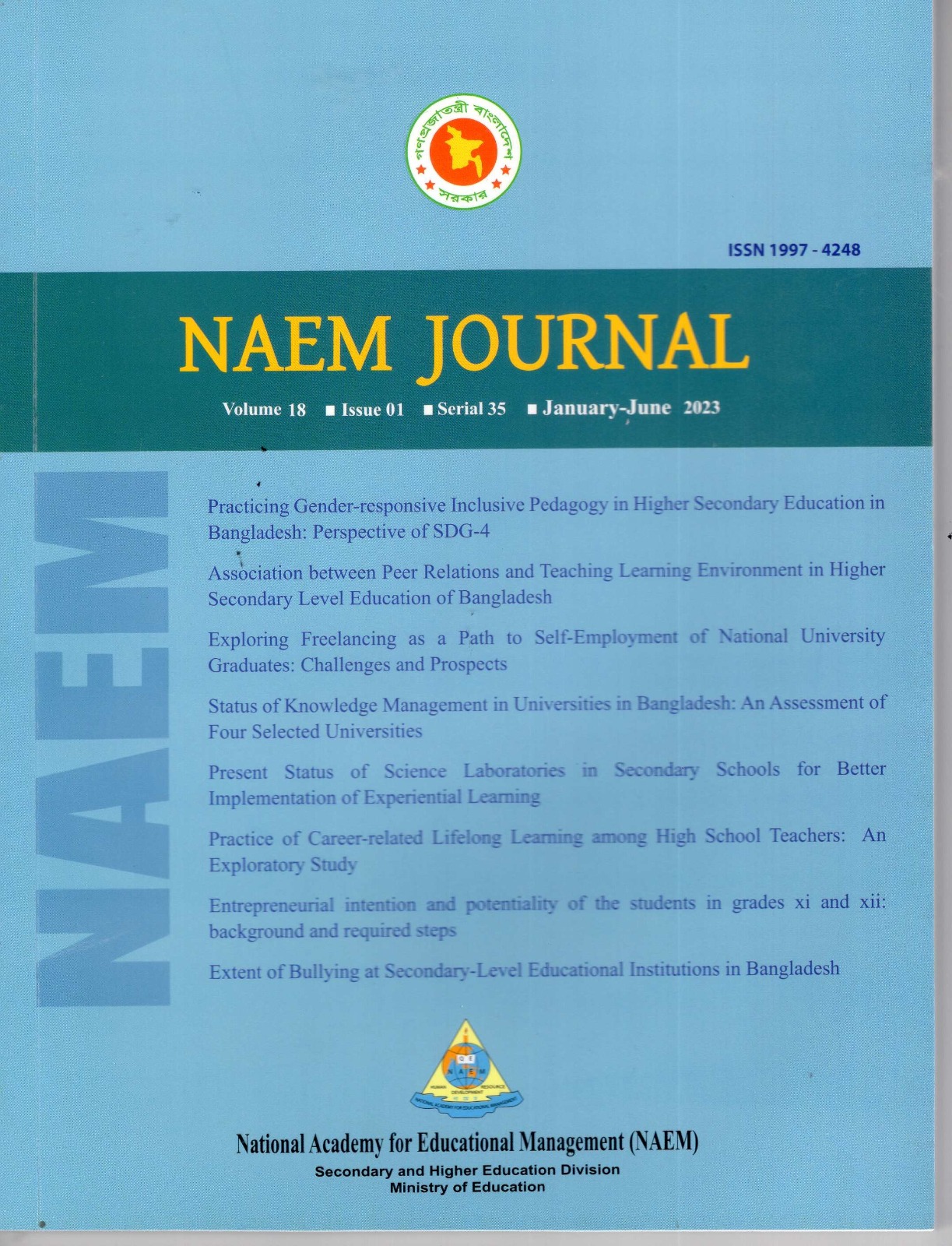
F, Practice of Career-related Lifelong Learning among High School Teachers: An Exploratory Study
Keywords:
Career-related Lifelong Learning High School Teachers Professional Development BangladeshAbstract
By career-related lifelong learning, it refers to continuous learning from any sources aimed at enhancing professional competency. This research focuses on career-related lifelong learning among high school teachers in Bangladesh, examining the extent of these activities, influencing factors, and challenges. Following a mixed-method strategy, data were collected from eight high schools and analyzed using a conceptual framework.
Findings indicate a significant lack of engagement in learning activities, influenced by factors such as age, working experience, and societal attitudes towards learning. Older teachers and those with extensive experience perceive reduced learning needs, affecting their motivation, perseverance, curiosity, and regulation of learning. Work pressure and institutional restrictions in professional learning activities hinder teachers’ intentions for continuous learning, particularly influencing non-compulsory activities. Access and participation in learning activities are more limited in rural districts compared to urban areas. The inadequate presence of lifelong learning initiatives in the policy framework has a long-term impact on creating a learning culture among teachers.
To overcome these challenges and foster continuing learning activities, the study suggests systematic training sessions, required incentives, and institutional heads’ role in supporting teachers’ professional development. It also recommends establishing mentoring programs for personalized support. Ensuring equitable access to technology and addressing barriers like internet access and workload are crucial for enhancing educational outcomes. Overall, this research provides valuable insights into existing issues of learning activities and ways of promoting lifelong learning among high school teachers in Bangladesh, aiming to improve teacher professional development, student achievements, and the overall education system.
References
1. Abdin, Md. J. (2020). Lifelong learning in the age of Fourth IR. The Independent. https://m.theindependentbd.com/printversion/details/237172
2. Ahmed, M. (2014). Lifelong learning in a learning society: Are community learning centres the vehicle? In Education, Learning, Training: Critical Issues for Development (Vol. 8). Brill Nijhoff.
3. Bangladesh Planning Commission. (2020). Eighth Five Year Plan (July 2020–June 2025). https://plancomm.gov.bd/
4. Beairsto, B., Ruohotie, P., Beairsto, J. B., & Klein, M. (2003). Empowering Professionals as Lifelong Learners.
5. Chivers, G. (2006). The training of university lifelong learning professionals as researchers. Journal of European Industrial Training, 30(5), 330–348. https://doi.org/10.1108/03090590610677908
6. Coşkun, Y. D., & Demirel, M. (2012). Üniversite öğrencilerinin yaşam boyu öğrenme eğilimleri [Lifelong learning tendencies of university students].
7. Creswell, J. W., & Creswell, J. D. (2018). Research Design: Qualitative, Quantitative, and Mixed Methods Approaches (5th ed.). SAGE Publications.
8. Crick, R. D., Broadfoot, P., & Claxton, G. (2004). Developing an effective lifelong learning inventory: The ELLI Project. Assessment in Education: Principles, Policy & Practice, 11(3), 247–272.
9. Drewery, D. W., Sproule, R., & Pretti, T. J. (2020). Lifelong learning mindset and career success: Evidence from the field of accounting and finance. Higher Education, Skills and Work-Based Learning, 10(3), 456–470.
10. Elfert, M. (2019). Lifelong learning in Sustainable Development Goal 4: What does it mean for UNESCO’s rights-based approach to adult learning and education? International Review of Education, 65(4), 537–556.
11. Felstead, A., Fuller, A., Unwin, L., Ashton, D., Butler, P., & Lee, T. (2005). Better Learning, Better Performance: Evidence from the 2004 Learning at Work Survey. National Institute of Adult Continuing Education.
12. Flick, U. (2000). Triangulation in Qualitative Research. SAGE Publications.
13. Gorges, J., & Kandler, C. (2012). Adults’ learning motivation: Expectancy of success, value, and the role of affective memories. Learning and Individual Differences, 22(5), 610–617. https://doi.org/10.1016/j.lindif.2011.09.016
14. Jackson, S. (2003). Lifelong earning: Working-class women and lifelong learning. Gender and Education, 15(3), 365–379.
15. Jarvis, P. (2007). Globalization, Lifelong Learning and the Learning Society: Sociological Perspectives. Routledge.
16. Kind, T., & Evans, Y. (2015). Social media for lifelong learning. International Review of Psychiatry, 27(2), 124–132.
17. Kolenc Kolnik, K. (2010). Lifelong learning and the professional development of geography teachers: A view from Slovenia. Journal of Geography in Higher Education, 34(1), 53–68.
18. Lavrijsen, J., & Nicaise, I. (2017). Systemic obstacles to lifelong learning: The influence of the educational system design on learning attitudes. Studies in Continuing Education, 39(2), 176–192.
19. London, M. (2011). Lifelong learning: Introduction. In The Oxford Handbook of Lifelong Learning. Oxford University Press.
20. London, M., & Smither, J. W. (1999). Career-related continuous learning: Defining the construct and mapping the process. In Research in Human Resources Management (Vol. 17, pp. 81–121). Elsevier Science/JAI Press.
21. Medel-Añonuevo, C., Ohsako, T., & Mauch, W. (2001). Revisiting Lifelong Learning for the 21st Century. UNESCO Institute for Education.
22. OECD. (2019). Education at a Glance 2019: OECD Indicators. OECD Publishing. https://doi.org/10.1787/f8d7880d-en
23. Öz, E., & Şen, H. (2021). The effect of self-regulated learning on students’ lifelong learning and critical thinking tendencies. Elektronik Sosyal Bilimler Dergisi, 20(78).
24. Öz, E. (2022). The impact of gender differences on lifelong learning tendencies in Turkey: A meta-analysis. SAGE Open, 12(2). https://doi.org/10.1177/21582440221099528
25. Riddel, S., Wilson, A., & Baron, S. (2001). Gender, social capital and lifelong learning for people with learning difficulties. International Studies in Sociology of Education, 11(1), 3–24.
26. Rogers, A. (2006). Lifelong learning and the absence of gender. International Journal of Educational Development, 26(2), 158–167.
27. Sahin, M., Akbasli, S., & Yelken, T. Y. (2010). Key competencies for lifelong learning: The case of prospective teachers.
28. Sammons, P. (2010). SAGE Handbook of Mixed Methods in Social and Behavioral Research. SAGE Publications.
29. Sarker, D. R. (2014). Adult Education for Women in Bangladesh: Problems and Prospects. A H Development Publishing House.
30. United Nations. (2016). Goal 4: Quality education. https://sdgs.un.org/goals/goal4
31. UNESCO Institute for Lifelong Learning. (2019). UNESCO Institute for Lifelong Learning: Promoting Lifelong Learning for All. https://unesdoc.unesco.org/ark:/48223/pf0000368557
32. Uslu, N. C. (2016). Attending lifelong learning activities.
33. Webb, S., Holford, J., Hodge, S., Milana, M., & Waller, R. (2017). Conceptualising lifelong learning for sustainable development and Education 2030. International Journal of Lifelong Education, 36(3), 315–330.
34. World Economic Forum. (2018). The Fourth Industrial Revolution could smash gender inequality—or deepen it. https://www.weforum.org/agenda/2018/03/the-fourth-industrial-revolution-could-smash-gender-inequality-or-reinforce-it/
Downloads
Published
Issue
Section
License
Copyright (c) 2024 2026 NAEM Journal

This work is licensed under a Creative Commons Attribution-NonCommercial 4.0 International License.
Copyright (c) 2026 NAEM Journal