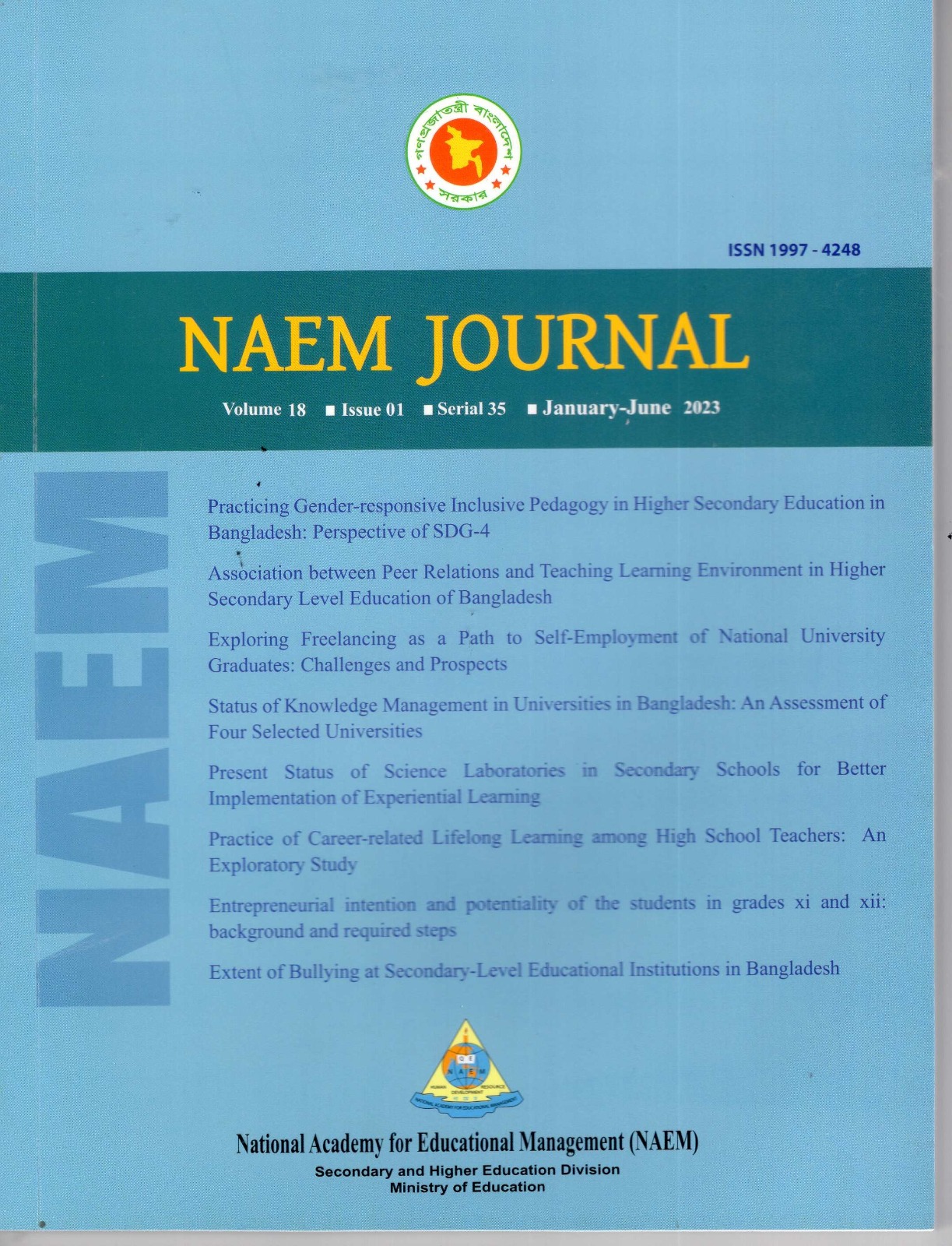
E, Present Status of Science Laboratories in Secondary Schools for Better Implementation of Experiential Learning
Keywords:
Science Laboratory, Secondary Schools, Experiential Learning, Apparatus, Chemicals.Abstract
This study investigated the existing status of science laboratories in secondary schools in Bangladesh, explored teachers’ and students’ attitudes towards laboratory use, identified challenges to keeping laboratories functional, and suggested ways to improve the implementation of experiential learning introduced in Grades 6 and 7 in 2023.
The study adopted a qualitative research approach, using observations, semi-structured interviews, and focus group discussions (FGDs). Data were collected from six headteachers of six secondary schools, 60 Grade 10 students participating in six FGDs, and science teachers from the selected schools. The collected data were transcribed, coded, categorized, and analysed according to the research objectives.
The findings revealed that the overall condition of science laboratories was unsatisfactory. Laboratories lacked adequate apparatus, chemicals, furniture, and space. Despite these limitations, teachers and students generally expressed positive attitudes towards practical activities and acknowledged their importance for effective science learning. Major challenges included shortages of science teachers, theory-focused textbooks, inadequate training in conducting practical classes, the absence of practical classes in school routines, and insufficient monitoring and supervision.
The study recommends modernizing science laboratories with adequate apparatus and chemicals, appointing laboratory managers with science backgrounds, providing training for teachers, filling vacant science-teacher positions, and strengthening monitoring and supervision. These measures are essential to ensure regular laboratory-based learning and improve the implementation of experiential learning in secondary schools.
References
1. Abrahams, I., & Reiss, M. J. (2012). Practical work: Its effectiveness in primary and secondary schools in England. Journal of Research in Science Teaching.
2. Babu, S. (2016). Teaching science in Bangladesh: Expectations versus reality. Journal of Education and Learning, 10(3), 275–288.
3. BANBEIS. (2015). Present situation of science education in secondary schools. Dhaka, Bangladesh.
4. Bayineni, V. K. (2020). What is experiential learning of science? https://www.prayoga.org.in/post/what-is-experiential-learning-of-science
5. Choudhury, S. K. (2009). Problems and prospects of science education in Bangladesh. AIP Conference Proceedings. https://doi.org/10.1063/1.3262614
6. Cullin, M., Hailu, G., Kupilik, M., & Petersen, T. (2017). The effect of an open-ended design experience on student achievement in an engineering laboratory course. International Journal of Engineering Pedagogy, 7(4), 102–119.
7. Duban, N., Aydoğdu, B., & Yüksel, A. (2019). Classroom teachers’ opinions on science laboratory practices. Universal Journal of Educational Research, 7(3), 662–670.
8. Gunstone, R. F. (1991). Reconstructing theory from practical experience. In B. E. Woolnough (Ed.), Practical Science (pp. 67–77). Open University Press.
9. Hancer, A. H., Şensoy, Ö., & Yıldırım, H. İ. (2006). An evaluation of the importance of contemporary science education at elementary schools and how this kind of science teaching must be. Pamukkale University Journal of Education, 19, 1–18.
10. Hossain, S., & Islam, H. (2021, October 21). School laboratories under the microscope. The Daily Star. https://www.thedailystar.net/shout/cover-story/news/school-laboratories-under-the-microscope-2197731
11. Hossen, M. L. (2020). Biggan Shiksha Keno Proyojon [Why science education is needed]. Dainik Shiksha, June 2, 2020.
12. Jahan, I., Azim, F. J., & Ahmed, S. S. (2011). Biology teaching-learning practices in secondary schools in Bangladesh. NAEM Journal, 7(2), 107–119.
13. Kabir, M. H. (2017, April). Declining of science students in Bangladesh. The Daily Observer. https://observerbd.com/details.php?id=70774
14. Kamba, A. H., Libata, I. A., & Usman, A. (2019). Lack of availability of science teaching facilities on students teaching and learning science in some selected secondary schools in Kebbi State. Journal of Advances in Education and Philosophy.
15. Kolb, D. A. (1984). Experiential Learning: Experience as the Source of Learning and Development. Prentice-Hall.
16. Millar, R., & Driver, R. (1987). Beyond process. Studies in Science Education, 14, 33–62.
17. National Curriculum and Textbook Board (NCTB). (1990). National Curriculum. Dhaka: Ministry of Education, Bangladesh.
18. National Curriculum and Textbook Board (NCTB). (2012). Secondary Curriculum. Dhaka: Ministry of Education, Bangladesh.
19. National Curriculum and Textbook Board (NCTB). (2020). Curriculum Framework. Dhaka: Ministry of Education, Bangladesh.
20. Nyanda, F. (2011). Effects of teaching science subjects in absence of science laboratory: A case study of Community Secondary School Morogoro Municipal. ResearchGate.
21. Osborne, J. (1998). Science education without a laboratory? In J. Wellington (Ed.), Practical Work in School: Which Way Now? (pp. 156–173). Routledge.
22. Teaching and Learning Research Programme (TLRP). (2006). Science Education in Schools: Issues, Evidence, and Proposals. Institute of Education, University of London. http://www.tlrp.org/pub/documents/TLRP_Science_Commentary_FINAL.pdf
23. Tobin, K. G. (1990). Research on science laboratory activities: In pursuit of better questions and answers to improve learning. School Science and Mathematics, 90, 403–418. https://doi.org/10.1111/j.1949-8594.1990.tb17229.x
24. Woodley, E. (2009). Practical work in school science—Why is it important? School Science Review, 91(335).
25. Zengele, A. G., & Alemayehu, B. (2016). The status of secondary school science laboratory activities for quality education in Wolaita Zone, Southern Ethiopia. Journal of Education and Practice, 7(31).
Downloads
Published
Issue
Section
License
Copyright (c) 2024 2026 NAEM Journal

This work is licensed under a Creative Commons Attribution-NonCommercial 4.0 International License.
Copyright (c) 2026 NAEM Journal