
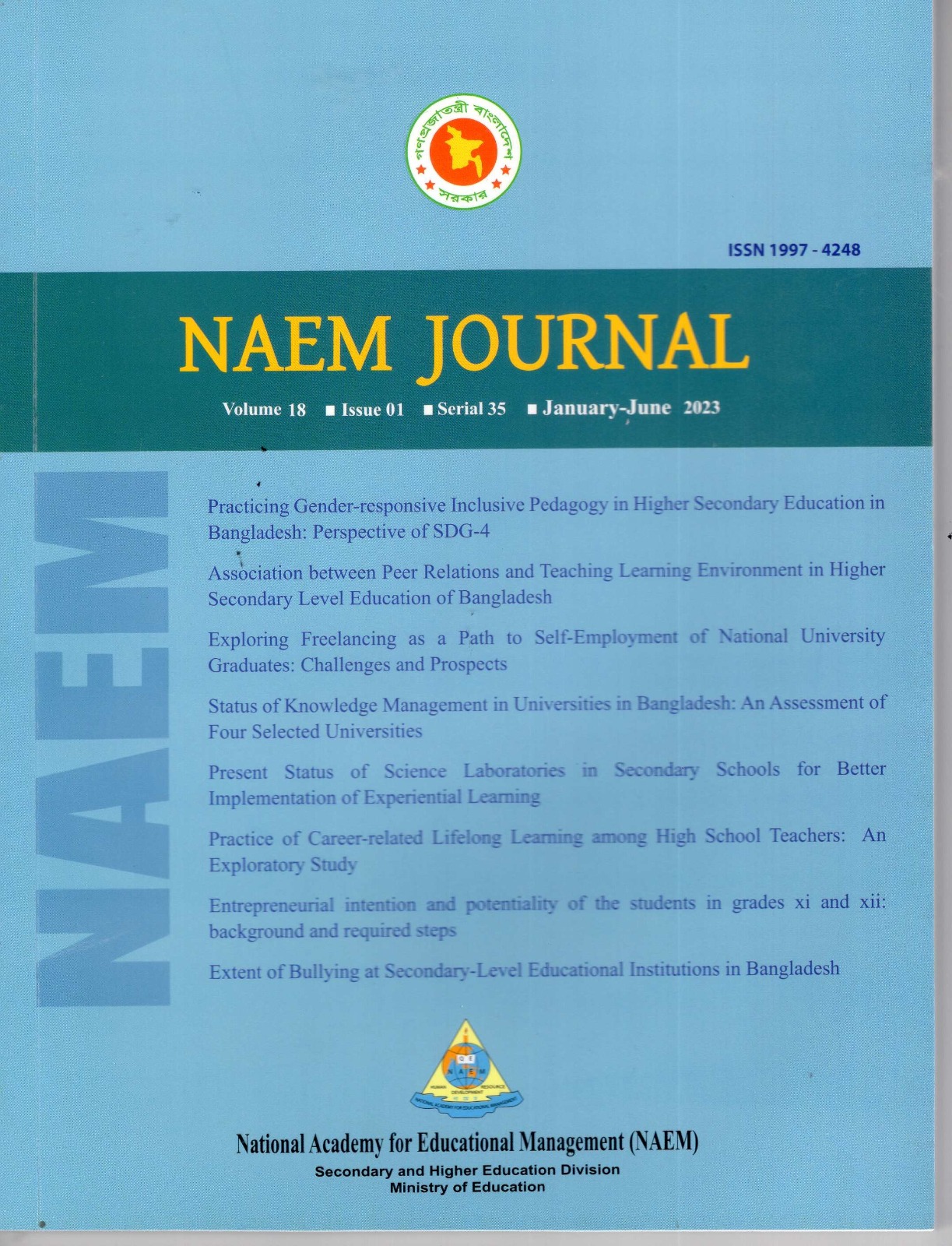
D, Status of Knowledge Management in Universities in Bangladesh: An Assessment of Four Selected Universities
Keywords:
Knowledge Management, Higher Education, Public University, Private University, Bangladesh, Human Capital, Structural Capital, Educational Development.Abstract
This study explores the current state of knowledge management in universities in Bangladesh, focusing on its challenges and potential solutions for improving the higher education system. A mixed-method approach was employed, combining questionnaire surveys, key informant interviews, and focus group discussions across four selected universities: Daffodil International University, Bangladesh Army International University of Science and Technology (BAIUST), Jahangirnagar University, and Comilla University. The study examines structural and governance capital, including curriculum design, physical facilities, teaching-learning practices, student performance assessment, and student support services, alongside human capital factors such as recruitment, training and development, career development, and research facilities.
The findings indicate that private universities generally received more favourable assessments than public universities in several areas, particularly curriculum development, physical facilities, teaching-learning practices, recruitment, and career development. However, both public and private universities face challenges related to research facilities, institutional support, training opportunities, and the effective implementation of knowledge management practices. The study recommends adopting digital technologies and learning management systems, improving research infrastructure, strengthening faculty and staff development, modernising curricula and assessment methods, and fostering collaboration with businesses and community organisations. It concludes that effective knowledge management is essential for improving academic quality, strengthening human capital, and advancing Bangladesh towards a knowledge-based society.
References
1. Agarwal, N. K., & Marouf, L. N. (2014). Initiating knowledge management in colleges and universities: A template. International Journal of Knowledge Content Development & Technology, 4(2), 5–18.
2. Ahammad, T. (2018, April 4). Overview on knowledge management. The Independent. https://m.theindependentbd.com/printversion/details/144359
3. Ali, M. M., Rattanawiboonsom, V., & Hassan, F. (2018). Knowledge management at higher educational institutes in Bangladesh: The case study of self-assessed processes of two educational institutions. International Journal of Trade & Commerce-IIARTC, 7(2), 514–535.
4. Andaleeb, S. S. (2021, February 1). The future contours of education in Bangladesh. The Daily Star. https://www.thedailystar.net/supplements/30th-anniversary-supplements/aspirations-the-next-50-years/news/the-future-contours-education-bangladesh-2047569
5. Andaleeb, S. S. (2011). Building knowledge enterprises and learning communities. In S. S. Andaleeb, H. R. Khan, & M. Ahmed (Eds.), Education and National Development (pp. 47–90). The University Press Limited.
6. Barbery, D. C., & Torres, C. L. (2019). The importance of leadership, corporate climate, use of resources, and strategic planning in family business. In Handbook of Research on Entrepreneurial Leadership and Competitive Strategy in Family Business (pp. 212–230). IGI Global.
7. Bontis, N. (2001). Assessing knowledge assets: A review of the models used to measure intellectual capital. International Journal of Management Reviews, 3(1), 41–60.
8. Hoq, K. M. G., & Akter, R. (2012). Knowledge management in universities: Role of knowledge workers. Bangladesh Journal of Library and Information Science, 2(1), 2–12.
9. Jennex, M. (2005). What is knowledge management? International Journal of Knowledge Management, 1(4), i–i.
10. Maxwell, J. A., & Loomis, D. M. (2003). Mixed method design: An alternative approach. In A. Tashakkori & C. Teddlie (Eds.), Handbook of Mixed Methods in Social and Behavioral Research (pp. 241–271). SAGE.
11. McAdam, R. (2000). Knowledge management as a catalyst for innovation within organizations: A qualitative study. Wiley Periodicals Inc., 233.
12. Newell, S., Robertson, M., Scarbrough, H., & Swan, J. (2002). Managing Knowledge Work. Palgrave.
13. Olssen, M., & Peters, M. A. (2005). Neoliberalism, higher education and the knowledge economy: From the free market to knowledge capitalism. Journal of Education Policy, 20(3), 313–345.
14. Starmind. (2020, June 19). What is knowledge management and why is it so important? https://www.starmind.ai/resources/what-is-knowledge-management-and-why-is-it-so-important
15. Tracey, W. R. (Ed.). (2004). The Human Resources Glossary. CRC Press.
Downloads
Published
Issue
Section
License
Copyright (c) 2024 2026 NAEM Journal

This work is licensed under a Creative Commons Attribution-NonCommercial 4.0 International License.
Copyright (c) 2026 NAEM Journal