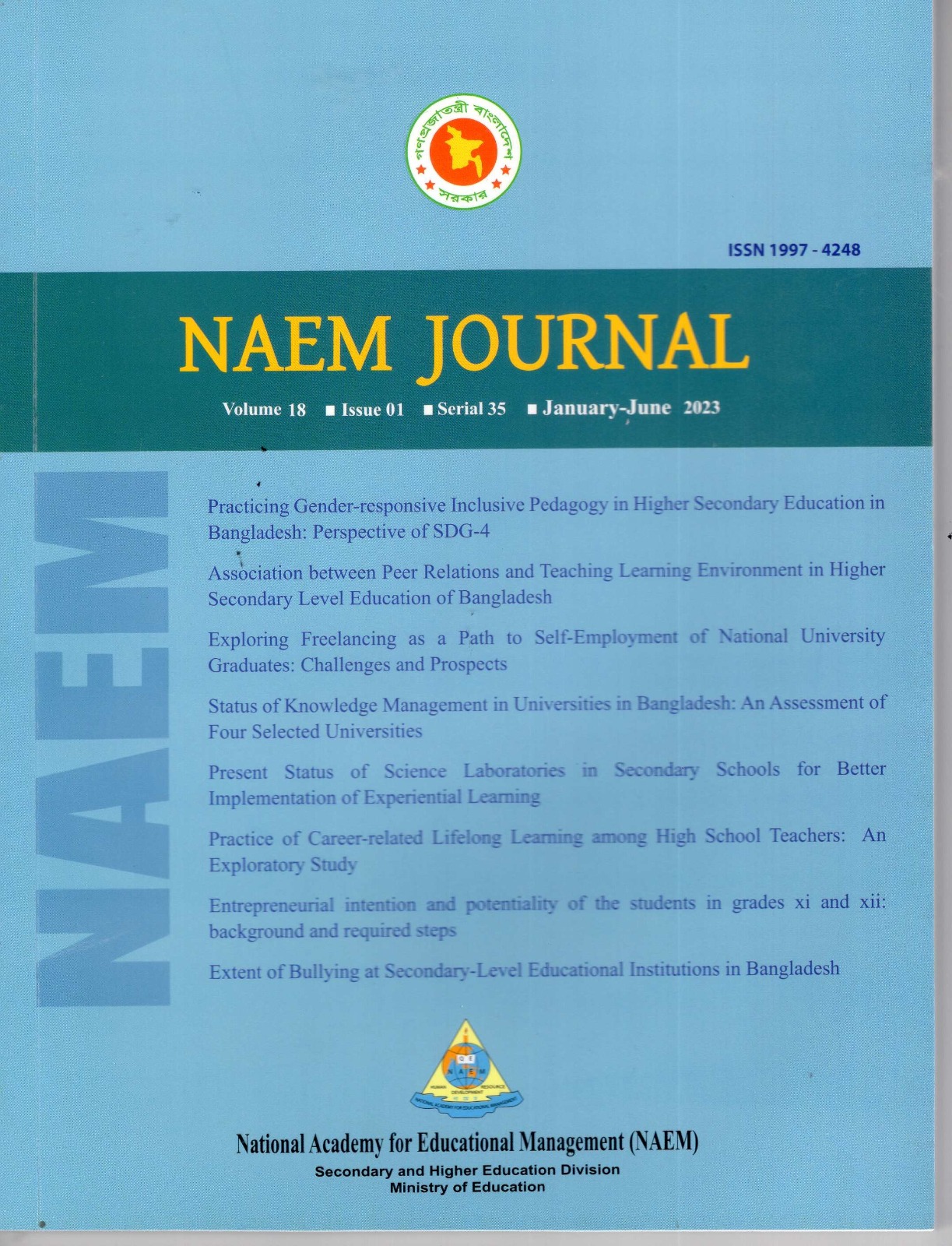
B, Association between Peer Relations and Teaching Learning Environment in Higher Secondary Level Education of Bangladesh
Keywords:
Peer relations Teaching-learning environment Learning capability Higher-secondary levelAbstract
The present study is based on peer relations among higher-secondary-level (college) students, which are considered an important means of improving the teaching-learning environment and students’ learning capability in Bangladesh. To measure peer relations and their impact, the study followed attachment theory and used the measurement dimensions of intimacy, popularity, trust, and insightfulness. The main objective was to assess students’ awareness of the concept and importance of peer relations and examine their association with the learning environment and students’ learning capability.
The study covered 526 randomly selected respondents from 16 colleges across four districts of Bangladesh. Data were collected using a well-structured questionnaire. The findings indicate an important association between peer relations and the teaching-learning environment, although peer relations are not formally practiced in most institutions. The study also found that family and social support are insufficient to ensure the best possible outcomes through peer relations. It concludes with recommendations for relevant stakeholders and policymakers to create a supportive environment, strengthen peer relations, improve the teaching-learning environment, and develop students’ learning capabilities. Despite its limitations, the study contributes to the literature on peer relations and highlights their potential to support more effective and enjoyable learning.
References
1. Acedo-Carmona, C., & Gomila, A. (2019). Personal trust extends cooperation beyond trustees: A Mexican study. International Journal of Psychology, 54, 687–704.
2. Akter, S. (2021). Factors affecting academic self-efficacy and its impact on perceived academic burnout among students in Bangladesh. International Journal of Management, Entrepreneurship, Social Science and Humanities, 4(1), 17–31.
3. Aydoğdu, F. (2022). Developing a peer relationship scale for adolescents: A validity and reliability study. Current Issues in Personality Psychology, 10(2), 164–176.
4. Aziz, Z., & Hossain, M. A. (2010). A comparison of cooperative learning and conventional teaching on students’ achievement in secondary mathematics. Procedia - Social and Behavioral Sciences, 9, 53–62.
5. Babu, G., Suresh, P., & Pariventhan, K. (2017). Enhancement of learning through collaborative learning techniques. New Man Journal of Multidisciplinary Studies, 4(1), 27–38.
6. Beiswenger, K. L., & Grolnick, W. S. (2010). Interpersonal and intrapersonal factors associated with autonomous motivation in adolescents’ after-school activities. The Journal of Early Adolescence, 30, 369–394.
7. Biswas, D. (2015). Impact of classroom interaction on English language learning and teaching in secondary level of Bangladesh [Doctoral dissertation, BRAC University].
8. Blatchford, P., & Baines, E. (2006). A follow-up national survey of break times in primary and secondary schools. Report to Nuffield Foundation.
9. Blatchford, P., & Baines, E. (2010). Peer relations in school. In International Handbook of Psychology in Education (pp. 227–274).
10. Bosworth, K., & Hamilton, S. J. (1994). Collaborative learning: Underlying processes and effective techniques. New Directions for Teaching and Learning. San Francisco: Jossey-Bass.
11. Brislin, R. W. (1980). Translation and content analysis of oral and written materials. Methodology, 389–444.
12. Campbell, D. T., & Fiske, D. W. (1959). Convergent and discriminant validation by the multitrait-multimethod matrix. Psychological Bulletin, 56(2), 81.
13. Ciani, K. D., Middleton, M. J., Summers, J. J., & Sheldon, K. M. (2010). Buffering against performance classroom goal structures: The importance of autonomy support and classroom community. Contemporary Educational Psychology, 35, 88–99.
14. Cillessen, A. H., & Marks, P. E. (2011). Conceptualizing and measuring popularity: Popularity in the peer system (pp. 25–56).
15. Cillessen, A. H., & Rose, A. J. (2005). Understanding popularity in the peer system. Current Directions in Psychological Science, 14(2), 102–105.
16. Cochran, W. (1963). Sampling Techniques. New York: John Wiley & Sons.
17. Coffey, A., & Atkinson, P. (1996). Making Sense of Qualitative Data: Complementary Research Strategies. Sage Publications.
18. Evlat, A., & Avcioglu, H. (2022). Teachers’ opinions on peer relations between students with special needs in primary education. International Online Journal of Primary Education, 11(2), 447–460.
19. Fredricks, J. A., Blumenfeld, P. C., & Paris, A. H. (2004). School engagement: Potential of the concept, state of the evidence. Review of Educational Research, 74, 59–109.
20. Hair, J. F., Anderson, R. E., Tatham, R. L., & Black, W. C. (1995). Multivariate Data Analysis with Readings. New York, NY: Prentice Hall.
21. Hawley, P. H., Little, T. D., & Pasupathi, M. (2002). Winning friends and influencing peers: Strategies of peer influence in late childhood. International Journal of Behavioral Development, 26, 466–474.
22. Hoferichter, F., Kulakow, S., & Raufelder, D. (2022). How teacher and classmate support relate to students’ stress and academic achievement. Educational Psychology.
23. Hossain, A., & Tarmizi, R. A. (2013). Effects of cooperative learning on students’ achievement and attitudes in secondary mathematics. Procedia - Social and Behavioral Sciences, 93, 473–477.
24. Hossain, S. (2013). A study of determining the relationship between academic achievement and problem behavior of urban secondary school students in Bangladesh. The International Journal of Social Science, 8(1), 1–10.
25. Hossain, S. (2016). An exploration of the factors that contribute to students’ school satisfaction in Bangladesh [Doctoral dissertation, UNSW Sydney].
26. Islam, M. K., Sarker, M. F. H., & Islam, M. S. (2022). Promoting student-centered blended learning in higher education: A model. E-Learning and Digital Media, 19(1), 36–54.
27. LaFontana, K. M., & Cillessen, A. H. (2010). Developmental changes in the priority of perceived status in childhood and adolescence. Social Development, 19(1), 130–147.
28. Lu, F. (2020). A research on the peer relationship of primary and middle school students and its impact on self-learning pressure and motivation. In Proceedings of the 2020 3rd International Conference on Humanities Education and Social Sciences (ICHESS 2020) (pp. 796–800). Atlantis Press.
29. Ma, L., Luo, H., & Xiao, L. (2021). Perceived teacher support, self-concept, enjoyment, and achievement in reading: A multilevel mediation model based on PISA 2018. Learning and Individual Differences, 85, 101947.
30. Malti, T., Averdijk, M., Zuffianò, A., Ribeaud, D., Betts, L. R., Rotenberg, K. J., et al. (2016). Children’s trust and the development of prosocial behavior. International Journal of Behavioral Development, 40(3), 262–270.
31. Martin, A. J., & Dowson, M. (2009). Interpersonal relationships, motivation, engagement, and achievement: Yields for theory, current issues, and educational practice. Review of Educational Research, 79, 327–365.
32. Mehar, R., & Kaur, P. (2017). Effect of collaborative learning strategy on achievement in economics and self-esteem. International Journal of Research in Economics and Social Sciences, 7(12).
33. Mim, S. A., & Chowdhury, M. A. (2018). Mobile communication as a platform for learning science from peers: Possibilities in Bangladesh. Journal of Research in Science, Mathematics and Technology Education, 1(3), 267–282.
34. Mugenda, A. (2003). Research Methods: Quantitative and Qualitative Approaches. Nairobi, Kenya.
35. Murugan, G. S., & Annadurai, R. (2021). Family and peer relationship among high school students. Ilkogretim Online, 20(4), 3544–3554.
36. Neale, D. C., Carroll, J. M., & Rosson, M. B. (2004). Evaluating computer-supported cooperative work: Models and frameworks. In Proceedings of the 2004 ACM Conference on Computer Supported Cooperative Work (pp. 112–121). Chicago, Illinois, USA.
37. Parr, J. M. (2002). Environments, processes, and mechanisms in peer learning. International Journal of Educational Research, 37, 403–423.
38. Ragelienė, T. (2016). Links of adolescents’ identity development and relationship with peers: A systematic literature review. Journal of the Canadian Academy of Child and Adolescent Psychiatry, 25, 97–105.
39. Rubie-Davies, C. M., Stephens, J. M., & Watson, P. (Eds.). (2015). Routledge International Handbook of Social Psychology of the Classroom. Routledge.
40. Tarrant, M. (2002). Adolescent peer groups and social identity. Social Development, 11, 110–123.
41. Tomé, G., de Matos, M. G., Camacho, I., Simões, C., & Diniz, J. A. (2014). Friendships quality and classmates support: How to influence the well-being of adolescents. Higher Education of Social Science, 7(2), 148–160. https://doi.org/10.3968/5656
42. Tu, J. C., & Chu, K. H. (2020). Analyzing the relevance of peer relationship, learning motivation, and learning effectiveness—Design students as an example. Sustainability, 12(10), 4061.
43. Wang, G., & Hu, W. (2021). Peer relationships and college students’ cooperative tendencies: Roles of interpersonal trust and social value orientation. Frontiers in Psychology, 12, 656412.
44. Wang, P., & Chen, L. (2011). The influence of punishment and social value orientation on interpersonal trust and cooperative behavior in public goods dilemmas. Acta Psychologica Sinica, 43, 52–64.
45. Wentzel, K. R., Muenks, K., McNeish, D., & Russell, S. (2017). Peer and teacher support to motivation and effort: A multilevel study. Contemporary Educational Psychology, 49, 32–45.
46. Yıldırım, S. (2012). Teacher support, motivation, learning strategy use, and achievement: A multilevel mediation model. The Journal of Experimental Education, 80, 150–172.
47. Zavarone, E., & Vitali, A. (2011). Information, advice, friendship, notes and trust network: Evidence on learning from a classmate. GRASPA Working Papers, 1–4.
Downloads
Published
Issue
Section
License
Copyright (c) 2024 2026 NAEM Journal

This work is licensed under a Creative Commons Attribution-NonCommercial 4.0 International License.
Copyright (c) 2026 NAEM Journal