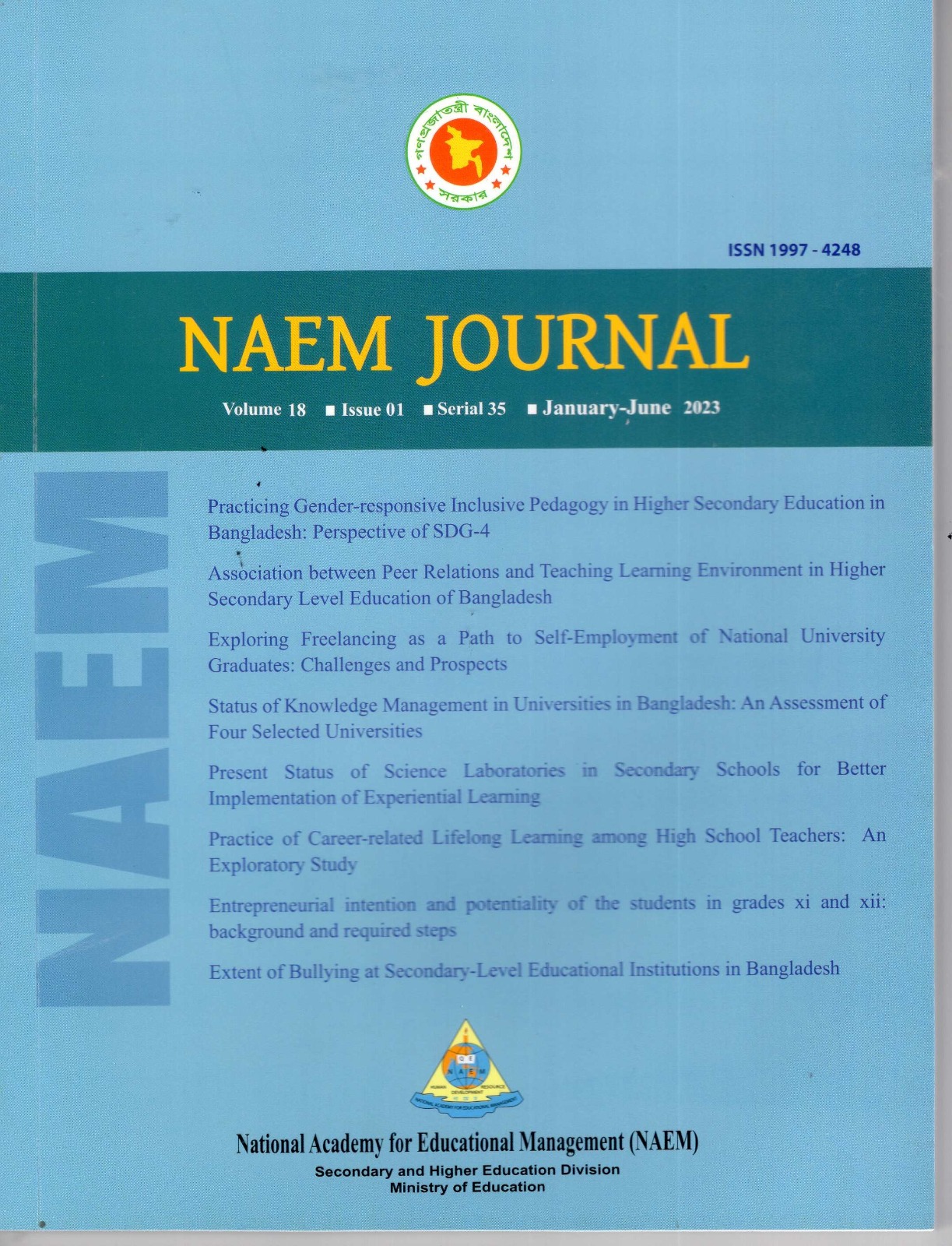
A, Practicing Gender-responsive Inclusive Pedagogy in Higher Secondary Education in Bangladesh: Perspective of SDG-4
Keywords:
Gender-responsive Pedagogy, Inclusion, Higher Secondary Education, Bangladesh, SDG-4Abstract
This study explores teachers’ capacities to implement gender-responsive inclusive pedagogy in higher secondary education in Bangladesh. The findings reveal a lack of specific curricular guidelines for achieving gender parity, creating a gender-friendly learning environment, addressing diverse learning needs, and reducing gender discrimination. However, the professional development training manual provides useful guidance for gender-responsive teaching practices. Using a qualitative research design, the study collected data from 12 government colleges across 12 districts in six divisions of Bangladesh. The respondents included 31 teachers and 21 students. Thematic analysis identified six key themes: pedagogical preparedness, teaching-learning activities, classroom management, language and interaction, feedback and assessment, and professional development. The findings indicate positive efforts by teachers to promote equal participation, inclusive communication, and gender equality, although challenges remain in classroom implementation and institutional support. The study recommends developing specific policy guidelines, integrating gender-responsive pedagogy into teacher training manuals, and strengthening institutional support to promote inclusive and equitable quality education in line with Sustainable Development Goal 4 (SDG-4).
References
1. Aguilar, L., et al. (2008). Training Manual on Gender and Climate Change. San José, Costa Rica: IUCN, UNDP, GGCA.
2. Atangana-Amougou, T. (2016). UNESCO and Gender Equality in Sub-Saharan Africa: Innovative Programmes, Visible Results. Paris: UNESCO. https://unesdoc.unesco.org/images/0025/002595/259590e.pdf
3. Bangladesh Bureau of Statistics and UCEP Bangladesh. (2018). Education Scenario in Bangladesh: Gender Perspective.
4. Barker, V. (2012). A generational comparison of social networking site use: The influence of age and social identity. International Journal of Aging and Human Development, 74, 163–187.
5. Becker, G. (2009). Human Capital: A Theoretical and Empirical Analysis, with Special Reference to Education (3rd ed.). Chicago: University of Chicago Press.
6. Bever. (2014). Creating Supportive Learning Environments for Girls and Boys: A Guide for Educators. IREX. https://www.irex.org/
7. Bhat, R. A. (2015). Role of education in the empowerment of women in India. Journal of Education and Practice, 6(10), 188–191.
8. Bramberger, A. (2015). PädagogInnenprofession und Geschlecht: Gender Inclusion. Wien: Academic Press.
9. Chattopadhyay, T. (2004). Role of Men and Boys in Promoting Gender Equality [E-book]. Bangkok: UNESCO Asia and Pacific Regional Bureau.
10. CIDA. (2008). Gender Equality Toolkit. Quebec: Canadian International Development Agency.
11. Derbyshire, H. (2002). Gender Manual: A Practical Guide for Development Policy Makers and Practitioners. DFID.
12. Doroba, H. (2017). How African Policies Are Promoting Gender Equality in Education. https://www.adeanet.org/en/how-african-policies-are-promoting-gender-equality-in-education
13. FAWE. (2005). Gender Responsive Pedagogy: A Teachers’ Handbook. Nairobi: Forum for African Women Educationalists.
14. Frei, S., & Leowinata, S. (2014). Gender Mainstreaming Toolkit for Teachers and Teacher Educators. Canada: Commonwealth of Learning.
15. Gay, G. (2002). Culturally Responsive Teaching: Theory, Research and Practice. New York, NY: Teachers College Press.
16. Hawken, J. (2017). Drawdown: The Most Comprehensive Plan Ever Proposed to Reverse Global Warming. Penguin.
17. IBE-UNESCO. (2017). Training Tools for Curriculum Development: A Resource Pack for Gender-Sensitive STEM Education.
18. Jaffar, S. (2010). Evaluation of the Gender-Responsive Pedagogy (GRP) Model for the Forum for African Women Educationalists.
19. Kreitz-Sandberg, S. (2016). Gender inclusion and horizontal gender segregation: Stakeholders’ strategies and dilemmas in Swedish teachers’ education. Gender and Education, 28(3).
20. Leach, F., Dunne, M., & Salvi, F. (2014). School-Related Gender-Based Violence: A Global Review of Current Issues and Approaches in Policy.
21. Luswata, S. (2018). Gender Equality Strategy for the Continental Education Strategy for Africa, 2016–2025. FAWE, Kenya.
22. Maluwa-Banda, D. (2003). Gender-Sensitive Educational Policy and Practice: The Case of Malawi. Paper commissioned for the EFA Global Monitoring Report 2003/4.
23. Ministry of Education, Ethiopia. (2014). Gender Responsive Pedagogy Manual for Pre-service and In-service Teacher Training. https://www.moe.gov.et/documents/20182/36315
24. Mlama, P., Dioum, M., Makoye, H., Murage, L., Wagah, R., & Washika, R. (2005). Gender Responsive Pedagogy: A Teacher’s Handbook. Nairobi: Forum for African Women Educationalists (FAWE).
25. Organisation for Economic Co-operation and Development (OECD). (2015). Education at a Glance 2015: OECD Indicators. Paris: OECD Publishing. https://doi.org/10.1787/eag-2015-en
26. Orodho, J. A. (2014). Life skills education in Kenya: An assessment of the level of preparedness of teachers and school managers in implementing life skills education. IOSR Journal of Humanities and Social Science, 19, 32–44.
27. Paulo Freire. (2000). Pedagogy of the Oppressed. New York: Continuum.
28. Sadev. (2016). Gender Equality in and Through Education. Report 2016:9. Sweden: Swedish Development for Development Evaluation.
29. Saikhjee, A., Fyles, N., & Kanyangarara, T. (2017). Guidance for Developing Gender-Responsive Education Sector Plans (pp. 83–84). USA: The Global Partnership for Education. https://www.globalpartnership.org/guidance-developing-genderresponsive-education-sector
30. Skjortnes, M., & Zachariassen, H. J. (2010). Gender perspective on higher education. Gender and Education, 22(2), 143–163.
31. Strickland, R., & Duvvury, N. (2003). Gender Equity and Peacebuilding: From Rhetoric to Reality—Finding the Way. Washington: International Center for Research on Women.
32. Tollefson, J., & Osborn, M. (2008). Cultivating the Learner-Centered Classroom: From Theory to Practice. Thousand Oaks, CA: Corwin Press.
33. UNESCO. (2017, June). Comments for Consideration by the Committee on the Elimination of Discrimination Against Women (CEDAW) for the General Recommendation on Girls’/Women’s Right to Education.
34. UNESCO. (2018). Practical Tips for Teaching Large Classes: A Teacher’s Guide. France: UNESCO.
35. UNICEF & Ministry of Education–Rwanda. (2018). National Gender Responsive Teachers’ Guide.
36. Wanjama, L. N., & Njuguna, F. W. (2015). Documented Gender Responsive Pedagogy (GRP) Good Practices: Case Study. Nairobi: Kenya.
Downloads
Published
Issue
Section
License
Copyright (c) 2024 2026 NAEM Journal

This work is licensed under a Creative Commons Attribution-NonCommercial 4.0 International License.
Copyright (c) 2026 NAEM Journal