
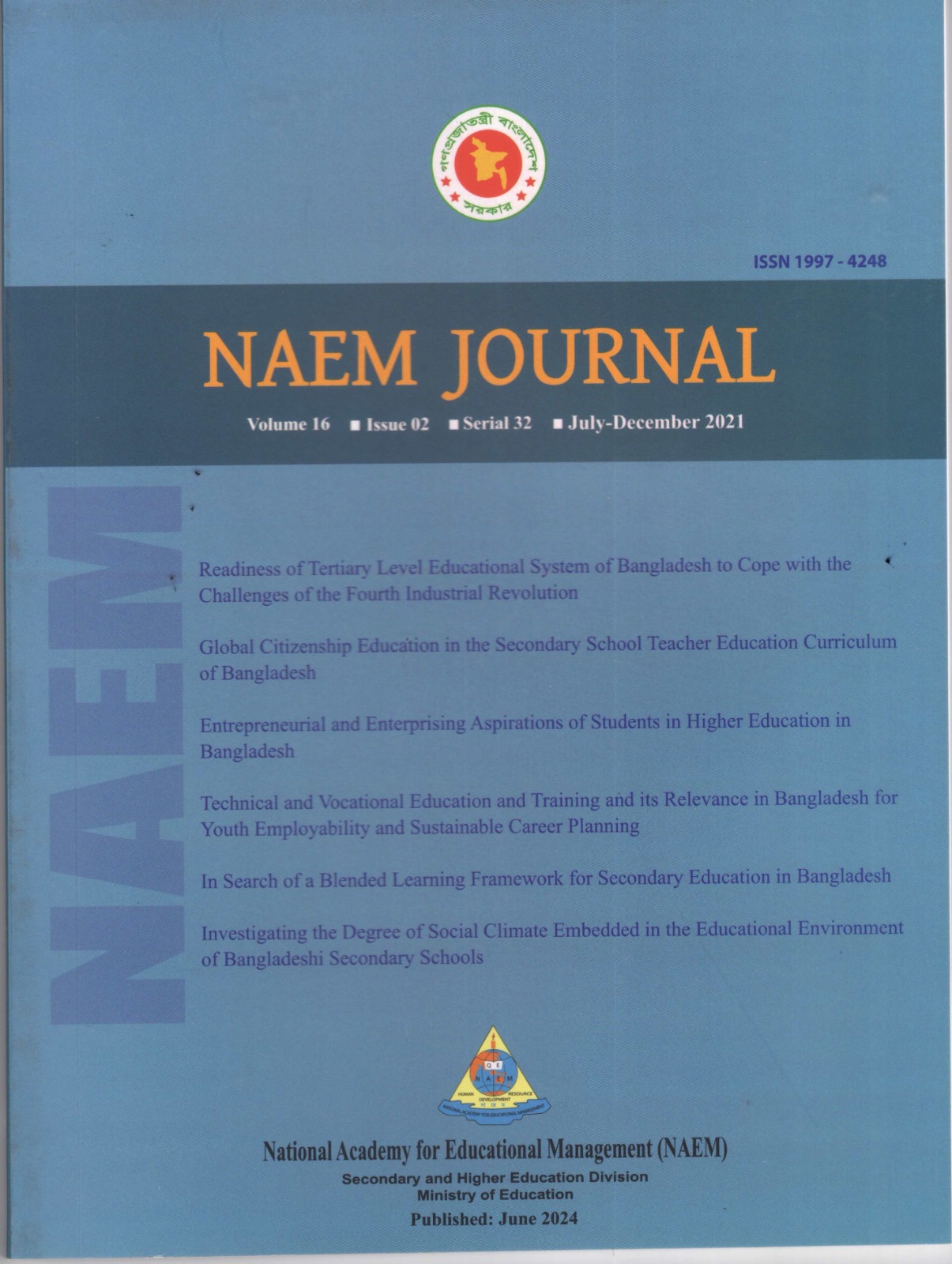
F, Investigating the Degree of Social Climate Embedded in the Educational Environment of Bangladeshi Secondary Schools
Keywords:
Bangladeshi Secondary Schools, Educational Environment, Peer Sensitivity, Social Climate, Students’ Wellbeing, Teacher-Student Interactions.Abstract
This research examines the extent of different domains of the social climate embedded in the educational environments of secondary schools in urban, rural, and hilly regions of Bangladesh. The domains include peer sensitivity, disruptiveness, teacher-student interactions, achievement orientation, support for different economic backgrounds, and safety problems. The study considers social climate important because it relates to learners’ physical and social-emotional safety and influences their academic, social, emotional, ethical, and civic learning. Data were collected through questionnaire surveys, semi-structured interviews, and focus group discussions involving secondary school teachers and students. The findings indicate that peer sensitivity is more prevalent in urban and hilly schools than in rural schools. Teacher-student relationships vary according to the social conditions and practices of the communities where schools are located. Teachers in rural and hilly areas appear concerned about students’ mental well-being, although support for learning outside the classroom remains limited. Students in urban schools reported insufficient support for those from different economic backgrounds. The study recommends strengthening student well-being in urban schools, improving academic orientation in rural and hilly schools, and addressing safety issues across the country.
References
Ahmed, E. (2008). “Stop it, that’s enough”: Bystander intervention and its relationship to school connectedness and shame management. Vulnerable Children and Youth Studies, 3(3), 203–213.
Allodi, M. W. (2010). Goals and values in school: A model developed for describing, evaluating and changing the social climate of learning environments. Social Psychology of Education, 13(2), 207–235.
Astor, R. A., Benbenishty, R., & Estrada, J. N. (2009). School violence and theoretically atypical schools: The principal’s centrality in orchestrating safe schools, 423–461.
Behrman, J. R., Deolalikar, A. B., & Soon, L. Y. (2002). Promoting effective schooling through education decentralization in Bangladesh, Indonesia, and Philippines (ERD Working Paper Series No. 23).
Brand, S., Felner, R. D., Seitsinger, A., Burns, A., & Bolton, N. (2008). A large-scale study of the assessment of the social environment of middle and secondary schools: The validity and utility of teachers’ ratings of school climate, cultural pluralism, and safety problems for understanding school effects and school improvement. Journal of School Psychology, 46(5), 507–535.
Cemalcilar, Z. (2010). Schools as socialisation contexts: Understanding the impact of school climate factors on students’ sense of school belonging. Applied Psychology, 59, 243–272.
Cohen, J., McCabe, L., Michelli, N. M., & Pickeral, T. (2009). School climate: Research, policy, practice, and teacher education. Teachers College Record, 111, 180–193.
Haahr, J. H., Nielsen, T. K., Jakobsen, S. T., & Hansen, M. E. (2005). Explaining student performance: Evidence from the international PISA, TIMSS and PIRLS surveys.
Hamid, M. O. (2011). Socio-economic characteristics and English language achievement in rural Bangladesh. Bangladesh e-Journal of Sociology, 8(2).
Hoque, K. E., Alam, G. M., & Abdullah, A. G. K. (2011). Impact of teachers’ professional development on school improvement—an analysis at Bangladesh standpoint. Asia Pacific Education Review, 12(3), 337–348.
Hossain, S., O’Neill, S. C., & Strnadová, I. (2019). What really matters for students’ school satisfaction in Bangladesh? Psychology in the Schools, 56(5), 670–689.
Khan, A., Ahmed, R., & Burton, N. W. (2020). Prevalence and correlates of depressive symptoms in secondary school children in Dhaka city, Bangladesh. Ethnicity & Health, 25(1), 34–46.
Mohsena, M., Debsarma, S., & Haque, M. (2016). Determining the quality of educational climate in a private medical college in Bangladesh via the Dundee Ready Education Environment Measure instrument. Journal of Young Pharmacists, 8(3), 266–274.
Nahar, N., Talukder, M. H. K., Khan, M. T. H., Mohammad, S., & Nargis, T. (2010). Students’ perception of educational environment of medical colleges in Bangladesh. Bangabandhu Sheikh Mujib Medical University Journal, 3(2), 97–102.
Rahman, M. M., Hamid, M., & Islam, M. (2016). Continuous school improvement plan for quality education in the light of pedagogy: An action research.
Sakib, N., Islam, M., Al Habib, M. S., Bhuiyan, A. I., Alam, M. M., Tasneem, N., & Mamun, M. A. (2020). Depression and suicidality among Bangladeshi students: Subject selection reasons and learning environment as potential risk factors. Perspectives in Psychiatric Care.
Thapa, A., Cohen, J., Guffey, S., & Higgins-D’Alessandro, A. (2013). A review of school climate research. Review of Educational Research, 83(3), 357–385.
Zullig, K. J., Collins, R., Ghani, N., Hunter, A. A., Patton, J. M., Huebner, E. S., & Zhang, J. (2015). Preliminary development of a revised version of the school climate measure scale. Psychological Assessment, 27, 1072–1081.
Zullig, K. J., Koopman, T. M., Patton, J. M., & Ubbes, V. A. (2010). School climate: Historical review, instrument development, and school assessment. Journal of Psychoeducational Assessment, 28(2), 139–152.
Downloads
Published
Issue
Section
License
Copyright (c) 2024 2026 NAEM Journal

This work is licensed under a Creative Commons Attribution-NonCommercial 4.0 International License.
Copyright (c) 2026 NAEM Journal