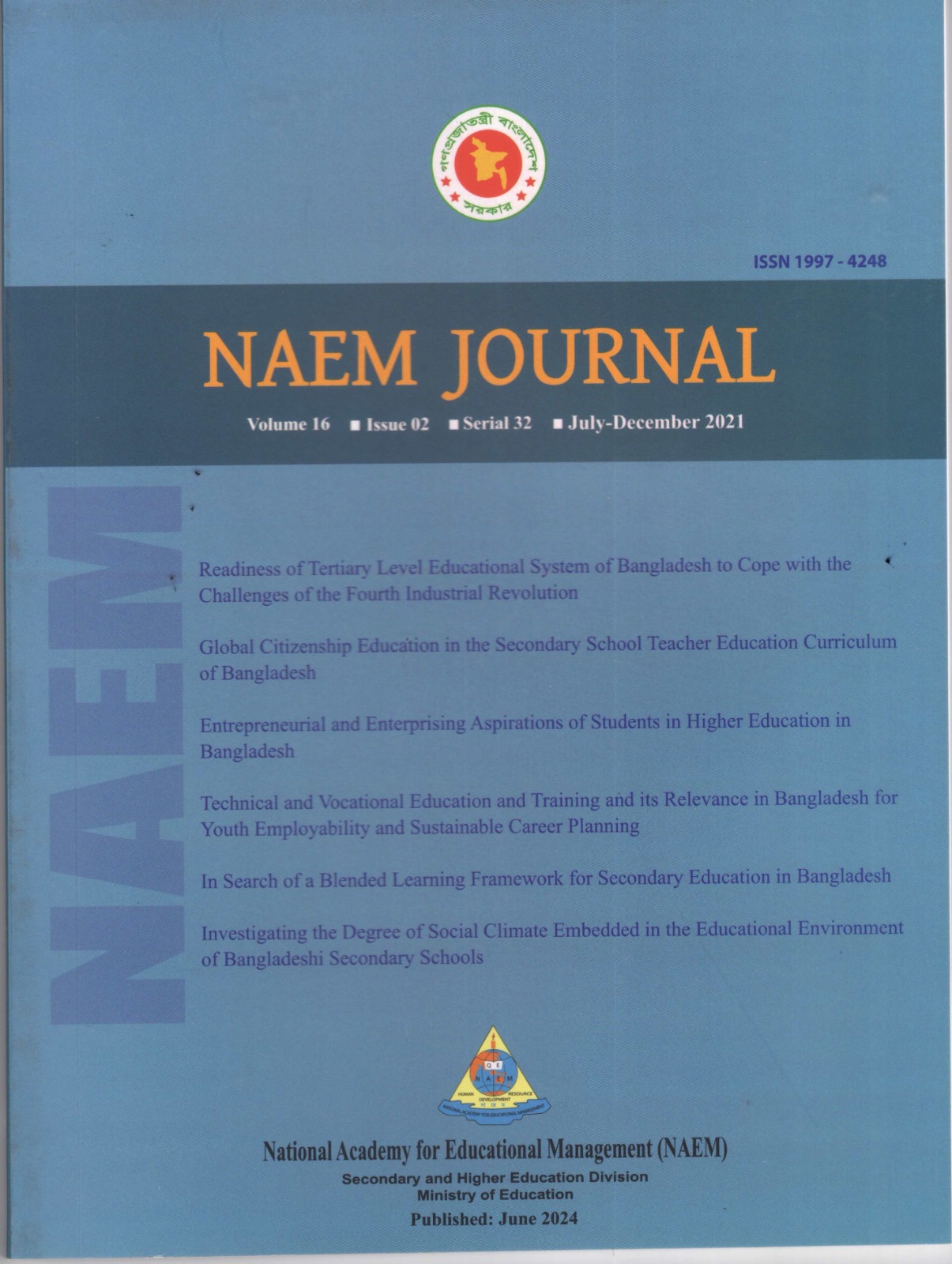
E, In Search of a Blended Learning Framework for Secondary Education in Bangladesh
Keywords:
Blended Education, Blended Learning Framework, Learning Approach, Secondary Education, BangladeshAbstract
This article explores the possibilities of implementing blended learning in secondary classrooms and proposes a framework for secondary education in Bangladesh. A mixed-method approach to data collection was employed, involving teachers and students from secondary schools. Data were collected through questionnaire surveys, document reviews, online class observations, focus group discussions, and in-depth interviews. The study found that although the National Education Policy and ICT Policy emphasise the use of ICT to ensure quality education, specific provisions for ICT integration during emergencies and blended learning were lacking. Secondary schools conducted online classes and assignments during the COVID-19 pandemic; however, student participation was low. Most schools had a minimum level of ICT resources, but these were insufficient to implement blended education effectively. Teachers and students generally demonstrated positive attitudes towards blended learning. Based on these findings, the study proposes the Preparation–Engagement–Settlement (PES) framework. It recommends that secondary schools and local education offices ensure the Preparation and Engagement components, while the Ministry of Education should take responsibility for the Settlement components.
References
Adnan, M., & Anwar, K. (2020). Online learning amid the COVID-19 pandemic: Students’ perspectives. Journal of Pedagogical Sociology and Psychology, 1(2), 45–51. https://doi.org/10.33902/JPSP.2020261309
Alvarez, A. V. (2020). Learning from the problems and challenges in blended learning: Basis for faculty development and program enhancement.
Arabasz, P., Pirani, J. A., & Fawcett, D. (2003). Supporting e-learning in higher education. EDUCAUSE Center for Applied Research.
Babu, R., & Nath, S. R. (2017). Use of ICT in secondary education in Bangladesh: Policies and practices. ANTRIEP, 23(1), 5–6.
Bliuc, A.-M., Goodyear, P., & Ellis, R. A. (2007). Research focus and methodological choices in studies into students’ experiences of blended learning in higher education. The Internet and Higher Education, 10(4), 231–244.
Braun, V., & Clarke, V. (2006). Using thematic analysis in psychology. Qualitative Research in Psychology, 3(2), 77–101. https://doi.org/10.1191/1478088706qp063oa
Chowdhury, A. (2021, May 17). 5 questions to ask now to shape blended learning of the future. World Economic Forum. https://www.weforum.org/agenda/2021/05/5-questions-to-ask-now-to-shape-blended-learning-of-the-future/
Chowdhury, F. (2019). Blended learning: How to flip the classroom at HEIs in Bangladesh? Journal of Research in Innovative Teaching & Learning, 13(2), 228–242. https://doi.org/10.1108/JRIT-12-2018-0030
Cohen, L., Manion, L., & Morrison, K. (2011). Research methods in education (7th ed.). Routledge.
Concannon, F., Flynn, F., & Campbell, M. (2005). What campus-based students think about the quality and benefits of e-learning. British Journal of Educational Technology, 36(3), 501–512.
Denzin, N. (1978). Sociological methods: A sourcebook. McGraw-Hill.
Driscoll, M. (2002). Blended learning: Let’s get beyond the hype. IBM. http://www-3.ibm.com/software/mindspan/distlrng.nsf/89297bbbe911d2788525674c00675635/20630ec43b8dbb4985256b810060561e/$FILE/Blended%20Learning%20Feb%202002.pdf
Graham, C. R., Woodfield, W., & Harrison, B. (2012). A framework for institutional adoption and implementation of blended learning in higher education. The Internet and Higher Education, 14(4), 4–14. http://dx.doi.org/10.1016/j.iheduc.2012.09.003
Gray, C. (2006). Blended learning: Why everything old is new again—but better. https://www.astd.org/Publications/Newsletters/ASTD-Links/ASTD-Links-Articles/2006/02/Blended-Learning-Why-Everything-Old-Is-New-Again-but-Better
Greenwood, J. A., & Sandomire, M. M. (1950). Sample size required for estimating the standard deviation as a percent of its true value.
Kerres, M., & Witt, C. D. (2003). A didactical framework for the design of blended learning arrangements. Journal of Educational Media, 28(2–3), 101–113. https://doi.org/10.1080/1358165032000165653
Khan, B. H. (2010). The global e-learning framework. http://webserver.ignou.ac.in/institute/STRIDE_Hb8_webCD/Chapter%205.pdf
Maarop, A. H., & Embi, M. A. (2016). Implementation of blended learning in higher learning institutions: A review of literature. International Education Studies, 9(3), 41. https://doi.org/10.5539/ies.v9n3p41
Ministry of Education. (2010). National education policy 2010. Ministry of Education, Government of Bangladesh.
Ministry of Post, Telecommunication and Information Technology. (2018). National information and communication technology policy 2018. Government of Bangladesh.
Mumtaz, S. (2000). Factors affecting teachers’ use of information and communications technology: A review of the literature. Journal of Information Technology for Teacher Education, 9(3), 319–342. https://doi.org/10.1080/14759390000200096
Oliver, M., & Trigwell, K. (2005). Can blended learning be redeemed? E-Learning, 2(1), 17–26.
Roy, G., Babu, R., Kalam, M. A., Yasmin, N., Zafar, T., & Nath, S. R. (2021). Response, readiness and challenges of online teaching amid COVID-19 pandemic: The case of higher education in Bangladesh. Educational and Developmental Psychologist. https://doi.org/10.1080/20590776.2021.1997066
Sharmin, N., & Roy, G. (2011). Computer-aided learning and mentoring for improvement of teaching quality: An assessment of BRAC interventions. BRAC Research Report. https://www.ssrn.com/abstract=2923676
Southern Regional Education Board. (2006). Online teaching evaluation for state virtual schools.
Straub, E. T. (2009). Understanding technology adoption: Theory and future directions for informal learning. Review of Educational Research, 79(2), 625–649. https://doi.org/10.3102/0034654308325896
Valiathan, P. (2002). Blended learning models. http://www.learningcircuits.com/2002/aug2002/valiathan.html
Wang, Y., Han, X., & Yang, J. (2015). Revisiting the blended learning literature: Using a complex adaptive systems framework. Educational Technology & Society, 18(2), 15.
Wolfgang, G., Santally, M. I., Boojhawon, R., Rajabalee, Y., & Sungkur, R. K. (2017). Using learning analytics to investigate student performance in blended learning courses. https://doi.org/10.3217/ZFHE-12-01/03
Downloads
Published
Issue
Section
License
Copyright (c) 2024 2026 NAEM Journal

This work is licensed under a Creative Commons Attribution-NonCommercial 4.0 International License.
Copyright (c) 2026 NAEM Journal