
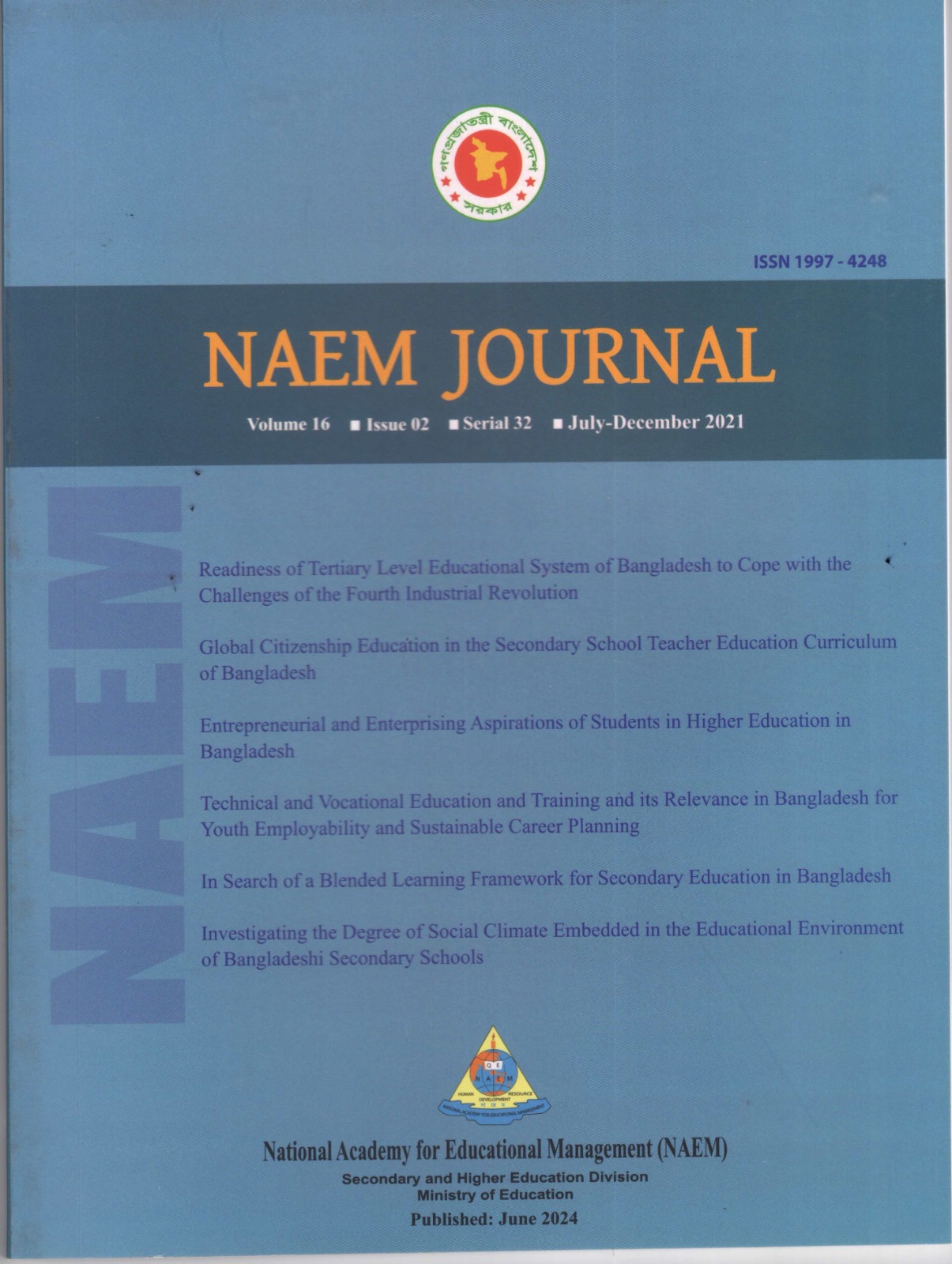
C, Entrepreneurial and Enterprising Aspirations of Students in Higher Education in Bangladesh
Keywords:
Entrepreneurial motivation in higher education; entrepreneurship education entrepreneurial orientation; student entrepreneurial aspirations; aspiring entrepreneurs; Bangladesh.Abstract
In academic studies on entrepreneurship, the question of what motivates an individual entrepreneur to launch a business persists. According to recent research, the institutional framework has a significant impact on individual behavior as well as the enabling of an entrepreneurial atmosphere for new companies. Researchers have identified entrepreneurial orientation as a fundamental course in establishing
new enterprises and effective business performance, yet individual-level research on the construct is still lacking. Hence, the objective of this study is to investigate the progression of entrepreneurial and enterprising ambitions among tertiary students in Bangladesh. The study encompassed acquiring data from a sample size of 1150 students currently enrolled in higher education institutions. The results indicate a notable level of enthusiasm for entrepreneurship among students, with a majority believing that entrepreneurship is a skill that can be acquired and enhanced through learning and development. Incorporating entrepreneurship education into the academic curriculum, with a specific emphasis on the identified critical skills and knowledge domains, as well as promoting university resources for entrepreneurship, are fundamental measures in fostering an entrepreneurial mindset among students. Educational and cultural policies are required to propel this new order forward. Policies promoting and raising awareness about the advantages of an entrepreneurial career will bring the necessary socio-cultural and normative transformation. This value-based criterion is crucial to educating young’s entrepreneurial mindset and attitude.
References
Abelha, M., Fernandes, S., Mesquita, D., Seabra, F., & Ferreira-Oliveira, A. T. (2020). Graduate employability
and competence development in higher education—A systematic literature review using PRISMA.
Sustainability, 12(15), 5900. https://doi.org/10.3390/su12155900
Ahmed, S. M., Majumder, A., & Rahman. (2011). Career choices among medical students in Bangladesh. Advances
in Medical Education and Practice, 51. https://doi.org/10.2147/AMEP.S13451
Aidis, R., & Mickiewicz, T. (2006). Entrepreneurs, expectations and business expansion: Lessons from Lithuania.
Europe-Asia Studies, 58(6), 855–880.
Baark, E. (2016). Innovation system reform in Indonesia and Vietnam: A new role for universities? STI Policy and
Management Journal, 1(1). https://doi.org/10.14203/STIPM.2016.53
Bischoff, K., Volkmann, C. K., & Audretsch, D. B. (2018). Stakeholder collaboration in entrepreneurship education:
An analysis of the entrepreneurial ecosystems of European higher educational institutions. The Journal of
Technology Transfer, 43(1), 20–46. https://doi.org/10.1007/s10961-017-9581-0
Bruton, G. D., Ahlstrom, D., & Obloj, K. (2008). Entrepreneurship in emerging economies: Where are we today
and where should the research go in the future. Entrepreneurship Theory and Practice, 32(1), 1–14.
https://doi.org/10.1111/j.1540-6520.2007.00213.x
Doran, J., McCarthy, N., & O’Connor, M. (2018). The role of entrepreneurship in stimulating economic growth in
developed and developing countries. Cogent Economics & Finance, 6(1), 1442093. https://doi.org/10.10
80/23322039.2018.1442093
Douglass, J. A. (2010). Creating a culture of aspiration: Higher education, human capital and social change. Procedia - Social and Behavioral Sciences, 2(5), 6981–6995. https://doi.org/10.1016/j.sbspro.2010.05.050
Du, J., Han, G., & Huang, Z. (2020). Promoting social entrepreneurial organizations: An empirical study of teacher
student co-entrepreneurship. Frontiers in Psychology, 11, 1470. https://doi.org/10.3389/fpsyg.2020.01470
Etzkowitz, H., & Leydesdorff, L. (2000). The dynamics of innovation: From national systems and “Mode 2” to a
triple helix of university–industry–government relations. Research Policy, 29(2), 109–123. https://doi.
org/10.1016/S0048-7333(99)00055-4
Falloon, G. (2020). From digital literacy to digital competence: The teacher digital competency (TDC) framework.
Educational Technology Research and Development, 68(5), 2449–2472. https://doi.org/10.1007/s11423
020-09767-4
Geng, B., Huang, T., Jiang, X., Lin, N., Gao, G., & Fan, L. (2021). The analysis of the innovation consciousness of
college student entrepreneurs under the teaching concept of chinese excellent traditional culture. Frontiers
in Psychology, 12, 717336. https://doi.org/10.3389/fpsyg.2021.717336
Hasan, Sk. M., Khan, E. A., & Nabi, Md. N. U. (2017). Entrepreneurial education at university level and
entrepreneurship development. Education + Training, 59(7/8), 888–906. https://doi.org/10.1108/ET-01
2016-0020
Hikmah, Z. N., Khairunnisa, R. A., & Nuriadin, I. (2020). Profile of learning independence in achieving creative
thinking ability of vocational school students. JIPM (Jurnal Ilmiah Pendidikan Matematika), 9(1), 12.
https://doi.org/10.25273/jipm.v9i1.5859
Jabeen, F., Faisal, Mohd. N., & I. Katsioloudes, M. (2017). Entrepreneurial mindset and the role of universities as
strategic drivers of entrepreneurship: Evidence from the United Arab Emirates. Journal of Small Business
and Enterprise Development, 24(1), 136–157. https://doi.org/10.1108/JSBED-07-2016-0117
Javalgi, R. G., Martin, S. L., Young, R. B., Hart, C. T., & Van Dyke, K. A. (2018). Identifying motivational factors
impacting entrepreneurship: Evidence from an emerging economy. KnE Social Sciences, 3(10), 138.
https://doi.org/10.18502/kss.v3i10.2891
Jing, T., Dancheng, L., & Ye, Z. (2016). Study of impact on undergraduates’ entrepreneurial failure based on the
model of psychological resilience-knowledge acquisition. English Language Teaching, 9(8), 224. https://
doi.org/10.5539/elt.v9n8p224
Jung, E., & Lee, Y. (2019). Development and validation of indicators to measure entrepreneurial mindset and
competency scales for college Students. The Korea Educational Review, 25(2), 259–287. https://doi.
org/10.29318/KER.25.2.10
Kellermanns, F. W., & Eddleston, K. A. (2006). Corporate entrepreneurship in family firms: A family perspective.
Entrepreneurship Theory and Practice, 30(6), 809–830. https://doi.org/10.1111/j.1540-6520.2006.00153.x
Kuratko, D. F. (2005). The emergence of entrepreneurship education: Development, trends, and challenges.
Entrepreneurship Theory and Practice, 29(5), 577–597. https://doi.org/10.1111/j.1540-6520.2005.00099.x
Liñán, F., Urbano, D., & Guerrero, M. (2011). Regional variations in entrepreneurial cognitions: Start-up intentions
of university students in Spain. Entrepreneurship & Regional Development, 23(3–4), 187–215. https://
doi.org/10.1080/08985620903233929
Loboda, V., Ostrovskyi, I., & Katernyak, I. (2019). Developing entrepreneurial mindset in university undergraduates.
E-Methodology, 5(5), 114–131. https://doi.org/10.15503/emet.v5i5.525
Mitonga-Monga, J., Flotman, A.-P., & Cilliers, F. (2016). Workplace ethics culture and work engagement: The
mediating effect of ethical leadership in a developing world context. Journal of Psychology in Africa,
26(4), 326–333. https://doi.org/10.1080/14330237.2016.1208928
Ncanywa, T., & Dyantyi, N. (2022). The Role of entrepreneurship education in higher education institutions.
E-Journal of Humanities, Arts and Social Sciences, 75–89. https://doi.org/10.38159/ehass.2022SP3117
Ndou, V., Secundo, G., Schiuma, G., & Passiante, G. (2018). Insights for shaping entrepreneurship education:
Evidence from the European entrepreneurship centers. Sustainability, 10(11), 4323. https://doi.
org/10.3390/su10114323
Ogunsade, A. I. (2017). The Influences of Institutional Environment on Individual Entrepreneurial Orientation
among Nigerian Youths. De Montfort University.
Ozaralli, N., & Rivenburgh, N. K. (2016). Entrepreneurial intention: Antecedents to entrepreneurial behavior in
the U.S.A. and Turkey. Journal of Global Entrepreneurship Research, 6(1), 3. https://doi.org/10.1186/
s40497-016-0047-x
Shi, Y., Yuan, T., Bell, R., & Wang, J. (2020). Investigating the relationship between creativity and entrepreneurial
intention: The moderating role of creativity in the theory of planned behavior. Frontiers in Psychology,
11, 1209. https://doi.org/10.3389/fpsyg.2020.01209
Siddiky, Md. R., & Akter, S. (2021). The students’ career choice and job preparedness strategies: A social
environmental perspective. International Journal of Evaluation and Research in Education (IJERE),
10(2), 421. https://doi.org/10.11591/ijere.v10i2.21086
Subhan, M., Amat, S., Abu Bakar, A. Y., Mahmud, M. I., Zein, M., & A, H. (2021). Career Self-efficacy (CSE)
influence towards selection of self-employment career among Riau university students’. International
Journal of Academic Research in Business and Social Sciences, 11(4), Pages 303-314. https://doi.
org/10.6007/IJARBSS/v11-i4/9677
Syam, A., Akib, H., Yunus, M., & Hasbiah, S. (2018). Determinants of entrepreneurship motivation for students
at educational institution and education personnel in Indonesia. Journal of Entrepreneurship Education.
https://www.abacademies.org/abstract/determinants-of-entrepreneurship-motivation-for-students-at
educational-institution-and-education-personnel-in-indonesia-7173.html
Tomlinson, M. (2017). Introduction: Graduate employability in context: Charting a complex, contested and multi
faceted policy and research field. In M. Tomlinson & L. Holmes (Eds.), Graduate Employability in
Context (pp. 1–40). Palgrave Macmillan UK. https://doi.org/10.1057/978-1-137-57168-7_1
Tomlinson, M., & Jackson, D. (2021). Professional identity formation in contemporary higher education students.
Studies in Higher Education, 46(4), 885–900. https://doi.org/10.1080/03075079.2019.1659763
World Medical Association. (2001). World Medical Association Declaration of Helsinki. Ethical principles for
medical research involving human subjects. Bulletin of the World Health Organization, 79(4), 373–374.
Yang, T., & Li, X. (2019). Research on social entrepreneurship based on the dual perspective of empathy and
impromptu behavior. Proceedings of the 2019 International Conference on Economic Management
and Cultural Industry (ICEMCI 2019). Proceedings of the 2019 International Conference on Economic
Management and Cultural Industry (ICEMCI 2019), Shenzhen, China. https://doi.org/10.2991/
aebmr.k.191217.144
Yordanova, D. & Jose. (2018). Desirability of technology entrepreneurship among Bulgarian STEM students: The
role of entrepreneurship education. EUROPEAN RESEARCH STUDIES JOURNAL, XXI(Issue 3), 446
462. https://doi.org/10.35808/ersj/1667
Zhao, X., Lin, C., Wang, S., & Zhao, H. (2022). Evaluation of women’s entrepreneurship education based on BP
neural network. Scientific Programming, 2022, 1–10. https://doi.org/10.1155/2022/5761363
Downloads
Published
Issue
Section
License
Copyright (c) 2024 2026 NAEM Journal

This work is licensed under a Creative Commons Attribution-NonCommercial 4.0 International License.
Copyright (c) 2026 NAEM Journal