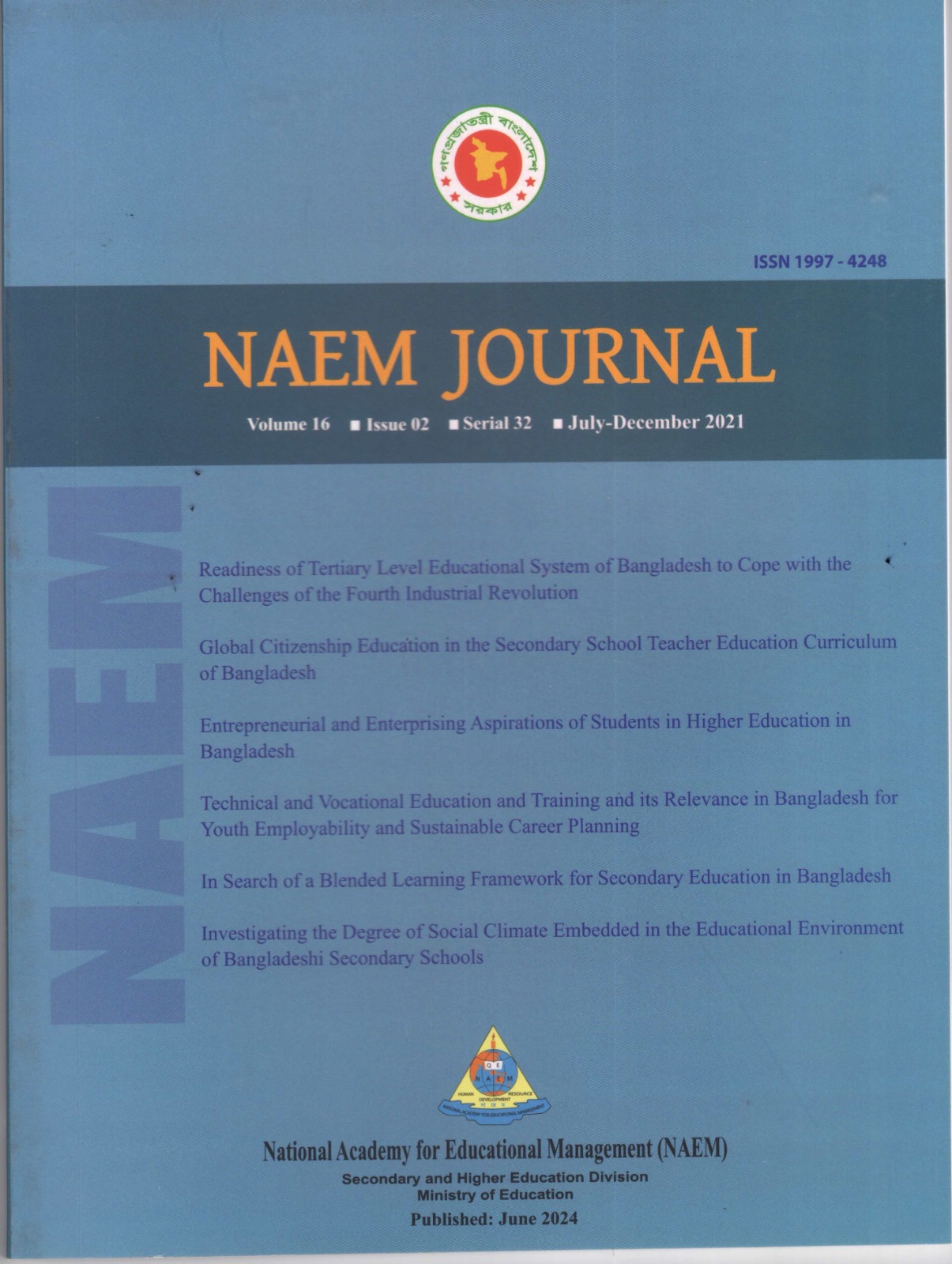
A, Readiness of Tertiary Level Educational System of Bangladesh to Cope with the Challenges of the Fourth Industrial Revolution
Keywords:
Fourth Industrial Revolution, Higher Education, Readiness, Rajshahi University, BangladeshAbstract
The global landscape is changing rapidly due to technological advancements and their applications in every sphere of life. These changes have brought about a new revolution, known as the Fourth Industrial Revolution (4IR). Globally, the 4IR has created both challenges and opportunities. Developed countries have already undertaken various initiatives to address these challenges and capitalize on the opportunities presented by the 4IR. However, like many other developing countries, Bangladesh faces significant challenges, including the potential loss of thousands of jobs across different sectors. Therefore, developing the necessary skills to cope with these challenges has become increasingly important.
Considering this pressing issue, the present study aims to assess the readiness of Bangladesh’s tertiary-level education system for the 4IR. Rajshahi University was selected as the case study, and eight departments under five faculties were purposively selected. The syllabuses of these departments were reviewed to assess their readiness for the 4IR.
The study reveals several limitations in tertiary-level teaching and learning in Bangladesh in the era of modern information and communication technology (ICT). These include an acute shortage of ICT-enabled infrastructure, slow internet connectivity, inadequate laboratory facilities and equipment, insufficient research grants and scholarships, faculty members’ mindsets, a lack of professional development training for faculty members, and learners’ limited motivation to face emerging challenges. The existing campus political culture practised by both teachers and learners is also identified as a significant problem in higher education institutions (HEIs) in the country.
Despite these limitations, most faculty members demonstrate a willingness to cope with the challenges posed by the 4IR. To address these challenges and capitalize on emerging opportunities, the study offers several policy recommendations. These include developing ICT-enabled infrastructure, modernizing curricula to incorporate global developments, enhancing laboratory and research facilities, establishing a specialized training institute for professional development, introducing research visits for faculty members and researchers, strengthening linkages between government organizations and universities, promoting academia–industry collaboration, regularly organizing conferences and seminars, keeping HEIs free from politics, and ensuring safe and secure campuses for students.
References
Balliester, T and Elsheikhi, A. (2018). The Future of Work: A Literature Review (ILO Research Department,
Working Paper No. 29.).
Bhawna and Gobind. (2015). Research methodology and approaches. IOSR Journal of Research & Method in
Education, 5(3), 48–51. https://doi.org/10.9790/7388-05344851
Bhuiyan, M. S. J. (2017). Influence of individual characteristics, organizational support system and learning
organizational practices in post-program transfer of training: A study on management development
programs of Bangladesh civil service. International Journal of Human Resource Studies, 7(3), 23. https://
doi.org/10.5296/ijhrs.v7i3.11404
GoB. (2019a). Determining Future Skill Development Need for Meeting the IT Industry Requirement based on
Fourth Industrial Revolution, Leveraging ICT for Growth, Employment & Governance.
GoB. (2019b). Future Skills: Finding Emerging Skills to Tackle the Challenges of Automation in Bangladesh.
GoB. (2020). National Strategy for Artificial Intelligence-Bangladesh.
GoB. (2022). Visit for Digital Entrepreneurship Development in India and Malaysia, ICT Division, May 8, 2022.
Gormus, A. (2019). Future of work with the industry 4 . 0. In International Congress on Socieal Sciences (INCSOS
2019) Procededing Book (1st ed., Issue October, pp. 317–323). SAGEYA.
Gray, A. (2016). The 10 skills You Need to Thrive in the Fourth Industrial Revolution. www.weforum.Org/
Agenda/2016/01/the-10-Skills-You-Need-to-Thrive-in-the-Fourth-Industrial-Revolution, Accessed on
December 30, 2021.
Hawksworth, J. (2018). AI and robots could create as many jobs as they displace. World Economic Forum.
[Online]. available: https://www.weforum.org/agenda/2018/09/ai-and-robots-could-create-as-many-jobs
as-they-displace/.
Mazumber, Q. H., Karim, M. R., & Bhuiyan, S. I. (2012). Higher Education Quality Improvement in Bangladesh.
Messaoudi, M. El. (2021). Soft Skills : Connecting Classrooms with the Workplace — A Systematic Review.
Universitepark Bulten Bulletin, 10(2), 116–138. https://doi.org/–https://dx.doi.org/10.22521/
unibulletin.2021.102.2
Prothom Alo. (2022, June 13). Human Chain Formed at Rajshahi University Campus Protesting Seat-trading and
Capture by Chattra League at Halls. Prothom Alo. www.prothomalo.com
Rajshahi University. (2022). University of Rajshahi Dairy 2022. Public Relations Office, University of Rajshahi.
www.ru.ac.bd
Roberts, A. (2022). Strategies for Governing : Reinventing Public Administration for a Dangerous Century The
“ Public Management approach ” Needed : a macro-level framework. In H. Zafrullah (Ed.), SANPA’S
Webinar on Public Administration (pp. 1–6). South Asian Network for Public Administration (SANPA).
www.southasianetwork.org
Reaves, J. (2019). 21st Century Skills and the Fourth Industrial Revolution: A Critical Future Role for Online
Education. International Journal on Innovations in Online Education, 3(1). https://doi.org/DOI: 10.1615/
IntJInnovOnlineEdu.2019029705
The Daily Star. (2018, December 21). Automation to cut 53.8 lakh jobs by 2041: study. thedailystat.net
UGC. (2020). 46th Annual Report-2019, University Grants Commission of Bangladesh, Ministry of Education.
www.ugc.gov.bd
Vasanthakumari, S. (2019). Soft Skills and Its Application in Workplace. World Journal of Advanced Research and
Reviews, 03(02), 66–72. https://doi.org/doi.org/10.30574/wjarr.2019.3.2.0057
Winterton, J., & Stringfellow, E. (2006). Typology of Knowledge, Skills and Competences: Clarification of the
Concept and Prototype.
World Bank. (2019a). Bangladesh Development Update: Tertiary Education and Job Skills. October, 1–47.
World Bank. (2019b). World Development Report-2019:The Changing Nature of Work.
World Economic Forum. (2016). World Economic Forum Annual Meeting 2015: Mastering the Fourth Industrial
Revolution. www.weforum.org
World Economic Forum. (2018). AI and robots could create as many jobs as they displace. World Economic Forum
(Online).
https://www.weforum.org/agenda/2018/09/ai-and-robots-could-create-as-many-jobs-as-they
displace/.
World Economic Forum. (2021). The Fourth Industrial Revolution. https://www.weforum.org/about/the-fourth
industrial-revolution-by-klaus-schwab
Downloads
Published
Issue
Section
License
Copyright (c) 2024 2026 NAEM Journal

This work is licensed under a Creative Commons Attribution-NonCommercial 4.0 International License.
Copyright (c) 2026 NAEM Journal